
An Ode to Low-Skilled Workers: Version 1

A month ago, I came up with the title “An Ode to Low-Skilled Workers.” Today and tomorrow, I’m running two versions of this essay.
The first is written by me the old-fashioned way.
The second is written by ChatGPT, using the prompt “Write a Bryan Caplan Bet On It post called ‘An Ode to Low-Skilled Workers.’”
I doubt you’ll have trouble figuring out which version is which, and I hope you’ll prefer my essay to the AI’s. But either way, please share your thoughts in the comments today and tomorrow.
Modern immigration debates are largely a contest between a populist side insisting, “Immigrants are terrible” and an elitist side countering with, “High-skilled immigrants are good.” Which, by implication, concedes that low-skilled immigrants are terrible.
Why, though, would low-skilled immigrants be terrible? You can imagine that low-skilled immigrants are prone to carry horrible Third World diseases, or are highly prone to terrorism. But this is just worst-case thinking. Mainstream standard complaints about low-skilled immigrants flow directly from a broader syllogism:
Major Premise: Low-skilled workers are terrible.
Minor Premise: Low-skilled immigrants are low-skilled workers.
Conclusion: Therefore, low-skilled immigrants are terrible.
Social Desirability Bias obviously stops even the angriest nativists from stating the Major Premise. But it’s the Major Premise that does the work. Why do low-skilled immigrants contribute relatively little to the economy? Because low-skilled workers contribute relatively little to the economy. Why would low-skilled immigrants be a burden on the welfare state? Because low-skilled workers are a burden on the welfare state. In fact, if you know the fiscal math, low-skilled natives are generally a bigger fiscal burden than low-skilled immigrants, because the former are far more likely to receive exorbitantly-priced public education.
To be clear, almost no one explicitly embraces the Major Premise. It’s an ugly idea, and voicing it makes the speaker look ugly by extension. But all Social Desirability Bias aside, “Low-skilled workers are terrible” is absolute lunacy. Most obviously, we’d starve without low-skilled workers, because they grow almost all of our food. The vast majority of construction and infrastructure workers lack college degrees, and without them, we’d be living in tents. If we’re lucky, because tents are made by low-skilled workers, too.
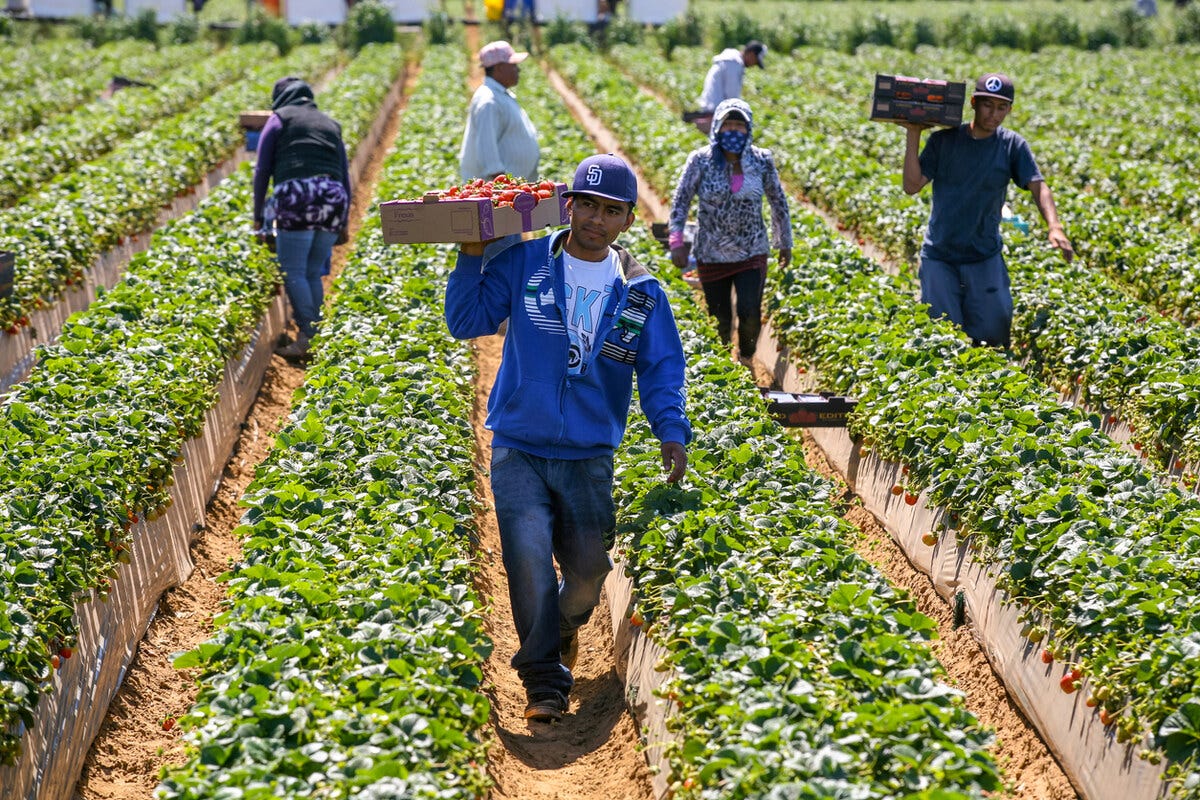
The basic necessities of food and housing aside, modern economies primarily provide services. Some of these services — like healthcare — are canonically high-skilled. But a vast range of tasks — food preparation, childcare, elder care, delivery, cleaning, maintenance — are largely performed by low-skilled workers.
What about Garett Jones’ finding that the social return to IQ vastly exceeds its private return? Low-skilled workers definitely have lower IQs than high-skilled workers, so if the gap between social and private returns to IQ were large enough, his math would imply that low-skilled workers are indeed terrible on balance. But as Jones himself conceded, the gap simply isn’t large enough: While importing vastly more low-IQ immigrants definitely reduces per-capita GDP, total production for humanity goes up, not down. Closely examined, Jones’ results confirm the common-sense result that low-IQ workers are vital for prosperity. Which is good news for him, because the essential social contribution of low-skilled agricultural workers is clear, while almost any regression is open to doubt.
The economically soundest reply to all these observations: “The average low-skilled worker is good. It’s the marginal low-skilled worker that’s terrible.” Logically speaking, this is a fine response, but anyone who utters it accepts a heavy evidentiary burden. If the typical low-skilled worker is so useful, why would an extra low-skilled worker be so useless? Yes, many of us feel satiated for food, and perhaps (if you’re in a cheap part of the country) for housing as well. Yet who feels satiated for time? Almost no one. In the First World, even wealthy people rarely employ a single personal servant. Yet if the price were right, most people would probably enjoy having at least four such servants: a valet, a driver, a cook, and a maid. After all, if you go to countries with very cheap labor, upper-class families commonly retain this eminently useful quadfecta.
Yes, if the economy had to lose either Jeff Bezos or his driver, we’d be better off with Bezos. But the economy is, fortunately, not a Trolley Problem. We almost never choose between Bezos and his driver, or between any high-skilled worker and any low-skilled worker. To quote the catchphrase of my late obese aunt, we’re free to announce, “I’ll have both.” And since the purpose of services is to save customers’ time, saying “Let’s have Bezos and his driver” is functionally equivalent to saying, “Let’s have Bezos with some extra Bezos.”
If you want to see how useful low-skilled workers really are, go to a Japanese 7-11. There, you will encounter cashiers of utmost competence. As a tourist, it’s a pleasure. But from an economic point of view, it is a tragic waste of human potential. If Japan welcomed a hundred million low-skilled immigrants, native-born cashiers would become store managers almost overnight. They’re more than qualified for the job! But in actually-existing Japan, high-skilled workers are stuck doing low-skilled work.
I freely confess: Very few of my personal friends are low-skilled workers. I’m a professor and a nerd, with decidedly high-brow tastes. If I tried sharing my feelings with any particular low-skilled worker, my outreach would no doubt come off as awkward and condescending. But I still declare before the whole world that I am deeply, sincerely grateful for low-skilled workers’ ubiquitous life-sustaining and life-affirming contributions. Contrary to popular insinuations, you are not charity cases. You keep us alive. You put roofs over our heads. You care for our children and our elders. You pick up the slack of life, taking care of the troubles others are too frazzled to handle. You deserve respect and appreciation, not casual disdain. Elites who talk as if you’re a massive burden aren’t merely rude. They are massively, blatantly, grotesquely wrong.
I don't think most people who oppose open borders or large scale immigration really spend much time thinking about the productive capacity of immigrants. They don't distinguish between low skilled or high skilled — they actually focus more on how much the origin culture overlaps with American (particularly traditional Anglo Christian Protestant) culture because that's the cost to individuals. They think 'X culture is or is not fairly punctual, does/doesn't tend to throw loud parties that carry on through midnight, does/doesn't favor redistributive political movements, etc.' And invariably high skilled workers tend to come from cultures that don't carry huge switching costs while low skilled workers tend to come from cultures that have massive switching costs.
Yes the math probably says the benefits are greater than the costs — but the benefits aren't as tangible and obvious as the costs. And critically, the costs and benefits aren't borne by the same people. The professor in a homogeneous suburb gets cheaper strawberries and a richer intellectual case for open borders. The working class neighborhood gets the actual friction of navigating a fundamentally different cultural operating system every day. If you live in a very diverse area and you're a traditional American raised in a watered down version of Calvinism — think Max Weber protestant ethic — you simply think 'these neighbors of mine require a lot of adjusting to.' They don't go 'ahh but they're increasing my disposable income by X%.' The aggregate math being positive doesn't make that friction less real — it just makes it easier to ignore if you're not the one bearing it. Until the economic case for immigration is paired with a credible answer to these switching costs, the argument isn't going to move anyone from the nativist side on this issue. Oh and im aware of the "no one.
has a right to their culture" argument but its kind of moot. If you tell someone "you dont have a right to impose your behavioral preferences on others" they will ignore you and try anyway because other peoples behaviors impact ones life.
You do not address Garett Jones’s *political* or *public policy* worry. Bad politics—roughly speaking, *socialism*—is the main reason poor countries are poor. Importing people who favor such policies will sooner or later undermine our prosperity. It is unfortunate that we cannot deport our native-born socialists; let us not make our position even worse by importing foreign ones—by importing the people who have created the self-defeating politics of most foreign countries.