

I’ve written dozens of posts about Social Desirability Bias. Social Desirability Bias is the key psychological building block of my new book. When asked to succinctly explain Social Desirability Bias, my standard slogan is: “When the truth is ugly, people lie.”
This would be unexciting, however, unless some truths were, in fact, ugly. Which they totally are. For example:
Some children are stupid.
Some workers are lazy.
Some decorated veterans are racist.
Most human beings are unwilling to die for their countries.
God is rarely the most important thing in anyone’s life.
Examples of ugly truths are so easy to mass produce that it’s easy to conclude that truth and ugliness go hand in hand. But it’s equally easy to mass produce pretty truths. For example:
Most parents truly love their children.
Most people are happy, even if their objective circumstances are bad.
The average human is much richer today than he was a century ago.
Life expectancy has dramatically increased over the last century.
Smallpox has been eradicated.
While ugly and pretty truths are rather easy to mass produce, the mass production of ugly and pretty falsehoods is absolutely trivial. Since imagination is infinite, we can create false statements without limit. Right?
Here’s a two-dimensional matrix to organize these observations, with a simple example for each box. Pretty/Ugly is on the left, and True/False is on the top, so I call it the “Pretty/True 2x2.”
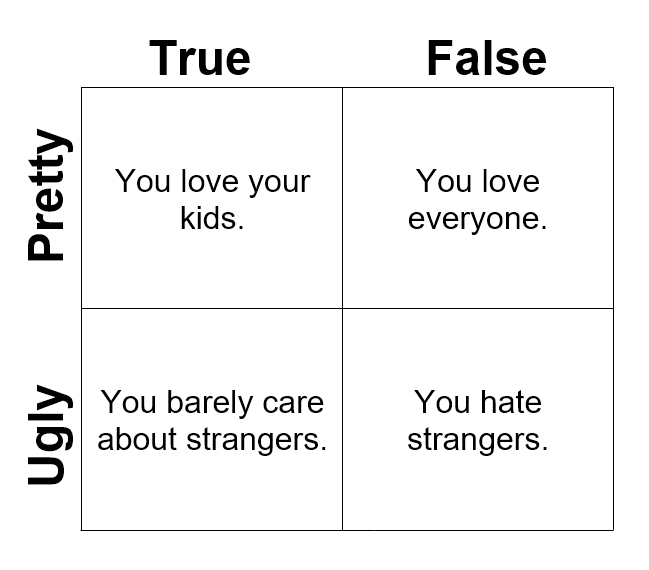
Obvious once you think about it? Sure. But still clarifying, at least for me. “Virtue signaling” leads people to speak what is Pretty and False, while “vice signaling” leads them to speak what is Ugly and False. Our World in Data is the great repository of Pretty and True, while cost-benefit analysis of public policy is packed with Ugly and True.
While it’s easy to generate statements to fill all four boxes, what would you discover if you classified all statements by humans, parents, priests, politicians, or social media personalities?
I could be wrong, but speaking Pretty Truths is pretty rare. Why? Because they seem boring and trite. Pretty Lies seem much more common. Since they’re not limited by reality, they’re more entertaining. And since they’re ridiculous, they’re also — as religion illustrates — a good loyalty test.
Most ugly truths, in contrast, are spoken “off the record” to our closest confidants, though they’re also the heart of stand-up comedy. Ugly lies, finally, are the stuff of shouting matches and internet trolls — a small fraction of statements that we’re nonetheless prone to repeat and ruminate on ad nauseam.
The main problem with the matrix, granted, is that True/False is binary, while Pretty/Ugly is a continuum. Aesthetically speaking, most statements are, like “I’ll bring you the salt,” almost neutral. Point granted, but I still like my matrix.
P.S. Please discuss further applications and limitations of the Pretty/True 2x2 in the comments.
> The main problem with the matrix, granted, is that True/False is binary, while Pretty/Ugly is a continuum.
As applied to human speech, you'll find that true/false is also a continuum.
The matrix misses key realities.
1) Cultural contingency — What’s “pretty” or “ugly” depends on culture and history; any “ugly truth” can be voiced about an out‑group in some context, so valence isn’t intrinsic.
2) Form vs. function — “Sex work is work” looks factual but functions as a moral/political signal demanding rights and respect; vague language often masks this gap.
3) Reframing and dignity — Many of Bryan’s “ugly truths” are obvious, but speech also preserves status: claims like “some kids are stupid” are commonly reframed (“doesn’t like school,” “better at hands‑on work”) to avoid dehumanizing people and to give them other paths to respect.
Bottom line: the Pretty/True 2x2 is a useful heuristic, but it should account for cultural context, the pragmatic function of statements, and the social role of reframing.