

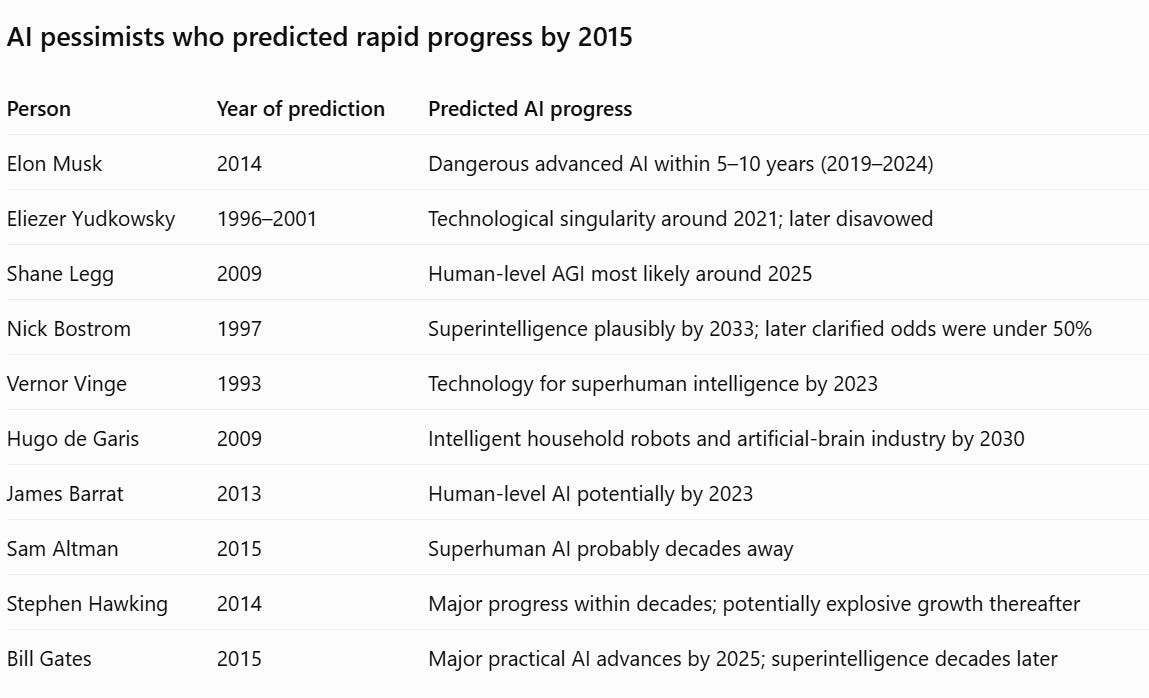
AI pessimists’ most powerful debating point is that, unlike normies, they foresaw the future. Back when AI was embarrassingly dumb, AI pessimists warned that it would rapidly improve. And rapidly improve it did. Here’s a list of who the leading AI pessimists are, what they said, and when they said it:
AI leaves me incredulous every day, but seeing is believing. AI is now better than I would have expected by 2100. Indeed, AI is now better than I ever expected it to be. We don’t have to argue about when AGI will arrive. By any reasonable definition, AGI arrived a couple of years ago.
Given the pessimists’ foresight and my confessed lack thereof, there is a strong reason to consider them to be more reliable than yours truly on the subject of AI. I freely concede that.
But AI pessimists plus Bryan Caplan are not the only people in world. Most notably, there have long been AI optimists. They too foresaw the future back when AI was embarrassingly dumb. Here’s a parallel list for these comparatively neglected visionaries.
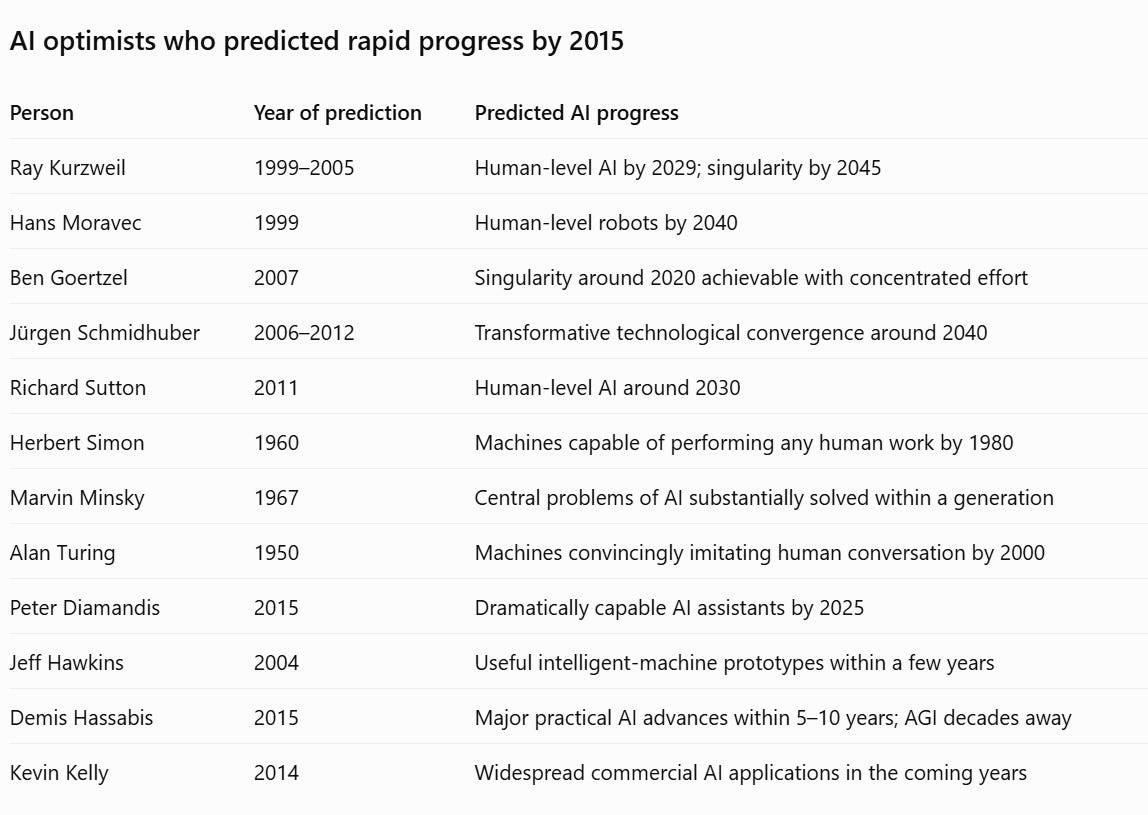
Upshot: There are two groups that, thanks to their predictive track records, have earned the right to be amplified: People who say that AI is going to be terrible, and people who say that AI is going to be great. Crucially, these two hypotheses are still, in philosophy of science jargon, observationally equivalent — equally consistent with existing data.
AI pessimists will no doubt try to rebut this claim of observational equivalence by pointing to shocking incidents like Hugging Face. But any AI optimist worth his salt, as well as anyone familiar with behavioral economics, will scoff. We should expect socially beneficial technologies to generate endless media scandals, and the prudent response is a mix of corrective tweaks and blasé shrugs. Consider this list of earlier technologies, persistent problems, and notorious incidents.
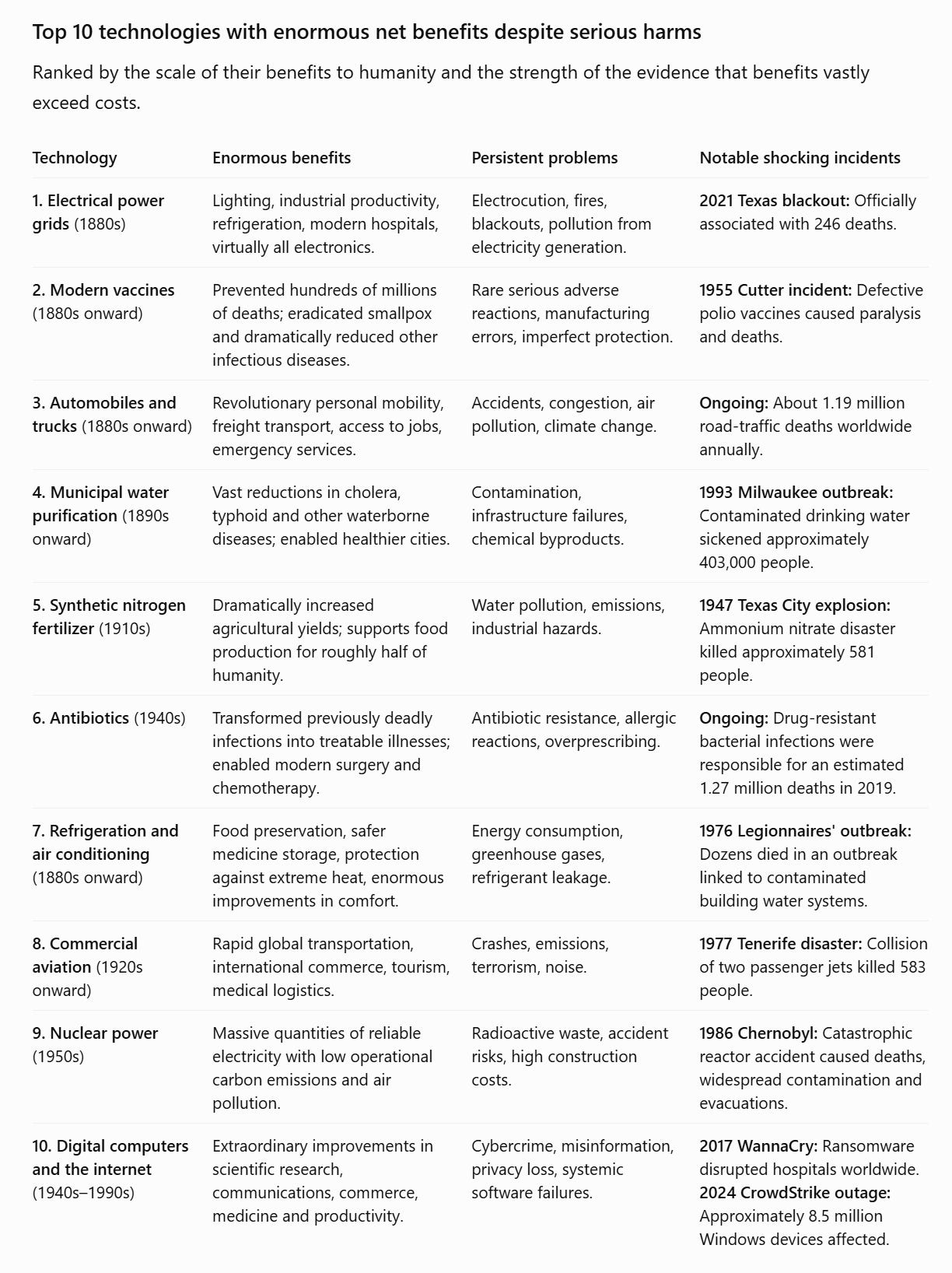
Condoleezza Rice quotably warned, “We don’t want the smoking gun to be a mushroom cloud.” But morbid truisms are no guide to prudent action. Each of these technologies would have massive net benefits even if the downsides were ten times as terrible.
Doesn’t the “Great-on-balance technologies always have some downsides” defense make AI optimism unfalsifiable? Of course not. What the AI pessimists need is for utterly catastrophic disasters to happen, not mere juicy scandals and moral panics. Consider: Over a million humans die annually from auto accidents, yet no one is talking about a “pause” for cars. Given the plausible upsides of AI, we should be willing to tolerate a similar level of collateral damage year after year.
Indeed, we should be ever-mindful that wonderful new technologies will be strangled in the cradle by innumeracy. Think about what asinine overreaction to nuclear accidents has done to nuclear power. Humanity discovered the cheapest, safest, cleanest energy imaginable, and then mostly banned it because of a few shocking anecdotes.
The lesson: Despite AI pessimists’ claims to be vindicated by facts, this is almost entirely a dispute over priors. Or to be more specific, a dispute over the right reference class to use. Scott Alexander colorfully calls it “reference class tennis”:
The Wimbledon Of Reference Class Tennis
“Reference class tennis” is an old rationalist idiom for people throwing analogies back and forth.
“AI will be slow, because it’s an economic transition like the Agricultural or Industrial Revolution, and those were slow!”
“No, AI will be fast, because it’s an evolutionary step like chimps → humans, and that was fast!”
“No, AI will be slow, because it’s an invention, like the computer, and computers were invented piecemeal and required decades of innovation to be useful.”
“No, AI will be fast, because it’s an invention, like the nuclear bomb, and nuclear bombs went from impossible to city-killing in a single day.”
“No, AI will be slow, because it will be surrounded by a shell-like metallic computer case, which makes it like a turtle, and turtles are slow.”
“No, AI will be fast, because it’s dangerous and powerful, like a tiger, and tigers are fast!”
And so on.
Comparing things to other things is a time-tested way of speculating about them. But there are so many other things to compare to that you can get whatever result you want. This is the failure mode that the term “reference class tennis” was supposed to point to.
One of Tetlock’s main discoveries in Superforecasting is that good forecasters start with base rates. But how do you find the right base rates to use? “Reference classes” are basically the same thing as “base rates,” and Scott makes it sound practically hopeless. Logically speaking, he’s right. If you want to predict my behavior, for example, you could use the base rate for libertarian American economists in their 50s. Or you could use the base rate for “Guys that just bought glasses at Costco.” How can anyone know which base rate is better?
But as Confucius never aphorized, “The man who says it cannot be done should not interrupt the man who is doing it.” Superforecasters don’t just use base rates; they routinely select apt base rates that lead to successful prediction. So the real question is not “Can they do it?” but “How do they do it?”
And the answer, despite much derision, is: using common sense.* When they hear AI pessimists forecast imminent human extinction, people with common sense instantly intuit: “This belongs in the ‘imminent human extinction’ reference class. Everyone who predicted human extinction in the past was totally wrong. I’ll start with that base rate.” Yes, there are other logically permissible reactions, like: “This belongs in the ‘predictions about the rising power of computers’ reference class.” But people with common sense just say “Bah” to that. The first base rate is sober, and the second is silly. If you don’t see that, I don’t know how I’d change your mind. But I’ll bet you’re wrong.
Doesn’t common sense also say “Bah” to AI optimism? When optimists predict the singularity or 10% annual growth of Gross World Product, then absolutely. Bah and bah. But common sense stands firmly on the side of, “Technological progress is very good on balance, despite abundant drawbacks.” As well as, “In the modern world, some technologies improve rapidly, but it’s hard to foresee which ones specifically.”
Where does this leave us? In terms of resolved predictions, AI pessimists and AI optimists have done roughly equally well. But in terms of common sense, AI optimism has a massive lead. Common sense is only agnostic about which technologies will race ahead. Now that uncertainty has been resoundingly resolved in favor of AI. While we shouldn’t tune moderate AI pessimists out entirely, AI optimists are the latter-day visionaries worth humoring. While their outlandish predictions will not come to pass either, they are right to paint a bright future… marred by an endless stream of problems and complaints. Just like every other big good thing that has happened.
* Known as Wisdom on your Dungeons & Dragons character sheet.
I don't get the title. Isn't AI Pessimism not only observationally equivalent, but also actually equivalent, to AI Pessimism? I suspect that you meant for the second "AI Pessimism" in the title to be "AI Optimism."
I think you're badly misreading this Bryan.
With a few exceptions at the extremes the "AI pessimists" and "AI optimists" are the SAME PEOPLE. They just differ in focus and what they were talking about when quoted (by you).
85% of them think AI is both risky and likely to produce a New Age of nearly unlimited abundance.
That 85% thinks there's some chance AI will kill us all (existential risk), and that *if it doesn't*, then things will be wonderful.
They differ on p(doom), their estimates of how likely the first is vs. the second, but virtually all of them have numbers in the range 0.1 to 0.9.
(And FWIW, none of these people think AI job loss is a real economic problem, except maybe transitionally. They worry about death, not poverty.)