

I’ve known that I wanted to be a professor since I was in junior high. First, I wanted to be an English professor, because I love literature. Then, in my senior year of high school, I discovered philosophy and economics. I spent most of my undergraduate years weighing whether to become a philosophy professor or an economics professor. In the end, I chose economics. But I’ve never forsaken philosophy — and while I don’t publish in philosophy journals, blogging gives me a better philosophy soapbox than the vast majority of professionals will ever have.
During my early years in philosophy, I was almost intellectually paralyzed by the subject’s seemingly impossible challenges. Challenges like…
Prove the external world exists. No proof? Then you can’t reject solipsism.
Prove you actually know anything. No proof? Then you can’t reject radical skepticism.
Prove all your memories aren’t fabricated. No proof? Then you can’t reject memory skepticism.
Prove you even exist as a durable mental being. No proof? Then you can’t reject Hume’s dissolution of the self.
Prove any mental states exist. No proof? Then you can’t reject eliminative materialism.
Prove your sense of free will isn’t an illusion. No proof? Then you can’t reject determinism.
Prove you know anything is morally right or wrong. No proof? Then you can’t reject moral nihilism.
The only reason my intellectual paralysis was incomplete was that I quickly discovered Ayn Rand and Aristotle’s notion of axioms. Not arbitrary mathematical axioms, but literally undeniable propositions. Radical skepticism can’t be right, because whoever says “No one can know anything” is claiming knowledge. Indeed, even “Maybe no one can know anything” is claiming knowledge about what’s possible.
Still, it wasn’t until I met Mike Huemer at UC Berkeley that I found my lifelong cure for intellectual paralysis. Huemer called it “intuitionism,” but it’s largely a rebranding of the pre-existing “philosophy of common sense.” The Huemerian response to all of the preceding demands for “proof” boils down to, “It’s obvious! End of story.” The less terse version: “The point of a proof is to move from more obvious propositions to less obvious propositions. So demands for ‘proof’ of the most obvious propositions are confused.” The maximally terse version, though, is a simple: “Bah!” Or as Thomas Reid explained centuries before Huemer:
And when we attempt to prove by direct argument, what is really self-evident, the reasoning will always be inconclusive; for it will either take for granted the thing to be proved, or something not more evident; and so, instead of giving strength to the conclusion, will rather tempt those to doubt of it, who never did so before.
Responding to absurd challenges with a “Bah!” is even more fruitful than it looks, because it doesn’t just allow us to reject glaring falsehoods without further argument. By the power of the contrapositive — “If A, then B; not-B, therefore not-A” — it also allows us to reject any valid argument that implies a glaring falsehood. Or in philosophical jargon, "One man's modus ponens is another man's modus tollens."
How does the Philosophy of Bah work in practice? Suppose someone demands proof of the existence of the external world. My immediate reply is to stonewall: “It’s obvious” or “Bah.” I often add: “And it’s obvious to you, too, so what are we arguing about?” If the challenger has good-faith arguments to the contrary, I’ll add: “The premises of your argument are much less obvious than the existence of the external world, so at least one of your premises is almost certainly false.” If you really have to choose between “The external world exists” and “I could be dreaming right now,” reject the latter premise, not the former.
Think about it this way: Suppose you’re a juror on a murder trial. A witness testifies that he saw the accused hack the victim to pieces with an ax. When the defense lawyer cross-examines the witness, his only challenges are: “Prove it wasn’t a dream” and “Maybe you’re a brain in a vat.” The correct reaction for the jurors is not to peruse philosophy journals for the latest replies to these classic canards. It is to summarily declare, “Bah.” If that’s your lawyer’s best defense against the charge of murder, the jurors should convict you. If “Bah” seems dogmatic, my response is: “I’m not dogmatic; you’re gullible.” As gullible as a man who stumbles on his wife cheating in flagrante delicto who accepts the explanation, “We were rehearsing a play.”
Can the Philosophy of Bah be abused? Of course; every good idea can be abused. But the fact that someone might “Bah” the disemployment effects of the minimum wage is a terrible reason to refuse to “Bah” solipsism or radical skepticism.
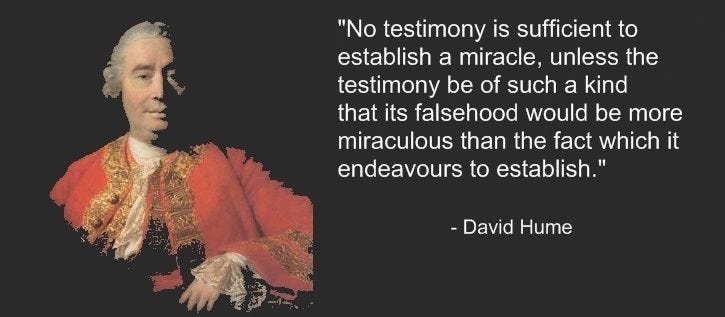
Is the Philosophy of Bah limited to the most fundamental truths? No. It shines for the most fundamental truths, but it’s broadly applicable. The best three-letter summary of Hume’s brilliant “Of Miracles” is, once again, “Bah.” It is absurd to seriously entertain claims about virgin births or demonic possession. Though I also love the long version:
When anyone tells me that he saw a dead man restored to life, I immediately consider with myself whether it is more probable that this person should either deceive or be deceived or that the fact which he relates should really have happened. I weigh the one miracle against the other and, according to the superiority which I discover, I pronounce my decision and always reject the greater miracle. If the falsehood of his testimony would be more miraculous than the event which he relates, then, and not until then, can he pretend to command my belief or opinion.
Much the same goes for claims about secular miracles, like alien visitation or AI annihilation. While they’re not quite as absurd as claims about supernatural miracles, the wise response is not to approach them with an open mind, but with the words of Saint Thomas: “Except I shall see in his hands the print of the nails, and put my finger into the print of the nails, and thrust my hand into his side, I will not believe.” (Yes, I am well-aware that the point of the story of Doubting Thomas is that we should have faith, but that’s what every scammer says. Bah!) I’ll believe that aliens are visiting Earth when I hold their super-tech in my own hands and examine it with my own eyes. If you’re excited by the latest UFO evidence, I’m happy to outsource my dismissal to Mike Huemer. But if Huemer didn’t exist, I’d just exclaim “Bah!“
I’m well-aware that stonewalling isn’t very persuasive. But if someone rejects premises as obvious as “The external world exists,” trying to change their mind is a fool’s errand anyway. The point of the Philosophy of Bah is not to convince others of the obvious, but to convince yourself of the obvious. Though the world is benighted, you don’t have to be.
It is no hyperbole to say that the world of ideas overflows with total nonsense. If you’re intellectually apathetic, you won’t be fooled. The more intellectually curious you become, however, the graver the danger that your mind will be totally overwhelmed by total nonsense. If, like me, you are highly curious, the intellectual danger is overwhelming. Fortunately, the Philosophy of Bah allows you to swiftly dismiss mass quantities of nonsense, leaving plenty of time to savor the many genuine accomplishments of the human mind.
It was obvious to many ancients that the world is flat, the Chinese didn't learn otherwise until visited by Jesuits. It was obvious to many who knew the world is round that it was the center of the universe, with other astral bodies rotating around it. It was obvious that the species which exist on Earth have always existed, and have always been separate. It was obvious to pre-modern people that medicine aided their health, and your colleague Robin Hanson has written about how we evolved to show that we care via medicine, even when it doesn't work (as was generally the case prior to the 20th century). It was obvious that solid objects were not mostly empty space before we discovered electrons. It was obvious to Aristotle that some humans are naturally slaves. Modern science overturned so many of these beliefs because it helps make more accurate predictions. Many of your philosophical beliefs don't do that, and skeptics can stand on no less solid ground.
Nice read, but perhaps you do not love philosophy as much as you think- Bah seems like an excellent conversation stopper! A resort to common sense, like a resort to logic, science, rationality, etc. are all parcel to the epistemological tradition of foundationalism. This leaves you with a series of other problems, I.e. how do you find which beliefs are foundational, but you may consider or ignore this at your own leisure.