

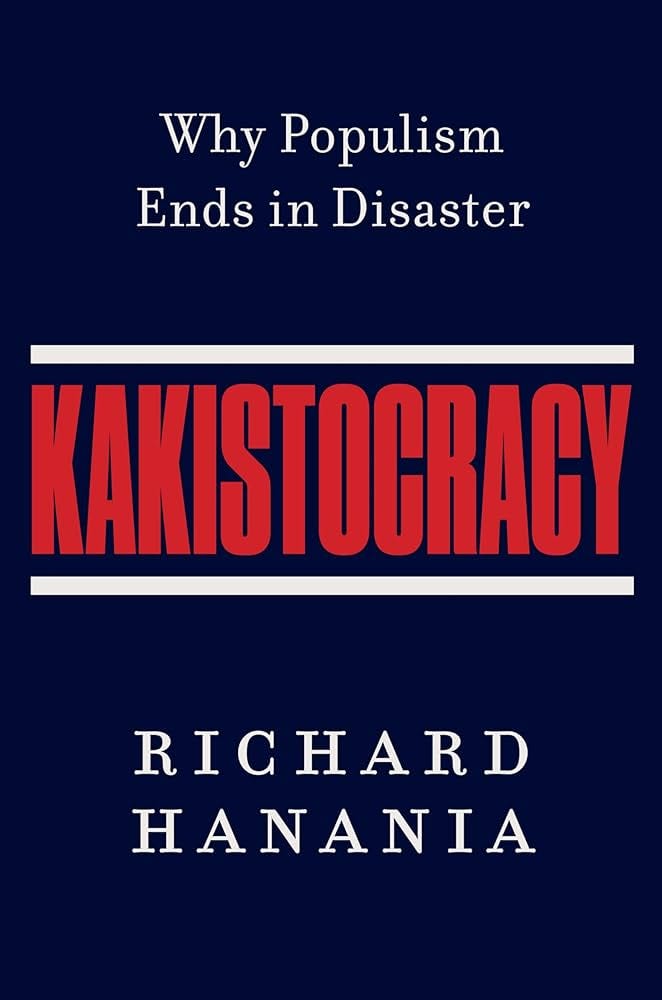
Anticipating the runaway success of his new Kakistocracy, a major magazine is profiling Richard Hanania. When they called me up, one of the top topics was allegations of racism. While Richard himself freely admits his racist past, many critics insist that he remains racist to the core. The interviewer broke these current critics down into two camps:
Camp #1: Critics who think that Richard, per Rihanna, “is only sorry he got caught.” On this view, Richard is merely pretending to have changed his mind. I told the interviewer that this is a reasonable presumption. If I didn’t personally know Richard well, I would, though mindful of his pre-expose pro-immigration pieces, still wonder about his sincerity. But since I do know Richard well, my response was, “If he’s faking, give him an Academy Award.” While I sadly lack telepathy, I’d be amazed if straight-talking Richard could keep up a multi-year facade.
Camp #2: Critics who think that Richard is still blatantly and by definition racist because he believes in racial differences in IQ, personality, criminality, and beyond. For some critics, even looking at the numbers is suspect. To ponder the possibility that the differences are anything other than a natural response to white racism is practically satanic. While I was tempted to dismiss these critics as crazed fanatics, the conversation made me realize that the issue is more subtle. True, simply believing in racial differences — even large genetic racial differences — is never racist. Expressing these views, however, often is a strong symptom of racism.
The most blatant example in my mind: Whenever someone broaches the subject of sub-Saharan African IQ, they often start casually advocating horrific human rights violations. As I explained a decade ago:
In my experience, if a stranger brings up low IQ in Africa, there’s about a 50/50 chance he casually transitions to forced sterilization or mass murder of hundreds of millions of human beings as an intriguing response. You can protest that they’re just trolling, but these folks seemed frighteningly sincere to me.
Given this high psychotic base rate, the correct Bayesian inference is that broaching the subject of low sub-Saharan IQ sharply raises the probability that you are racist in the worst sense, even if the speaker never personally advocates forced sterilization or mass murder. After all, for every ten people who broach the subject and immediately voice openness to human rights violations, there must be a few people who broach the subject while glossing over their openness to such violations.
More generally, expressing belief in racial differences becomes a strong symptom of racism in two common conditions.
Condition #1: Misanthropic tone. If a low-IQ student is failing a class, you can regretfully but candidly tell him, “Given your test scores, I’m afraid you’re never going to become a mathematician or a scientist.” Or you can gloat, “You, a scientist?! But you’re a freakin’ moron!” The same goes for racial differences. You can regretfully but candidly acknowledge them: “Blacks commit murder at about 7.5 times the white rate, so high black incarceration rates for murder are just what you should expect.” Or you can gloat, “Blacks?! They’re all a bunch of murderous thugs!” The key point: Unless you are in fact a racist, there’s nothing funny about these gruesome facts. And unless you’re a racist, it’s easy to grasp why you ought not gratuitously lump the vast majority of non-murderous blacks in with the merely relatively large murderous minority.
Condition #2: Time and place. If a low-IQ student is failing in school, his teacher could talk to him privately about realistic career options: “Do you know how much money skilled craftsmen make?” Or he could humiliate him in front of his peers: “After graduation, Johnny’s gonna be pumping gas for the rest of you.” The same goes for racial differences. If you’re giving a lecture on racial discrimination in Econ 321, racial IQ differences are fair game. The classroom is a forum for well-reasoned discussion of statistical reality, and IQ is in fact a major cause of racial earnings disparities. But if you decide to raise the same topic at a mixed-race wedding, your motive is clearly to humiliate and antagonize. It’s like loudly speculating about the couple’s probability of divorce. People are at the wedding to celebrate, and you’re going out of your way to tarnish attendees’ experience. If you weren’t a racist, why dredge up this topic in this situation?
Granted, inferring motives from words is a struggle. Misunderstandings abound. That’s what makes Curb Your Enthusiasm such a deep show. Larry David repeatedly makes misanthropic remarks at the wrong time and place, leading others to judge him an even worse person than we, the all-seeing viewers, know Larry to be. But inferring motives from words is a two-front struggle. You have to infer neither too much nor too little from what people say, how they say it, when they say it, and where they say it.
What does all this mean for Hanania? Long-form writing is the ideal forum for well-reasoned discussion of racial differences. And his long-form tone for the last decade, though occasionally acerbic, is almost never misanthropic. On the contrary, Richard strives to nudge readers into being better people. Since I read almost every word he writes, I confidently exonerate him of racism for anything he says in essays or books.
His Twitter/X posts, by his own admission, are in contrast often calculated trolling for clicks. While you could argue that Twitter/X isn’t meant to be taken seriously, I see why some of Hanania’s bon mots raise red flags of racism for readers. Since I know him personally, I discount these flags. But yes, if Hanania wanted to allay all rational suspicion of his racism, he would have curated his social media more closely, especially pre-2024.
I have a dream. I dream of a world where well-informed people calmly and candidly discuss society’s ugliest statistical realities. I dream of a world where no one stigmatizes those who participate in these discussions as “racist” (or “sexist,” “homophobic,” “xenophobic,” “anti-Semitic,” or “Islamophobic”). I dream of a world where everyone in these discussions speaks respectfully about all of the groups under consideration. I dream of a world where the point of these discussions is to help craft humane tailored policy responses, not rationalize collective punishment or bless the status quo. Above all, I dream of a world where all participants are mindful that individual exceptions to statistical rules are ubiquitous. The hashtag #NotAllX is never far from the thoughts of any intellectually honest person.
Well done.
I can no longer read most of what Hanania writes because of his TDS and his obsession with not merely going after the far MAGA right but claiming that almost the entirety of the right IS now the far MAGA right. And therefore the Democrats are the superior political party and “The Media is Basically Honest and Good.”
I actually attribute this otherwise highly irrational behavior change on his part to his desire to get as far away as he can from his racist past. But on that point I am just guessing.
This change in Richard is sad, because he used to be incredibly interesting, 85% on target with 15% eye-rollingly infuriating bad takes. But now the ratio seems to be reversed.
But all that said, I agree that claims that today he is “racist” are just dead wrong.