

Protectionism has been absurd for centuries. Trade is, for all practical purposes, a technology, so protectionism is just Luddism in disguise. This well-shared infographic is worth a million words:
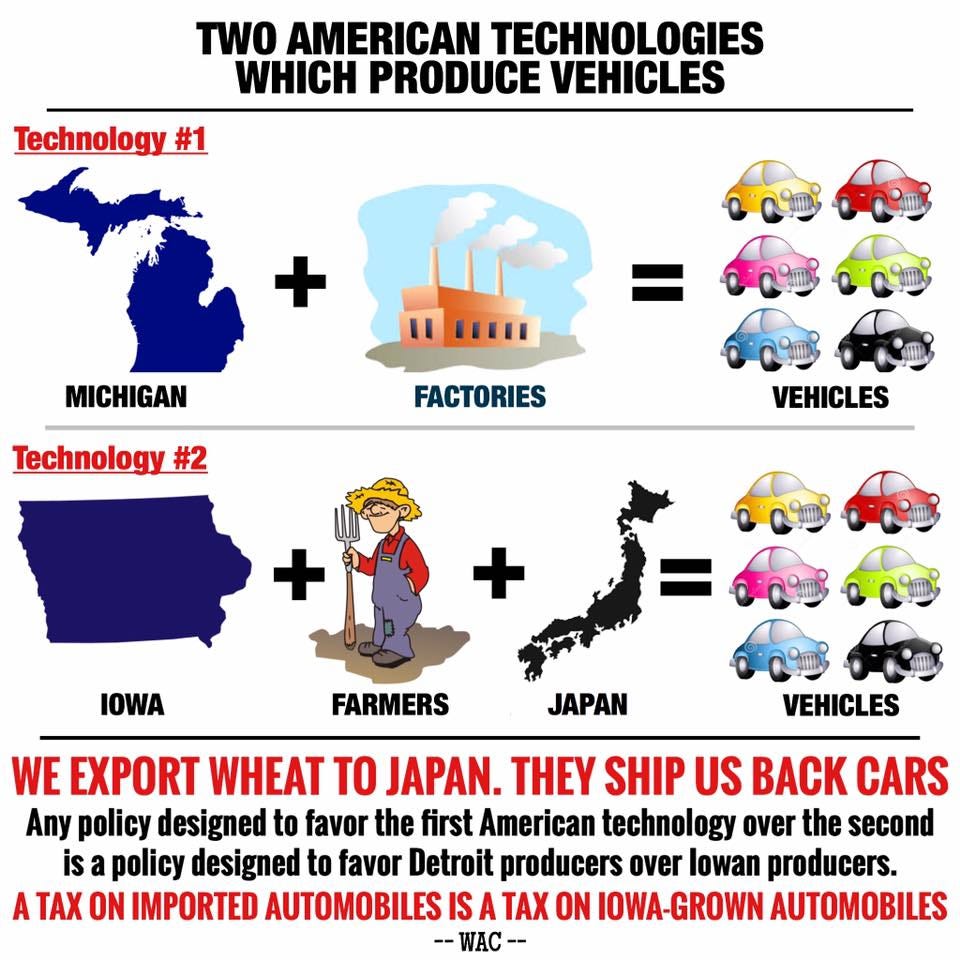
But over the last ten years, protectionism has taken a major turn for the worse. Classic protectionism was at least predictable. Protectionists looked at sellers and saw gainers; they looked at buyers and saw losers. Ergo, the more a country sells, the more it gains; the more it buys, the more it loses.
Philosophically, whether a person is “buying” or “selling” is a matter of perspective. When I exchange dollars for yen, we normally say that I’m “buying yen.” But you could just as easily say that I’m “selling dollars.” Similarly, when I exchange dollars for a Korean car, we normally say that I’m “buying a car.” But again, you could just as easily say that I’m “selling dollars.” In ordinary language, however, there is a standard default perspective: When two parties exchange money for goods and services, the person handing over money is the buyer, and the person handing over goods and services is the seller.
Until about ten years ago, protectionism built on this standard default perspective. Advanced military technology aside, it didn’t matter what you sold or what you bought. Your country was “winning” as long as the market value of what it sold exceeded the market value of what it bought.
Since then, however, protectionists have risen to a new level of nonsense. While they still loudly complain when their countrymen buy goods and services from foreigners, they also loudly complain when their countrymen sell oddly specific goods to foreigners.
Most notably, modern-day protectionists complain about selling foreigners housing. Non-college males build houses and sell them to foreigners. By classic protectionist logic, this is the pinnacle of “winning”: Blue-collar Americans get piles of money, and foreigners pay through the nose. But today’s protectionists have somehow convinced themselves that this is bad. Why? Because it drives up the price of homes for native homebuyers.
Notice: The same objection holds for all exports. Whenever foreign demand rises, prices go up, and some domestic buyers feel “priced out” of the market. If we follow this logic, the classic protectionist position reverses: Instead of looking at international trade and saying, “Sellers are gaining at the expense of buyers,” we have to say, “Buyers are gaining at the expense of sellers.”
But modern-day protectionists, unconstrained by logic, complain ad hoc. Buying foreign cars is bad… but so is selling domestic houses. How are we supposed to know whether it’s buying or selling that endangers our national well-being? Just trust the protectionist complainers and they’ll tell us.
The same goes for tourism. Hosting foreigners is a major export industry. For places like Spain’s Canary Islands, tourism is over one-third of the whole economy. By classic protectionist logic, such tourist centers are an outstanding way for your country to profit at the expense of the rest of the world. But many modern-day protectionists have redefined tourism as a problem. Foreign consumers have driven up prices, excluding the hapless natives. Classic protectionists saw attractive locations as assets that countries could use to amass wealth. Now they treat incoming foreign wealth as a grave danger to the native inhabitants of attractive domestic locations.
How are we supposed to know which products are dangerous to buy, and which products are dangerous to sell? The exasperating subtext, again, is: Trust the complainers and they’ll tell us the answer.
Modern-day protectionists even complain about the export of energy. Back in the 70s and 80s, protectionists were sure that the Saudis were bleeding America dry. If only we could achieve “energy independence”! Thanks to fracking, the U.S. is now a net exporter of petroleum. Classic protectionists would have rejoiced: America gets the wonderful money and jobs, while foreigners endure our domination. Modern-day protectionists, in contrast, are angry that exporting energy makes U.S. consumers pay higher energy prices.
An old adage laments, “They’ve got you coming and going.” Today’s protectionists have got us buying and selling. Any economic interaction with foreigners is a potential target of their childish wrath, without rhyme or reason.
But isn’t it true that selling housing, tourism, and energy potentially hurts domestic consumers? Absolutely, because all progress hurts someone. New tech always hurts someone. Freer trade always hurts someone. The wise response is not to clutch pearls and impede progress, but to remember the most fundamental lesson of economics: The secret of mass consumption is mass production. In a word: abundance. Protectionism is ultimately just protection from progress itself.
A clearer exposition is hard to think of. Really good rant, no fluff, no propaganda, just good natural sarcasm due to the subject itself. Unfortunately, Luddites have no sense of humor or self-awareness.
I buy all of this without reservation. I bite all the bullets.
And yet.
Suppose a man lives in an isolated house, with a beautiful view. He's lived there all his life.
And someone wants to build an eyesore there. A sewage works maybe.
The sewage works is built.
The man is really very hurt by this. He moves away, and finds another place to live. But he never feels at home again. He would have spent all his money to prevent it happening.
The greater good is served by the pain of an individual, who had something and now doesn't have it.
------------------------------------------------
Do you find this story psychologically plausible?
If he actually *owns* the land that the sewage works is built on, does that make a difference?
Should the state have the power to take his land against his will?