

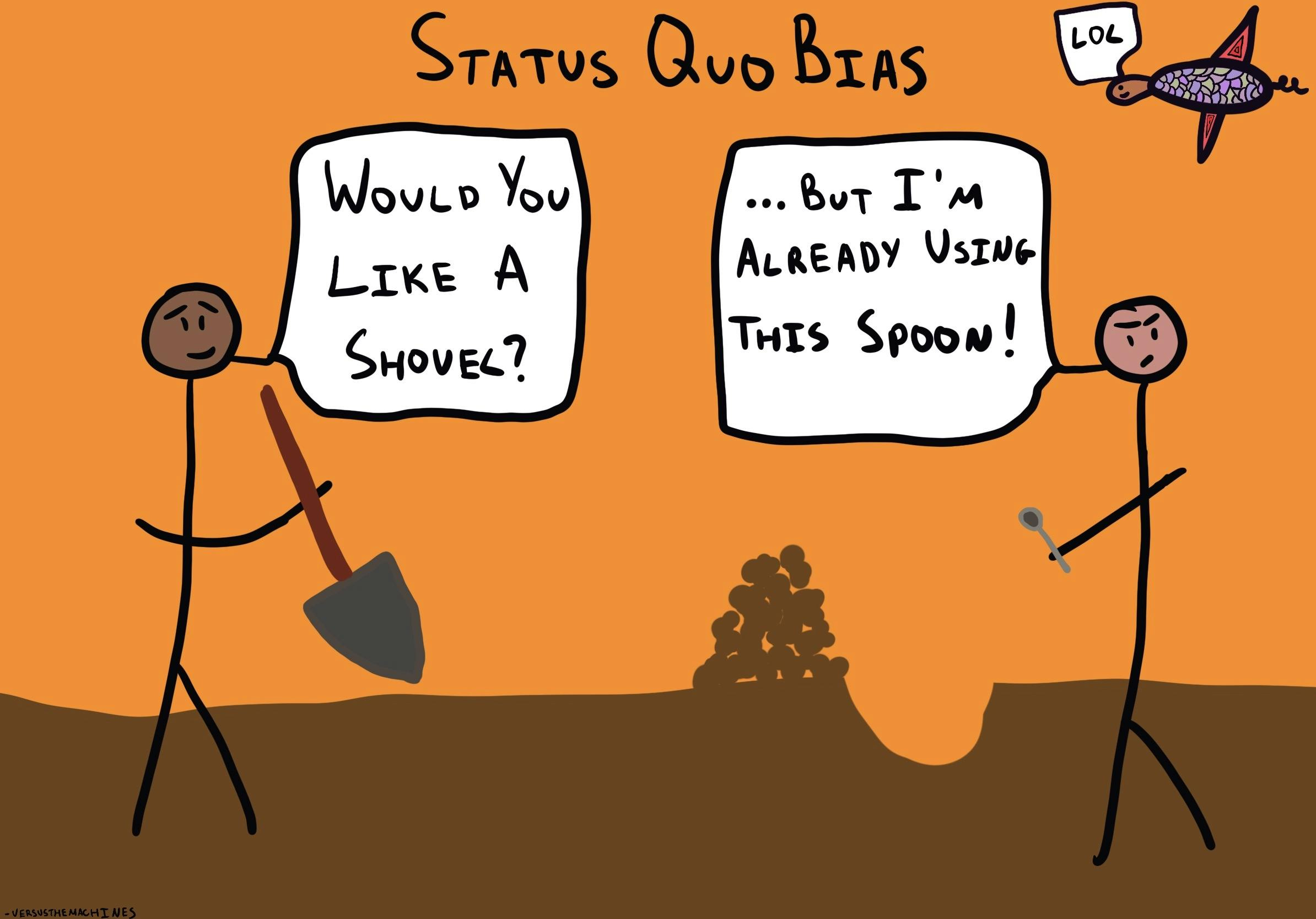
Human beings suffer from status quo bias: When they face different default options, they make different choices. Offering “a burger and fries for $10, with $3 off without the fries” is economically equivalent to “a burger for $7, and fries for $3.” But the two offers are not psychologically equivalent, and a restaurant will sell more fries using the first framing.
The same goes for, say, marriage. “Divorce is tough, unless you check the ‘easy divorce’ box” is economically equivalent to “Divorce is easy, unless you check the ‘tough divorce’ box.” But it’s pretty obvious that these alternate default rules will noticeably affect behavior. If tough divorce is the default, more people will opt for tough divorce; if easy divorce is the default, more people will opt for easy divorce.
Notice, however, that there’s a key disanlogy between buying lunch and getting married: when you buy lunch, you (usually) just want something to eat; you’re (usually) not trying to make a good impression on other people. When you marry, however, you’re clearly trying to make a good impression on other people. At the bare minimum, you’re trying to make a good impression on your spouse-to-be. In most cases, you’re also trying to make a good impression on your spouse’s family.
Now suppose that when they marry, 75% of people go with the default rule for divorce. In “tough divorce” states, 75% opt for tough divorce; in “easy divorce” states, 75% opt for easy divorce. What should you conclude about the degree of commitment of your spouse-to-be when he proposes easy divorce or tough divorce? It depends on your state’s default rule!
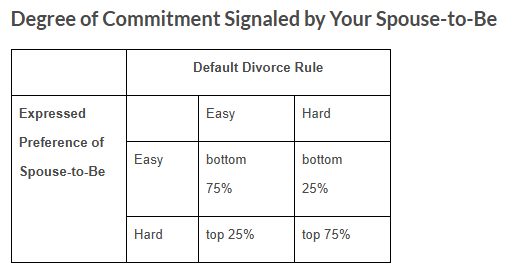
If you live in an easy divorce state, asking for easy divorce is only a moderately negative signal. You’re putting yourself in the bottom 75% of commitment. But if you live in a hard divorce state, asking for easy divorce is a seriously negative signal. You’re putting yourself in the bottom 25% of commitment.
The same goes when your spouse-to-be asks for hard divorce. In an easy divorce state, this is a seriously positive signal. He puts himself in the top 25% of commitment. In a hard divorce state, in contrast, this is only a moderately positive signal. Asking for hard divorce when hard divorce is the default puts you in the top 75% of commitment.
The lesson: status quo bias and signaling interact in a surprising way. When status quo bias makes a signal more common, sending that signal says less about you, and not sending that signal says more about you.* Making something the status quo doesn’t just change our behavior; it changes what a given behavior communicates to our fellow men.
* This abstracts from people’s generic desire to signal conformity, which complicates matters.
The post appeared first on Econlib.
You’re comparing apples and oranges here.
You’re asking about how people would make their actual lunch choice in the moment. But you’re comparing that with how people would choose to signal about how they might make their potential divorce decision to be applied a future time. Those are not comparable things.
And that’s before you even consider the heft of the decision itself. Choosing a side dish for lunch is not even comparable to divorce.
And that’s also before considering that any vendor who sells anything will “package” things to sell more stuff.
> The same goes when your spouse-to-be asks for hard divorce. In an easy divorce state, this is a seriously positive signal. He puts himself in the top 25% of commitment. In a hard divorce state, in contrast, this is only a moderately positive signal. Asking for hard divorce when hard divorce is the default puts you in the top 75% of commitment.
It's not that easy, if the commitment is symmetric.
For a less emotionally charged topic: notice period for employment contracts (in jurisdictions were firing is generally legal). Does pushing for a long notice period as an worker mean that you are committing yourself to the company? Or does it mean that you want the company to pay you for a long time, even after they've already decided to fire you?