

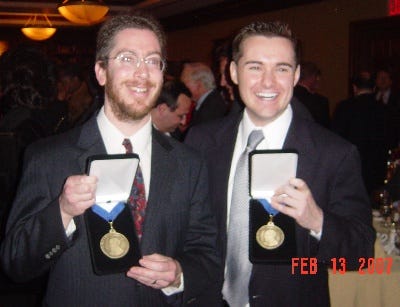
Since my co-author and friend Ed Stringham is on campus today at GMU, let me spotlight our Templeton-prize-winning 2005 Review of Political Economy article, “Mises, Bastiat, Public Opinion, and Public Choice: What’s Wrong With Democracy.”
While I’ve long been a friendly critic of Austrian economics, Caplan-Stringham defends the political economy of Ludwig von Mises (along with the notably similar political economy of Frederic Bastiat) against his fellow Austrians.
Both the Mises–Bastiat view and the standard public choice view reach relatively negative conclusions about democracy. But the two positions appeal to contradictory mechanisms. In the usual public choice view, the problem with democracy is that the voters are right, but ignored. In the Mises–Bastiat view, the problem with democracy is that the voters are wrong, but heeded.
What are we talking about?
Mises freely compares the politician’s dependence on the public with the businessman’s dependence on consumers. What is his rationale? To use modern terms: the median voter model. Voters have preferences, and prefer politicians who support those preferences. Since politicians want to win, they have a clear incentive to conform: ‘No matter what the constitution of the country, governments always have to pursue that policy which is deemed right and beneficial by public opinion. Were they to attempt to stand up against the prevailing doctrines they would very soon lose their positions to men willing to conform to the demands of the man in the street.’ (Mises, 1998b, p. xii)
Which leads straight to a pointed question and Mises’ line-in-the-sand response:
If democracy is such a great tool for matching public opinion and public policy, how could he have been so critical of the political-economic direction of the 20th century? Quite simply, Mises questions the wisdom of public opinion. The public commits an array of what we would now call systematic mistakes:
‘Democracy guarantees a system of government in accordance with the wishes and plans of the majority. But it cannot prevent majorities from falling victim to erroneous ideas and from adopting inappropriate policies which not only fail to realize the ends aimed at but result in disaster.’ (Mises, 1998a, p. 193)
Mises eschews Social Desirability Bias like the plague.
Mises naturally focuses on the public’s erroneous ideas about economics: ‘The fact that the majority of our contemporaries, the masses of semi-barbarians led by self-styled intellectuals, entirely ignore everything that economics has brought forward, is the main political problem of our age’ (Mises, 1981b, p. 325).
Caplan-Stringham then contrasts Misesian political economy with conventional public choice, and argues that research from 1995-2005 strongly supports the former.
For Mises, the key distinction is apparently private versus collective choice. If consumers judge the applications of an idea, Mises does not worry whether the man in the street grasps underlying theories. Good ideas sell, bad ideas flop. If however voters judge the applications of an idea, Mises sees no filter other than their direct assessment of the idea.
Our biggest doubt about the Misesian view is his emphasis on the long-run influence of professional intellectuals.
While economists exert influence over popular economic beliefs, evidence suggests that sophistry has a life of its own. Only a handful of modern economists promote anti-foreign bias or make-work bias. Economists from the entire political spectrum agree on the biases’ folly. But anti-foreign and make-work bias remain popular with the public. Any economist who has taught introductory students knows how hard rooting out such fallacies is. You might lament that other intellectuals ‘got to your students first.’ But this requires a puzzling asymmetry: why is putting fallacies into students so easy, but taking them out so hard?
I’m especially fond of the conclusion.
Mises’ critique of Enlightenment liberalism applies almost verbatim to modern rational choice political economy:
‘They blithely assumed that what is reasonable will carry on merely on account of its reasonableness. They never gave a thought to the possibility that public opinion could favor spurious ideologies whose realization would harm welfare and well-being and disintegrate social cooperation ... They did not anticipate the popularity which ideas which they would have called reactionary, superstitious, and unreasonable acquired in the nineteenth and twentieth centuries. They were so fully imbued with the assumption that all men are endowed with the faculty of correct reasoning that they entirely misconstrued the meaning of the portents.’ (Mises, 1998b, pp. 864 –865)
The only difference is the degree of naivete. The Enlightenment liberals – with obvious exceptions like Bastiat – were refuted by events in the future. Modern political economy has been refuted by events in the past.
And:
Mises was not able to leapfrog over the mistakes of public choice because he was a subtler theorist. His story is transparently simple. Mises was not more insightful because he had more data. He had less. Mises succeeded because he paid attention to the data he had. He recognized that the question ‘Do voters have systematically biased beliefs about economics?’ is an empirical one. To answer it, he looked at the world, not a formal mathematical model.
You don’t have to remind me that the followers of Ludwig von Mises have a lot of crazy views. Their pure economic theory is often childish, and their empirical understanding of the economy needs major improvement. But there’s a reason I read Human Action and Socialism cover-to-cover in high school. The Kantian philosophy is bizarre at best. But Mises’ analysis of the political power of economic illiteracy is dead on.
Looking at the world as it is, whatever ideas that have got us here, they need the critical examination.
-
It tends to be difficult for democracy worshipers to keep in mind that half of the public has an IQ below average and even looking at those above average, at what level can we say that someone is smart?
It seems to me that most voters are unwitting agents of their tribal instincts and they are played by people that are often high functioning sociopaths and psychopaths, and so the function of political government has become that of managing/exploiting tribalist passions as various actors endeavor to maintain or gain political power/influence.
Would love to see you do a final verdict on the Medicaid back and forth