

Stanley Milgram’s infamous Obedience to Authority experiment seemingly showed that most Americans would shock a stranger to death simply because an authority in a white coat ordered it. Ironically, ethical authorities deemed Milgram’s experiment so unethical that they prevented its replication for decades. But in 2009, Jerry Burger found a workaround that allowed him to run a nearly identical experiment. Milgram replicated nicely.
A key feature in both experiments: The authorities in white coats were paper tigers. They displayed no power to punish disobedience, nor did they claim such power. When faced with reluctant subjects, they just followed this escalation script:
“Please continue, or Please go on.”
“The experiment requires that you continue.”
“It is absolutely essential that you continue.”
“You have no other choice, you must go on.”
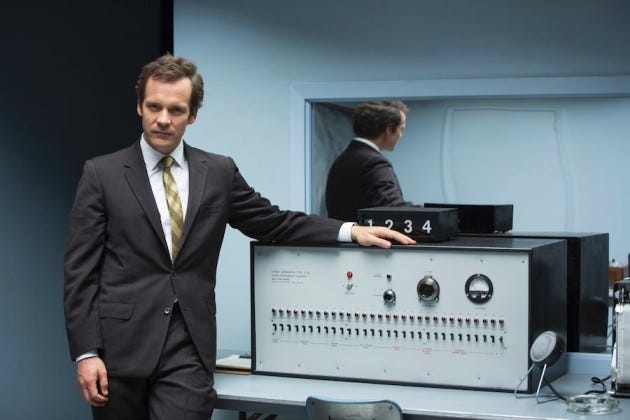
Due to the folly of Human Subjects Review, lots of obvious variations on Milgram have never been tested. There’s one small experiment on (placebo, hence painless) self-harm, and nothing on whether people will obey commands to hand over money or other valuables. I strongly suspect that most people will not endure physical pain or financial loss on the mere say-so of the white-coated authority. But even so circumscribed, Milgram’s results give deep insight into the nature of what humans call “power.”
Intuitively, we tend to think that power flows from an ability to inflict punishment. Governments have power because they will imprison you or confiscate your property if you break the law. Employers have power because they will fire or demote you if you disobey orders. Teachers have power because they will give you a bad grade if you don’t do your work. Parents have power because they will ground you or take away your allowance if you don’t do what you’re told.
What Milgram shows, however, is that this is only part of the story. Another source of power is the perception of legitimacy, the sense that the authority is entitled to your obedience. Like when Legolas tells Boromir, “He is Aragorn, son of Arathorn. You owe him your allegiance.” In the Obedience to Authority experiment, to repeat, the white-coated scientist never ever claimed to possess the power of punishment. He just acted like he was worthy of obedience. And most of the subjects, despite misgivings, concurred.
So what? One of modernity’s most influential neologisms is “power relations.” If you listen closely, people see these power relations almost everywhere. And on reflection, many are Milgramian, distinctively lacking in punishment to back them up.
Consider, for example, those who object to age-gap relationships because “There’s a power relation.” What, pray tell, is the punishment that the older partner hangs over the head of the younger? If there’s any power relation, it exists simply because human beings tend to think that older people are entitled to boss younger people around. The same goes for workplaces that bar all relationships between people of unequal rank, even those who don’t work together. The vice president in charge of marketing has minimal ability to hurt the career of a secretary over in payroll. So if there’s any power relation, it exists simply because human beings tend to think that august vice presidents are entitled to boss around lowly secretaries.
Once you accept this point, you should also reassess how much the ability to punish matters more generally. Most parental power isn’t really based on punishment; in fact, a large share of parents are pathetic pushovers. In the face of a problem daughter, even mafioso Tony Soprano hilariously told his wife, “Let's not overplay our hand because if she finds out we're powerless, we're fucked!” Given massive grade inflation, most teachers clearly aren’t using bad grades to punish bad behavior. Most employers suffer from serious firing aversion. Even many governments are loath to actually punish lawbreakers, as we saw during Covid. In all of these cases, a large share of power comes not from punishment and threats, but the perception of legitimacy.
Not convinced? Notice that in many (though definitely not all) of these examples, the side with “less power” actually has abundant opportunities to make the side with “more power” suffer. Indeed, the balance of punishment often tips the wrong way. Problem children can torment their parents, and eventually have the option of cutting their elders off. Bad students notoriously torture teachers. Workers can and do distress employers by quitting at inopportune times. And given current discrimination laws and social norms, disgruntled workers can readily wreck their superiors’ careers. Either the whole “power relations” idea is mostly wrong, or it must be reinterpreted in Milgramian terms.
Once we do this reinterpretation, two options appear before us. One is to treat perceptions of legitimacy as fact. If people feel like scientists in white coats deserve obedience, then those scientists “have power” and non-scientists “need protection.”
But this is absurdly infantilizing and elastic. The better option is to accept that most alleged power is illusory. Though the illusion is widespread, those who perceive it have a responsibility to wake up and take charge of their lives. Act like the noble defiant minority in Milgram’s original experiment. You don’t have to do what other people tell you, even if they are wearing white coats. Instead of demanding protection from power, focus on the question, “What can he actually do to me? And would he want to, given what I can do in response?”
Better yet, ask the deeper: “Does this authority deserve my obedience?” Stop playing the victim, and start living as a thoughtful moral agent.
One thing I have never seen addressed regarding Milgram's experiment is whether the lab subjects, the one thinking they are inflicting pain, actually *do* think so. I have never paid a lot of attention to Milgram, maybe I've missed something. But I have tried to imagine myself approached by some professor or grad student asking me to sign up for an experiment for some nominal pay. When told my turning a dial inflicts pain on the experimental subject, my attitude would be that whatever happens, the subject must have agreed to it, that the whole process is kosher, because professors and grad students just don't go around shocking other students against their will for research.
It's sort of the same for people who object that R-rated movies or even porn objectify women (why never the men?). I've never seen any movie where I thought, "Oh heck, they're actually raping that poor women! Someone call the cops and get her out of there!"
You have to assume people have agency. Maybe some porn is so realistic that it could be mistaken for real criminals raping real women against their will. I am not up on the latest in porn realism or rape snuff films or whatever they would be called.
Back to Milgram ... I could easily imagine myself going along, on the assumption anything happening is part of the experiment and everyone involved is a voluntary participant. It would never occur to me that any fool grad student or professor would actually set up an experiment which would hurt people, let alone potentially kill them.
I have never believed the results have any relation to real people in most real circumstances.
Nicely done.