

Cate Hall’s You Can Just Do Things: How High-Agency People Get What They Want Out of Life sounds like a book designed to tell me what I want to hear. I’ve long believed in:
Literal free will. It is metaphysically possible for people to do more than one thing, holding constant the state of the universe. I am well aware of all the incredulity this engenders, but I observe my free will via introspection in every waking moment, and if you can dismiss my constant observation with “That’s just an illusion,” you could just as easily dismiss all observation as illusion.
Widespread overestimation of constraints relative to preferences. People are quick to say, “He can’t do X” when the correct story is obviously, “He doesn’t want to do X.” I can’t fly to the moon by flapping my arms, but I can refrain from drinking alcohol, eating 4000 calories a day, and much more.
Most humans are deeply conformist. Though this was probably functional in the ancestral environment, in a modern anonymous society, this creates immense opportunities for thoughtful nonconformists.
Nevertheless, reading Hall’s book starkly reminded me of the dangers of high agency. After being a high-profile lawyer and a professional poker player, she spent three years as a heavy drug abuser. She sees her drug addiction as a failure to use her agency. From the intro:
I consider the state of addiction to be the opposite of agency. Agency entails the ability to recognize all the degrees of freedom one has. Addiction strips them away, reduces life to one option, and subordinates everything else in service of making sure that option is selected over and over again. To some extent, you can think of addiction and agency as two sets of labels on the same dial, like hot and cold on a tap. Addiction is automaticity. Agency is autonomy.
For three years, I became a prisoner in my own life.
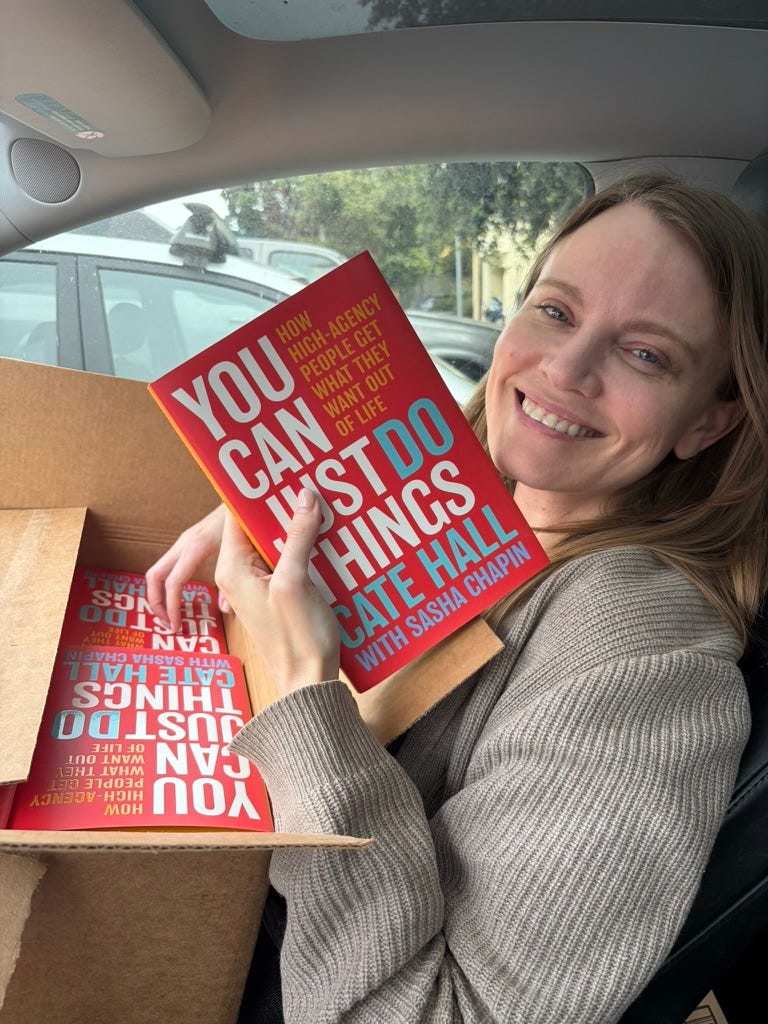
Or not. Hall repeatedly talks about the lame excuses people make for failing to do good things. I submit she should apply exactly the same skepticism to excuses people make for doing bad things. “I’m a prisoner in my own life” is wrong for lawyers who don’t like their job — and it’s wrong for drug abusers.
Imagine you see a heroin abuser shooting up on the street. You shudder, and say, “I could never do that.” But sure you could. Need help getting started? Most of the techniques Hall teaches apply. Thus, she tells readers to “Stop living in movie logic.” You don’t need the story to lead you into drug abuse. You Can Just Do Things. Good Things. Bad Things. Feel the power — and remember that with great power comes great responsibility.
I’m tempted to think that it’s primarily low IQ people who will use high agency badly. But Hall’s obviously high IQ, she chose three years of self-destruction, and though she’s an outlier, she’s not that extreme of an outlier. The main segment of the population I’d really trust with maximum agency is just people very low in Neuroticism.
This big reservation aside, Hall has a lot of pretty good advice. My favorites:
“Be willing to look stupid.” We’re in a highly anonymous society. Hardly anyone will notice, so the reputational risk is much lower than your emotions tell you.
“Get out of your lane.” Or to put it my way, “If you’re curious, experimentally enter a new lane and see if it works for you” and “Look like you’re supposed to be there.” No one ever told me a professor could become a graphic novelist. I just started making storyboards and ten years later, I was a graphic novelist.
“Court rejection.” That’s how Hall phrases it. The way I put it is, “Everyone is bad at everything at first” plus “Practice makes better.” So getting rejected at something new is part of the process of improving — and part of the process of finding out how quickly you’ll improve.
“Increase your surface area for luck” (as well as “Host events”). I have lots of amazing friends in large part because I go out of my way to meet people who might be amazing.
I also loved her advice for “the opposite of casual dating.” Not for everyone, but You Can Just Do This:
We started the relationship with severely incompatible communication styles and very different requirements in terms of personal space. Moreover, we were both shaken from recent breakups, and we lived in different countries!
Had we approached our relationship in the style of “casual dating” that’s popular these days, I don’t think we would have made it. Instead, we jumped in with both feet. Our first date was him moving in for a week, and our second was me bringing him along to a professional conference abroad. We got engaged within a couple of months, and married within a year.
Today, we’re one of those annoying couples that glow with love and affection. But we had to dig deep to get there. I can pinpoint several moments where I’m pretty sure we would’ve broken up if we hadn’t erected the “barrier to exit” of marriage.
“Wow, you’re great. Want to move in with me for a week?” would rarely work, but it’s a great icebreaker. And after you get rejected, you definitely try, “Well, would you at least go on a date with me Friday?” If that doesn’t get a laugh, you don’t want to be with that person anyway.
The barrier to exit comment is sort of funny given the book title. You Can Just Do Things except divorce apparently
What is it that you are claiming to observe? Because free will is generally taken to be more than a sensory observation or feeling. After all you have to verify that an observation is actually of the thing you want to prove. I mean let's consider two possibilities.
1) What you observe is something like: whatever you decide to do after deliberation is something you can choose to do. If you think 'i'm going to raise my arm' you observe that you do in fact raise your arm.
But at best you merely observe that you can do what you decide to do which it no way shows you could have decided otherwise. So it's not an illusion just not an observation of the claim you want to support [1].
Ultimately you could point to all sorts of other observations you have but unless you directly experience a counterfactual they can never actually be of the fact that you could have done differently and you can't say they actually instantiate what you mean by free will. At some point what you mean by the word has to be brought into play.
2) Maybe you observe that you strongly agree with the sentence "I have free will"? But that's only an observation that you believe you have free will not that you have it. That makes no more sense than claiming to directly observe the truth of field theory.
---
To put it in slightly different terms, is it possible to directly observe that you are a cool dude? You can observe that you feel cool or you can observe that you judge yourself to be cool. However to actually determine if you are cool we first need to determine what it means to be cool and check if you satisfy. Since neither feeling or judging yourself to be cool are what it means to actually be cool you can't just insist that you are cool by introspection.
--
1: If you abandon the claim you could have done something else and merely retreat to the compatibllist claim: had I decided to act differently I would have then it might be evidence for that.