

With Matthew Adelstein’s kind permission, here’s the transcript of the Adelstein/Huemer conversation on the ethics of insect suffering. Lightly edited by me.
00:37:48 MATTHEW ADELSTEIN
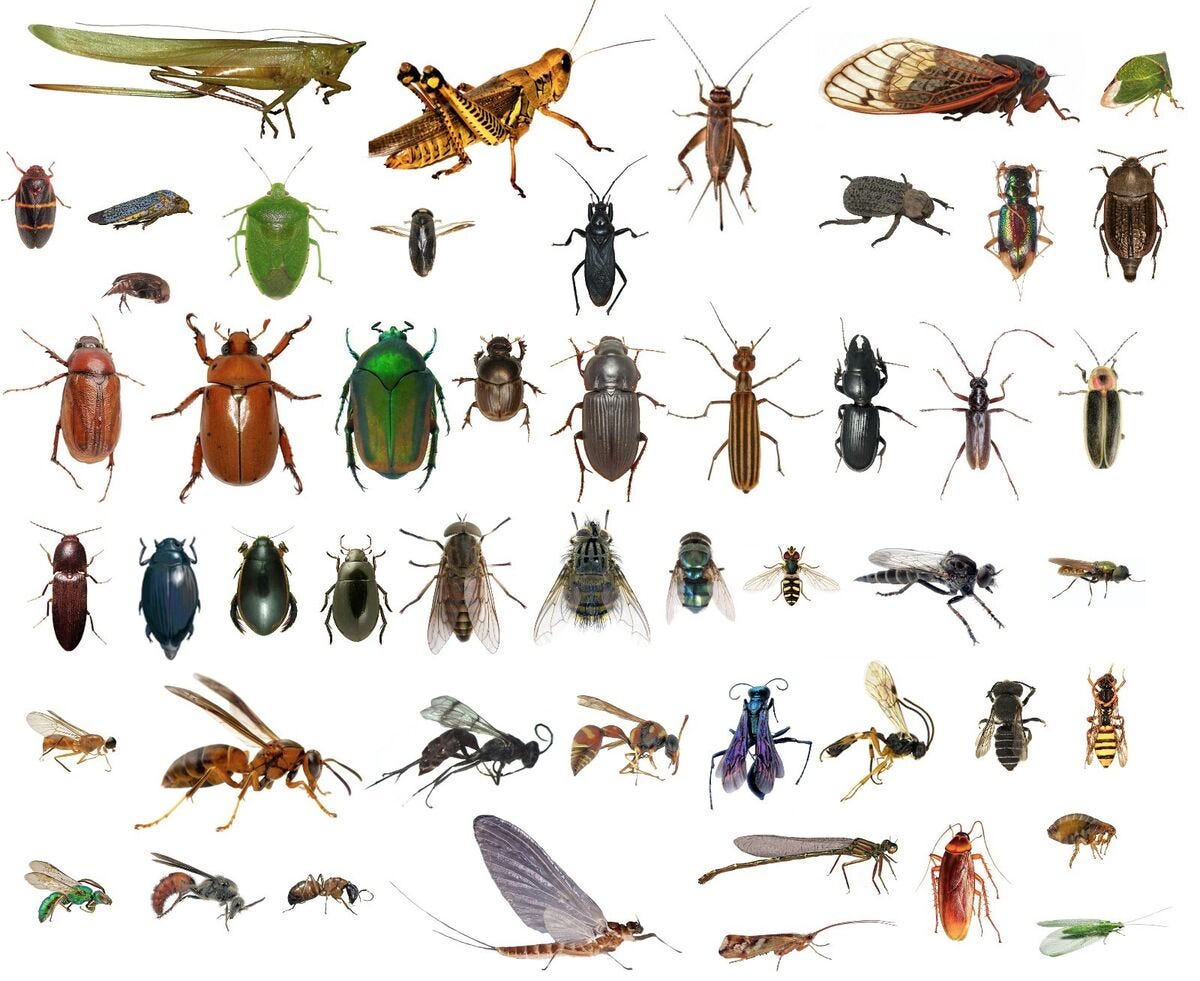
Okay. So, yeah. Politics, we agree, you know, not great what's happening currently. Woke left, also bad. One thing that we might disagree about is the bugs. I'm a big proponent of bug rights. So Mike, you accepted the repugnant conclusion that if there were a sufficiently large number of people with barely worthwhile lives, then the world of that would be better than one with just like 10 billion people with amazing lives. Do you accept the rebugnant conclusion that how we treat bugs is like the most important moral priority by all?
00:38:34 MICHAEL HUEMER
I mean, I was thinking that bugs are not sentient, so I was thinking they would count for nothing. I'm not completely sure of that. Yeah.
00:38:47 MATTHEW
So by kind of conservative estimates, it looks like about three trillion bugs die a second. And so if you think like that, or actually, no, sorry, I think three trillion was not that conservative, was like just like the standard estimate, but 300 billion by conservative estimates. If you think that like bugs probably aren't conscious. Well even if you think that there's a one percent chance that they're conscious and conditional on them being conscious there's a one percent chance that they're one percent as conscious as we are and just like there are so many of them that it just looks like the worst thing in the world and oh and by the way it's not like there are lots of things that are like you know there are like quadrillions of fish in the deep ocean and but we don't really have any effect on them okay but we've we affect quadrillions of bugs. We've reduced insect populations by maybe about 70%, according to some estimates. I've heard some people say those estimates are too high.
00:39:54 MICHAEL
But really, like across the world?
Not just in populated areas?
00:40:00 MATTHEW
Yeah. No, there's dispute about that. So it looks like that might be, you know, maybe more conservatively, it's more like 10%. But we're somewhat in the dark, but there are lots of estimates. Reduce the bug populations really by a lot. And so if you think bugs matter basically at all, then I think, or that there's even a tiny chance that they matter at all, there's just so many of them that in expectation, almost all suffering on Earth is had by bugs. And so then it looks like how we treat bugs is the most important thing in the world. Yeah.
00:40:37 MICHAEL
I don't know. Well, yeah, a couple of things. Well, OK. I mean, maybe there are more bugs than there are any other kind of animal, but, you know, you only have to count the ones that are being affected by us, right? So I don't know what the numbers are with that, right? So,
00:40:55 MATTHEW
So, like, just for a context, so Brian Tomasek did a sort of rough for me calculation, and he was pretty conservative in this number, so he assumed that we've only reduced bug populations by about 10%. He found that if this is right if you give a dollar to Givewell that reduces the number of insects by about 14 000 that are alive at any given time um okay because the longer a person lives the more bugs they kill yeah and more humans equals more taking over habitats that once belonged to the bugs and so then fewer bug populations because the longer a person lives the more bugs they kill yeah and more humans equals more taking over habitats that once belonged to the bugs and so then fewer bug populations
00:41:44 MICHAEL
Yeah so i mean there are three things that i wonder about. Okay well I don't know I guess two things. Okay so one is like I'm not sure that they're sentient at all so like there's probably some minimum brain size or brain sophistication to be sentient and they may not be because you know like they all have like brains that are literally a millionth the size of a person's brain like that's a I think that's a typical thing right and then you know you might think well okay like even if they are sentient maybe they're only a millionth as as sentient if they're degrees of awareness you know but it might also be just might also just be zero because you have to reach a certain threshold to be sentient at all. The other thing that I worry about is I'm not sure that their lives are overall good rather than bad. Is the life of an insect mostly pleasure or is it mostly pain? You know, even if they are sentient, it's not obvious that it's mostly good rather than bad experiences.
00:42:45 MATTHEW
Yeah. So I actually, I very much agree with the third point. And in fact, I would, I'd go a lot further. I wouldn't say I'm not sure whether they're more good than bad. I'm pretty sure they're more bad if they're conscious. And the argument for that is just most insects are r strategists, meaning they give birth to enormous numbers of offspring, very few of whom survive. So if you give birth to, you know, if you have 500 offspring and only two of them will survive, that means almost all of them die super young and painfully. And, you know, they often die from, like, starving to death or getting, like, partially crushed to death and then slowly dying over the course of hours. In any case, it's not the most pleasant, it seems like. I would say I think this this is a reason to be like very pro-civilization and the human species and saving lives it's even better than we thought because it just reduces bug populations and that's like just the most important thing in the world to reduce bug populations. Bugs suffering is just like many orders of magnitude bigger of a deal than poverty or war.
Regarding the point about bugs, just whether bugs are conscious or whether if they are conscious, they're very conscious. Well, even if you think they're only a little conscious, like there are enough of them that it's very important. And I don't think there's any good reason to think that having just physically small brains or brains with few neurons correlates with how intense your experience are.
So for instance, if you look at in humans, if you want to figure out how intense a human's experience is, you don't look at how many neurons they have active. And in fact, experimentally, that has basically no correlation and often an inverse correlation with the intensity of their experiences. Rethink Priorities commissioned a kind of long and detailed report where they looked at whether there was a correlation between neuron number and consciousness. And their guess was probably that neuron count is just not a very good proxy for consciousness. It's better to look at certain behavioral proxies, so how sophisticated the creature's mind is, what sorts of things it does. I think their overall estimate was that probably the intensity of insect experiences is within two orders of magnitude of the intensity of ours and maybe more after commissioning a pretty detailed report. And so if you think that has even any chance of being right, to me it seemed pretty reasonable, then I think that insect suffering ends up looking really important. For context, salmon and bees have similar-ish numbers of neurons.
I think we can be biased against insects just because they're really small. But if they were just physically larger, it would seem weirder to think that they just don't have any intense experience. In terms of whether they're conscious at all. I guess I think they are probably conscious. Insects, they respond to anesthetic. They make trade -offs between pain and reward. If you inflict some amount of pain on them in order to get food, they'll make a calculation of how much pain they're willing to endure for the food. If you if you give them anesthetic then they're willing to endure pain for the food. If they endure pain in a location they avoid it in the future in the future, they can become addicted to drugs. Some of them can communicate like bees, can do a bunch of smart stuff I think I think at the very least this is enough to make it sort of at least not totally implausible that they're more than minimally conscious.
00:47:05 MICHAEL
I mean so you know what I read was that there are these cases where like the insect has been grievously injured and it's still acting like normal, like it continues eating or continues mating even though like it's just had this absolute like mortal injury like you know his abdomen has been crushed or whatever. It's like lost a couple of legs and it's still doing its thing like which you would not possibly do right because the amount of pain that you would have…
You know about the about the correlation between neuron counting consciousness like I'm wondering how you could do a study on that because like how do you know the level of consciousness? What's the empirical test for the level of consciousness.
00:47:51 MATTHEW
Oh well the idea is just if you look at like more intense experience like you compare cases where people have really intense pain to cases where people have more mild pain and then you look at what the neural proxies are for that and actually the more intense pain generally has fewer active neurons yeah i mean that or like when people are on psychedelic drugs they seem to have like super crazy and intense experiences and then you look at their brains and their brains are actually less active than during normal waking life. And for anyone who's done psychedelic drugs, of course not not that I ever have or would [engage in] obviously deeply immoral violation of the law, I think it's it's generally clear that your experiences are more vivid than is typical.
00:48:43 MICHAEL
Okay I'm not sure how convincing that is. I thought would be that well like just a particular organism just like its total neuron count sort of effects it's kind of like how conscious all of his experiences are right it's just like because I have a lot of neurons just like all of my experiences are kind of somehow sort of like more more felt…
00:49:15 MATTHEW
I mean so right so you could pop but then I think if you thought that you would predict that in cases where humans have more active neurons we'd have more intense experiences, we'd be more like intensely conscious and then that that doesn't seem to be right. But also like humans have way more neurons than like cows and elephants have more neurons than humans and so you'd have to think that just like elephants’ experiences… If you try to linearly extrapolate from the number of neurons, then you'd have to think that one elephant is worth thousands of cows. Whoa.
00:49:53 MICHAEL
Wait. That sounds like an overstatement there, right? Isn't it?
00:49:58 MATTHEW
Let's see. How many times? I'm going to ask Claude. More neurons do elephants grow out than cows. Yeah, while you're thinking about that, I mean, so it's not necessarily just the neuron count. So just sort of like features of the brain in general. So like the insects are just going to have less sophisticated brains, fewer neurons, but like everything else that's going on, like whatever, total information processing capacity or whatever is going to be a lot lower. And a little bit like, you know, by like six orders of magnitude or something like that.
Yeah. So, so, okay. So I was wrong about cows. They only have about three times more neurons than cows. But they have about 1,300 times more neurons than chickens. And this is just because they're larger organisms, so they have physically larger brains. In other organisms, it's pretty unintuitive that the results you get from neuron count seem pretty unintuitive. And there are cases of humans just using a bunch of neurons, and then they don't seem to report their experiences being much less. I agree that insects have simpler brains, and for this reason we should think they're less conscious. I guess I would say that it doesn't seem like... I think taking that into account, my mean estimate would be within a few orders of magnitude of the intensity of our consciousness. And even if you think that there's only like a 1% chance that's right, there's so fricking many of them that like, it just ends up being the most important thing in the world by orders of magnitude. Yeah.
00:51:51 MICHAEL
Yeah. I mean, like it might be one of these things where like there's a small probability that it's super important. Right. And then, the greater probability is that it's not important at all, but you have to take it into account anyway because it might be super important.
00:52:13 MATTHEW
Yeah, I mean, I think it's at least decently likely that I would put it at more than 50 % odds that insects are conscious. And I can talk about the thing. I'll discuss your counterpoint in a moment. So if insects are conscious, even if you think they're only barely conscious, suppose you think you're so confident that insects are not conscious that you think that over the entire course of an insect's death, the total amount of pain that causes is only as bad in expectation as one human scraping their knee. Well, so it looks like maybe trillions of insects die per second. So what you get is like, insect suffering would be as bad if at any given time, there was just a population like, you know, like 10 or 100 times larger than Earth, who had just had the constant experience of scraping their knee. And like, that would probably be the worst thing in the world. Like the population way larger than the population of earth is just constantly experiencing mildly unpleasant pain that would be like the biggest deal in the world by a lot and so even if you're really conservative and you think that suffering is only that bad like it's the worst thing in the world especially if you correctly think that a lot of small pains can aggregate to be as significant as a single very large pain. Even if you don't think that you should think it's plausible enough that insects are above the threshold for being experiencing significant pain that it ends up being really bad in expectation.
00:54:09 MICHAEL
I think we sort of [have] similar practical views right because like most of the people would be saying this would be saying oh so now we need to stop killing insects right but but actually you think now we need to expand civilization which I guess we need to kill more insects. But I mean this does have some implications at the margins so like it'll maybe mean that like charities that save humans are better.
00:54:26 MATTHEW
We need to kill more insects but I mean this does have some implications at the margins. So like it'll maybe mean that like charities that save humans are better than charities that save farmed animals. Because if every dollar you give to GiveWell reduces the number of insects at any given time by about 14,000, given that insects are r strategists this way you know prevents a very large number of insects from from coming into existence.
00:55:16 MICHAEL
So I did one other thing about whatever consciousness is, you know i read a little bit about this but I'm not an expert on this, like how you think about how conscious something is but…
So I did say this stuff about the neuron count but I don't think it's that simple like it's probably a lot more to the brain than just the number of neurons, right? So like you know because it could be well it's partly about the number of neural connections and so okay so I think elephants have bigger brains than humans isn't that right.. They're not smarter than us but they're smarter than some people, but not than you and I.
MATTHEW
Certainly that's right yeah i could take any elephant in a chess match. The elephant would start knocking around the chess board with its trunk. I would completely wreck that elephant.
00:56:07 MICHAEL
Right you'd have no chance. In fact I bet it wouldn't even be able to move one of the pieces…
00:56:14 MATTHEW
It would surrender immediately just by knocking over it…
00:56:19 MICHAEL
But anyway it's more complex than just a neuron count and I don't know the details of everything that's relevant in the brain so the number of neural connections is relevant, it also might be particular parts of the brain that are especially relevant so like maybe the frontal lobes are more relevant maybe the neocortex is more relevant stuff. Like if something about the brain is going to lead to higher consciousness, lead to their being consciousness, and maybe higher levels, so I hope that the insects are not sentient I couldn't say that I know that they're not but I hope that they're not.
00:57:00 MATTHEW
There are different views about what proxies you should look at consciousness. I think the best work on the subject was done by Rethink Priorities, where they compiled a really detailed report looking at a bunch of behavioral proxies to try to estimate the extent of animal consciousness. For bees, I think their mean estimate was that bees experience pain 15 as intensely as we do okay and that might seem high but (1) bees are kind of they're like surprisingly smart like they're smarter than some fish and (2) other insects… also like if there's lots of uncertainty where we just don't really know the proxies for consciousness then like a lot of that was low probability that they're really conscious. So regarding the point about how insects, like you'll start eating them and they'll just like keep mating or whatever so there was a paper on this that's like very widely cited by Eisemann. I think you cited in your book where you're talking about why you don't think insects are conscious
There was a lengthy reply by Meghan Barrett called “The Era after Eisemann” where she goes over some reasons to be doubtful of the original findings of the Eisemann paper. I think there are a couple of points. One of them is what Eisemann did was based on observations of some insects in the lab in a few labs over the years. So even if you buy that that'll tell you that some insects are not conscious but it won't tell you that all of them are not conscious. Okay and once again even if you think only one percent of them are minimally conscious in expectation then it ends up being the most important thing so it wouldn't be that shocking if the simpler insects were not conscious but the super smart insects like bees are.
I mean not that as I said I could beat the bees in chess very easily and if they tried to do philosophy like they would just fail completely. Like if a bee tried to do philosophy you'd give them a thought experiment and they'd probably say like oh that's not realistic. You give them the trolley problem and they're like oh what if the trolley became a bunch of balloons or something. They just start saying you know what if one of the people on one of the tracks is Adolf Hitler. Then what?
00:59:56 MICHAEL
Yeah. This reminds me that there was a science fiction novel by Cixin Liu where there are these conscious, intelligent ants. It's about a time in the distant past when dinosaurs and ants each had a civilization and symbiotic. It has the ants talking to the dinosaurs and stuff like that. And I found it unrealistic. You would probably really relate to it, and you'd be rooting for the ants. Now I'd be rooting against the ants. We need fewer ants. Yeah. In the story, it seemed like the ants were having a good time. Oh, okay. Then I'd be rooting for the ants. But it wasn't mentioning how many of them die when they reproduce.
01:00:40 MATTHEW
Oh, okay. Yeah, crucial oversight in the story. I bet many people were left wondering about that. Sent many emails to the author. What were the ants' reproductive strategies like? So a lot of the stuff in the Eisemann paper looked at like an insect will have been injured a while ago, so it'll have broken a limb, and then it'll walk on the limb or something.
But one thing that seems plausibly true of fish and also potentially true of insects, is that it looks like they have the immediate shooting chronic pain. Sorry, opposite of chronic pain, like the immediate shooting pain when you cut someone, but they don't really have chronic pain. And so if that's true, that would explain the findings of why they seem to kind of ignore injuries after they've gotten them, but when you do injure them for the first time, then they act very adversely. And this is kind of what you'd expect if insects have these really short lives. Having lasting chronic pain that influences their behavior in the long term isn't that beneficial. But just like, thing hurts them, they try to get away, would be more beneficial.
And also, in general, in humans... the reason why pain is beneficial is like if we feel pain in limb then we'll avoid walking on a limb but insects just have very different like skeletal structures it's not as damaging for them to walk on injured limbs and so for that reason I think you just expect like it's… I don't think we can be confident that insects don't feel pain from the fact that some of them some of the time when they're injured act like they're not…
01:02:41 MICHAEL
Yeah. Yeah, no, it seems like somebody should do more experiments and see, like, you know, injure them right before you observe the behavior and see what happens there.
01:02:54 MICHAEL
Yeah. Yeah. Do we know about, like, the nerve cells that are in the limbs and stuff like that? Like, are they sending pain signals?
01:03:02 MATTHEW
Yeah, insects do have nociceptors. Yeah, now there's a further question about whether they actually experience pain or they just have like harm-like sensors to damage but at least some evidence that they feel pain.
01:03:16 MICHAEL
So obviously you know about the Problem of Other Minds, right, and you can't actually prove anyone's having experiences. So you know you might think oh okay so like they respond to anesthetics like I've heard that but you know the hypothesis wouldn't be that there's nothing going on like when the nociceptors are stimulated. Right it'd be that there's just some mechanism, some like sort of stimulus response mechanism, and it responds to bodily damage or something that causes pain-like behavior, but maybe there's nothing going on inside, and think okay so it responds to anesthetics but you would kind of expect that, right because it's going to be deactivating whatever you know maybe the activity of the nerves that we're sending the pain signals or whatever circuits are in the tiny insect brain that would lead to the pain behaviors deactivating. So you might say though like oh it was kind of unfair because well you could also hypothesize that other people aren't feeling pain because you can only observe their behavior, you can't like observe their pain and maybe people are just stimulus response mechanisms and you just deactivate part of that mechanism.
01:04:31 MATTHEW
I agree, the inference as you get to minds less like ours is get sketchier and sketchier. So like we can be almost certain but not quite we can be certain that we're conscious, we can be almost certain but not quite that other humans are conscious, we can be very confident but a bit less less certain that like other mammals are conscious, fish we’re even more uncertain, and then insects we’re even more uncertain than that. Yeah, the being sort of like behaves in a bunch of ways as if it's conscious and in a bunch of ways other than just like avoids things that harm it, like you know it responds to anesthetic and so on. I think it's at least plausible that it's conscious, and that’s all that's needed for the rebugment conclusion is that it's not like super improbable.
So are you gonna become a big bug rights activist advocate, for bugs to have the right to be killed to prevent their being
01:05:39 MICHAEL
A bug anti-right activist, it would that be respecting their rights actually well anyway they probably wouldn't have rights…
01:05:52 MATTHEW
Yeah yeah a bug anti -right activist that's right… but yeah a bug welfare activist. The best thing for them is to not exist and right because [their] welfare level [was below] zero…
01:06:16 MICHAEL
Yeah, maybe there are tiny disembodied bug souls, right, that are waiting to get embodied in a bug body, and those souls have a right to not get embodied. And so we should try to prevent that.
01:06:29 MATTHEW
Yeah, seems right. Yeah, one practical takeaway is if you think insect suffering is really important, probably you shouldn't eat insects because you need to eat just huge, like they're really small, so you need to eat huge numbers of them in order to like feed yourself for a meal and we should be pretty concerned about insect farming where there are some organizations like the Insect Institute that are trying to reduce the extent of insect farming. Where that that seems pretty good because we're like breeding trillions of them in hellish indoor conditions oh and then by the way we feed them to tortured farmed fish So it's not like they're being fed to humans as a replacement for factory farming. They're in fact being fed to factory farmed animals. So it doesn't seem good.
01:07:23 MICHAEL
Wait, what insects are we raising on farms? This sounds disgusting... Who wants to eat insects?
01:07:30 MATTHEW
So we're raising mostly, I mean, different ones, like, you know, we raise silkworms for silk, but the ones that are being eaten are primarily black soldier flies. And they're mostly, right, so people don't want to eat them. And so what they do is they feed them to farmed fish. I see. Because they're like cheaper or something than the other food. I mean, it's mostly a fairly small industry, but it's likely to increase. Right now, it's only like a trillion black soldier flies, but it'll be like 30 trillion, it looks like, in the not too distant future.
01:08:10 MICHAEL
Okay, yeah. All right, so let's stop doing that, I guess.
01:08:15 MATTHEW
Yeah, you're going to shut down your black soldier fly farm.
01:08:22 MICHAEL
Yeah, I guess I'm going to stop eating fish. I wasn't eating fish, but that would be another reason not to.
01:08:32 MATTHEW
So one of the replies to your book, Dialogues on Ethical Vegetarianism, well, it came from Bryan Caplan, where he says that you appeal to this ethical principle. You shouldn't cause others tons of extreme agony for small personal benefit. But that's just crazy when you think about the implications. It implies that you don't get to torture trillions of bugs for slight personal benefit. It implies that if your action to drive to this store... cause deleterious effects huge numbers of bugs it would be wrong.
And it's just almost feels like there's something different going on when Bryan Caplan does moral reasoning than when I do. Where it almost feels like what he's doing is an exercise, and just like finding things about the world that would sound weird and then if you can like offload them onto the opposing view then like that's a cost for them when like no of course if if it turned out that by your action to drive to the store you just caused like huge amounts of agony for tons of creatures and it was for small personal benefit like of course that would be morally wrong, because suffering is bad. This isn't because we can do calculus or are smart, the badness of your headaches have nothing to do with how smart you are, and like so for causing this to these creatures that are not smart but they were just causing them huge amounts of agony like obviously that that would be wrong.
01:10:18 MICHAEL
It'd be very inconvenient that it's wrong but reminds me of okay this is another reference to Cixin Liu the science fiction author. In the Three Body Problem, there's a point where okay so the aliens the trisolarans, they've been doing these advanced physics particle experiments and at some point they discover that when they do these experiments they're actually destroying entire universes. Okay and then the the alien decides to use to give an argument that destroying other civilizations is not a big deal because like yeah we just destroy universes all the time. So like it's not such a big deal if we go and destroy the Earth, we kill the humans, no big deal we've been doing that all along.
Okay now you know that's obviously bad but you can sort of understand the feeling or you can sort of understand like what they would be appealing to. It's not totally implausible that there would be some psychological influence in this direction if you find out that you've been doing this all along then you sort of like downplay how important it is and then other horrible things that are similar start to seem better.
Like that's the Bryan Caplan thing right?
01:11:35 MATTHEW
You can imagine some hypothetical economist in this world named Schmyan Schmaplin uh who who who thinks that that this vindicates it completely.
01:11:46 MICHAEL
Yeah that was probably the guy in the trisoleran civilization was making that argument.
MATTHEW
Yeah i remember I remember one thing you said in your book that I found quite convincing is: If the world is weird, just as a matter of fact, then there should be weird ethical judgments. So like you were responding to the charge that factory farming is the worst thing in the world is weird. Like what's unintuitive because we don't normally vividly consider the fact that we're torturing a population as large as the number of people who have ever lived every two years, causing more agony in a few years than has ever existed in all of human history. When you take into account that fact that the world is weird and that that we're just doing way more bad stuff to animals than to people then it stops seeming as as weird and I think that's the thing about insects. That we massively affect the lives of quadrillions of insects, and we don't think that's bad just because insects are small and weird looking, and it's inconvenient to care about them. And so we just never feel empathy for them. So given that our moral judgments are largely driven by emotion, no one has any emotions about mistreating insects. So just no one cares about it, even if they're convinced abstractly that it's a bad thing. No, that's right.
01:13:16 MICHAEL
I mean, yeah. So, you know, like here's a somewhat more kind of more general thing, right? You know how they say you can't infer an ought from an is? Now, maybe that's true, maybe that's not, but surely you can't go the other way, right? Like you can't just take your moral judgments and then figure out the descriptive facts of the world from your moral judgments, right? Like something has gone wrong there, okay? So like that's kind of like what the Caplan argument is doing.
Or like the argument that we're doing this all the time and now that wasn't his argument like we're doing this all the time so it can't be that bad but that is psychologically what's going on, right? The fact that you realize that you're doing the thing all along like we're all doing it every day in actions that we're used to and we're used to thinking are perfectly fine, they're constantly having this effect that we don't think about but when we attend to the fact that we're constantly having this effect then that is creating a psychological influence to judge that effect not to be so bad, right? But that's clearly bad reasoning because you can't figure out it just like from your sense that the thing is okay.
01:14:32 MATTHEW
Like if you have a sense that the thing is okay because you haven't considered important facts about it then you can't use that sense to prejudge whether those important facts about it are true. Like you can't say oh of course driving to the store is fine without considering the impact on insect suffering and say thus it must be that insect suffering is important if your intuition that driving to the store is fine was formed without thinking about the impact on insect suffering. Now I think that driving to the store is fine, it's perhaps even praiseworthy, because it makes there be fewer insects.
01:15:13 MICHAEL
I realized that what i was saying there was unclear and I think I got confused there, because it's it's more like the inference is this is common so it's not so bad, right? So like just the facts about often something is going on shouldn't influence your judgments about the fundamental moral values, but it clearly does.
An example that i gave when I wrote a reply to Caplan on this, was like, imagine we discovered that, actually, this is kind of similar to your example, but we discovered that bacteria were just super-smart and intensely conscious. This would have really inconvenient ethical judgments. This would imply that basically every time you take antibiotics, you're committing genocide of an intelligent civilization. But this wouldn't be a good reason to think, well, then I guess if you're really small, you don't matter. It would just be a reason to think the world's really ethically inconvenient so that the right ethical views imply very annoying things. It feels like people go the other way, where they just assume our ordinary practices can't be unjustified without considering the relevant facts, and then use that verdict to assume that the relevant facts have to turn out so that our ordinary moral practices are not justified. I mean, sorry, are justified.
I mean, I don't know, it's repetitive, but, you know, you can get a radical ethical conclusion if the facts are surprising. Yeah we shouldn't be surprised that somebody gets like this you know radically revisionary ethical view if it turns out that there's a bunch of facts that like our common sense moral views didn't take into account and that are really surprising. If every time you scratched your ear an infinite number of people were tortured to death it would scratching your ear would be the worst thing you ever did.
MATTHEW
In fact it would be so bad that you should probably preemptively kill yourself just so that we don't actually hear.
01:17:34 MICHAEL
I would just have our ears amputated, yeah. Yeah.
01:17:40 MATTHEW
It's silly to say, well, we all know a priori that scratching your ear is fine. Oh, it's so ridiculous to think that our ordinary practice of scratching your ear, it's a Moorean fact that we get to scratch our ear. Yeah.
What a bizarre stance. For one, if it was technically feasible to extinct mosquitos, we should do that.
I would like to hear Bryan’s response to the Three Body Problem analogy and “if the world is weird, then you should expect your morals to be weird.” “Weird” I think means “different from the ancestral environment.” While our ancestors knew there were thousands or millions of insects, they had neither the ability nor evolutionary pressure to help them, so they didn’t develop empathy for the tiny things. Why isn’t this reason to care more about insects?