

Mike Huemer is the greatest philosopher. It is no hyperbole to say that he “taught me how to think.” He is also a confirmed ethical vegetarian who practices what he preaches.
Nine years ago, I wrote this piece arguing that insects provide a strong reductio ad absurdum to Huemer’s view. If animal suffering is morally important, then insect suffering is morally important, which implies that even the most seemingly innocuous activities — driving a car, building a house — are morally monstrous. Since this conclusion is absurd, we should reject one of the premises. Namely: We should reject the view that animal suffering is morally important. Instead, contrary to ethical vegetarianism, the badness of suffering heavily depends on the intelligence of the sufferer. In the subsequent multi-round debate (see all of the links here, plus all of part 5), Huemer produced this graph, which nicely summarizes my broader view:
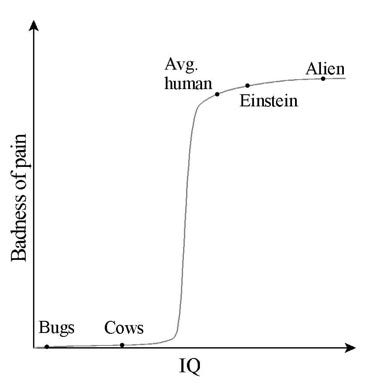
In terms of persuasion, I have probably never failed so badly in all my life. At least two smart friends subsequently told me that my arguments were bad enough to convert them to the opposite of my position. Predictably, though, I still say I’m right and Huemer is wrong. Which leaves myself and the best philosopher at an impasse, alas.
Why don’t I just defer to the best philosopher? Because, I insist, Huemer’s not following the rules of good thinking that he taught me:
The fundamental fallacy of rationalism is the idea that human knowledge proceeds from the abstract to the concrete, from the general to the specific; that one arrives at particular judgments by applying pre-given abstract rules to particular circumstances. The evidence of human experience stands almost uniformly against these assumptions, in virtually every area of human intellectual endeavor. In the sciences, one does not begin with an abstract theory and then use it to interpret experiences. If one wants to develop a theory, one begins with a large collection of concrete facts; patterns may emerge and explanations may suggest themselves, once one has collected a sufficient body of background facts. One’s theories must conform to and be driven by the concrete facts, not the other way around…
The same is true in philosophy. [I]f we wish to arrive ultimately at some general theory of ethics, we must start from a variety of relatively concrete, particular ethical truths. It is those who proceed in the opposite direction—declaring some general, abstract theory and then demanding that the particular facts conform to it—who are responsible for the mountains of failed (and often absurd) theories that dominate the landscape of the history of philosophy.
Imagine how I felt, then, when I discovered that Matthew Adelstein had interviewed Mike Huemer on insect suffering. In our debate, Huemer maintained that insects probably don’t feel pain anyway, so my reductio ad absurdum never even gets off the ground. I knew that Adelstein, in contrast, agrees me with that bugs feel pain, and Huemer on ethical vegetarianism. So what would the two of them say?
See for yourself in the video below, starting around 38:50. I’ll be replying in the near future.
As usual with your posts on “ethical vegetarianism,” you don’t seem to have bothered to find out what ethical vegetarians actually say or think. You briefly mention “suffering,” but you aren’t making any real argument about suffering. As usual, you’re implicitly assuming that all we care about is deaths. But no, not all deaths of nonhuman animals are equally important, and most ethical vegetarians don’t say otherwise. Most of us are focused on the animals’ whole lives in factory farms more than on the exact moment of their deaths. So there’s nothing inconsistent about caring more about the pig kept in cruel conditions throughout his/her life than about an ant living a normal ant life until suddenly being killed by a car — too fast for the ant to feel anything.
Also, even if vegetarians should treat insects better than they do now, that doesn’t invalidate our arguments about other species. At worst, that means we’re imperfect. Would you say the American founders’ writings should be totally dismissed because they were inconsistent and hypocritical on some fundamental issues, such as women’s rights and slavery? No, we should benefit from their best principles while realizing that it took a long time for those principles to be applied to more and more of society. Progress takes a long time, often on the scale of centuries or even millennia. It’s entirely arbitrary to say that the current thinkers or activists need to have gotten every issue right or we won’t take anything they say seriously.
Most of your posts on other topics are excellent, but your posts about vegetarianism and animals consistently suffer from these blatant oversights. What’s the point of repeatedly posting about this topic when you haven’t learned the first thing about it?
It's awfully convenient for you that, according to the graph that represents your view, almost every animal besides humans have neglible moral worth, but then it spikes such that even the dumbest humans have moral worth. It'd be very inconvenient for your life if even some very smart animals like golden retrievers or parrots had significant moral weight. It'd also be very inconvenient for your life if the dumbest humans, like those with severe autism or Downs syndrome, had animal-level moral worth, if only because it'd inspire a lot of rage at you. It'd also be very inconvenient for you if you thought the smartest humans/aliens/AI could have more moral worth.
None of that is outright inconsistent as a moral theory. It's just very, very suspiciously convenient.