

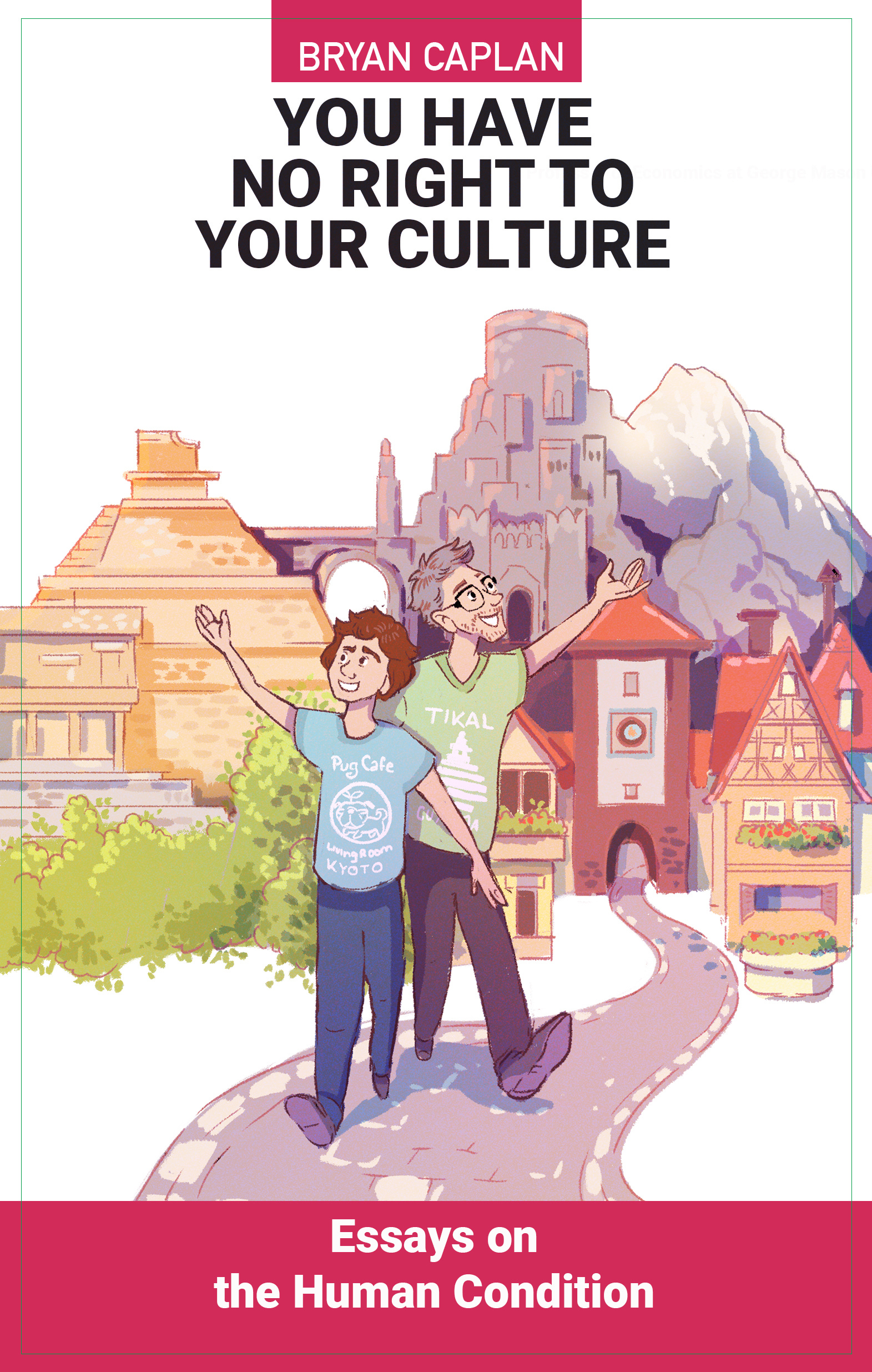
Almost everyone embraces “cultural” critiques of capitalism. The left has “cultural studies“; the right has the mantra, “We’re a country, not an economy.” The upshot, in both cases, is that government ought to do something about culture. Freeze it in place? Force it to progress? Turn back the clock?
My latest book of essays, You Have No Right to Your Culture: Essays on the Human Condition, flips this narrative. All of these demands for “reshaping culture” are thinly-veiled calls for coercing humans. As the title essay explains:
[C]ulture is… other people! Culture is who other people want to date and marry. Culture is how other people raise their kids. Culture is the movies other people want to see. Culture is the hobbies other people value. Culture is the sports other people play. Culture is the food other people cook and eat. Culture is the religion other people choose to practice. To have a “right to your culture” is to have a right to rule all of these choices — and more.
What’s the alternative? Instead of treating capitalism as the root of cultural decay, the world should embrace capitalist cultural competition. Actions speak louder than words; instead of using government to “shape” culture, let’s see what practices, beliefs, styles, and flavors pass the market test. Which in practice, as I explain elsewhere in the book, largely means the global triumph of Western culture, infused with an array of glorious culinary, musical, and literary imports. Nativists who bemoan immigrants’ failure to assimilate are truly blind; the truth is that even non-immigrants are pre-assimilating at a staggering pace.
After exploring the glories of cultural competition, the second part of You Have No Right to Your Culture explores the commonalities of human nature. While my critics often accuse me of econo-autism, at least I’m wise enough to see through humanity’s ubiquitous lip service. Anyone who actually “puts their culture first” would take drastic steps to avoid other cultures. Since almost no one takes such drastic steps, we can safely infer that actual cultural preferences are much cosmopolitan than expressed cultural preferences.
The third and lengthiest part of the book is a collection of economically- and philosophically-informed travelogues. Before finishing my Ph.D., the only foreign countries I ever saw were Canada and Bermuda. Now, I’ve been to over forty. A low count compared to Tyler Cowen or Christoph Heuermann, but more than enough to appreciate the universal values of free markets, cosmopolitanism, and managerial talent.
You Have No Right to Your Culture ends with essays on what I call “GMU econoculture.” Since I arrived at George Mason University’s economics department in 1997, my colleagues and I have carved out a unique perspective on what we really know, what really matters in life, how to push the research frontier forward, and how to have great conversations. Since I believe in cultural competition, this is my effort to sell the value of our cultural niche to the wider world.
Four years ago, I hatched a plan to publish eight books of my collected blog essays. I sifted through thousands of old blog posts, selected the top 5%, and organized them by theme. There was Labor Econ Versus the World on labor econ, How Evil Are Politicians on demagoguery, Don’t Be a Feminist on wokeness, Voters as Mad Scientists on behavioral political economy, You Will Not Stampede Me on non-conformism, Self-Help Is Like a Vaccine on self-improvement, and Pro-Market and Pro-Business on free-market economics. Now, with the publication of You Have No Right to Your Culture, I’ve finally completed the project.
As usual, you’re free to just search the Bet On It archives to read the whole book for gratis. But in exchange for just $15 for the paperback or $9.99 for the e-book, you get a pretty and curated package. Since I start blogging 22 years ago, I’ve striven to write pieces of lasting value, not trite and emotional commentary on current events. If you’ve read this far, I think you’ll agree.
P.S. I’m happy to do podcasts, interviews, and other promotions of the new book. Just email me to set something up. ;-)
P.P.S. AMA on all things cultural tomorrow!
And if the immigrant culture considers your women to be whores and has no moral scruples about raping them? Then what, Dr Caplan?
How cultivated.