

Here is Hyrum Lewis’ reaction to last week’s guest post by Spencer Marlen-Starr.
Dear Marlen and Bryan,
Thanks for keeping me in the loop here and continuing the conversation about our competing views on the nature of ideologies. Marlen, I appreciate the effort you’ve put into developing empirical tests to adjudicate between our theories.
Since the test of the truth of any theory lies in its predictive value, then I can only applaud your efforts to come up with a rigorous test of our theory. If our theory is not testable/falsifiable, then it’s not a valid theory.
Having said that, I think there is some misunderstanding about what we are claiming which I tried to clear up in our earlier exchange with Bryan on his blog. It’s reflected in his response to you:
Interesting. But since the Lewis brothers say their theory is 100% right, partisan cues should ALWAYS overpower doctrine, right?
The big confusion many people have about our theory (and again, it’s our fault for not being clearer and more up front with our central claim) is that when we say “ideology is 100% social” we are only talking about IDEOLOGIES and not IDEOLOGUES.
Marlen, you correctly pointed out that we believe there are “anchor issues” that will not be changed by social cues. E.g., my mom is adamantly pro-life—she has changed her views on tariffs, the importance of character in public officials, the wisdom of the war in Iraq, etc. etc., but she would never change her views on abortion. Even if Donald Trump and the entire Republican establishment came out in favor of abortion rights, she would never change. She really is principled ON THAT ONE ISSUE, but the crucial point is that it’s just ONE ISSUE. So that’s why, in my last exchange with Bryan, I noted that I actually agree with him when he says that people’s ideological beliefs are probably about 85% socially determined. That percentage sounds about right to me. We are decidedly not saying that people’s views are 100% tribal, only that the packages of views that we call ideologies (“conservative,” “progressive,” “right wing,” “left wing”) are 100% tribal.
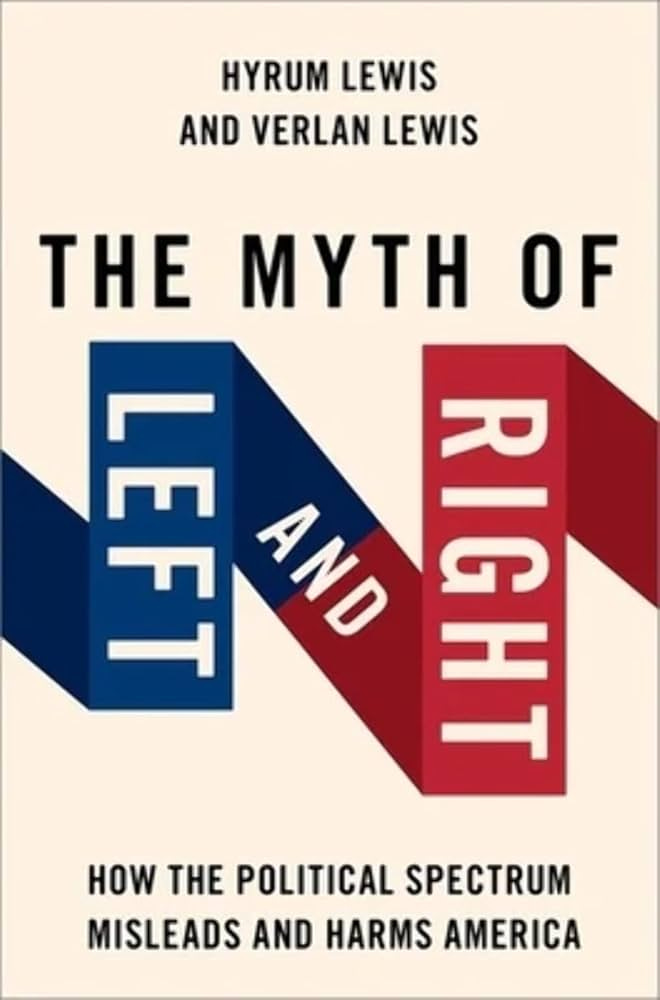
That is a subtle but crucial distinction. Our entire thesis is this: that there is more than one issue in politics and therefore a single spectrum is inadequate and misleading since it treats politics as unidimensional. The apparent connection between the many issues in the left and right packages is 100% tribal, and 0% essential. We can best explain the correlation between one’s pro-life and anti-tax beliefs through social conformity, not through some deep, underlying “one big issue” (i.e., “essence”).
It’s a simple fact that people tend to hold their views in predictable packages (e.g., someone who is pro-choice on abortion is also slightly more likely to be pro-vaccine, anti-tariff, pro-affirmative action, pro-immigration, etc.). The question we are trying to answer is, “why”? The standard view says that it’s because these seemingly distinct issues aren’t really distinct. They naturally go together, bound by an underlying left or right-wing essence. And since, according to this view, there is just one big essential issue in politics, then it’s useful to model this one big issue using a political spectrum.
We are saying that, actually, they are 0% connected by an essence and 100% connected by social conformity. It’s the connection, the package, THE IDEOLOGY that is 100% social. Our contention is that there is no “one big issue” binding these views together, only socialization. That’s what we mean by 100% social. What do abortion and tariff policies have to do with one another? Nothing. The tie between these two issues is 100% social and 0% essential.
But we are not saying that nobody has any principles and that ideologues will change 100% of their views with social priming (if we ever said or implied that, we were wrong). Is it possible for a feminist to be principled in being pro-choice? Of course! Will she change her views on abortion as her tribe changes? Not if it’s an anchor issue. Our theory doesn’t claim she will switch 100% of her positions as her tribe changes, only that the connection between the distinct issues of her tribe are 100% social. That’s a big difference. So a test to see whether people will switch all of their positions with social cues is not a test of our theory. It’s testing a misunderstanding of our theory. I’m sorry that we didn’t communicate better to nip this misconception in the bud.
Of course, the partisan cues studies are important to our theory, but not because they prove that everyone will change all of their views based on priming (I won’t, Marlen won’t, Bryan won’t, Verlan won’t, millions of Americans won’t). But they do show that 1) strong ideologues are more likely to change their views with social priming than non-ideologues, and 2) that this switching among strong ideologues shows that social conformity is sufficient to explain why unrelated issues tend to correlate. We don’t need to invoke a mysterious, invisible “one big issue to bind them all” to explain the correlation between seemingly unrelated issues. We just need to accept that they seem unrelated because they really ARE unrelated and it’s social conformity (largely driven by the myth of left and right) that makes people think otherwise.
Why did being pro-life tend to correlate with support for free trade twenty years ago, but not now? The essentialist theory can’t explain it, but the social theory can. It tells us that IDEOLOGIES will change as the tribe changes even if IDEOLOGUES themselves don’t always change because many of them will have “anchor issues” that are non-negotiable (Pat Buchanan, for instance, has always been against free trade, regardless of Republican flip-flopping on this issue).
Now, Bryan claims that, for all of the switching, the left is still generally defined by being anti-market because that is their key, bedrock principle. But as I’ve pointed out to him before, those coded as “left” and “liberal” in America were far more likely to favor of free markets than those coded “right” and “conservative” until around the New Deal era. Left-wing Jeffersonians were more pro-market than right-wing Hamiltonians, left-wing Jacksonians were more pro-market than right-wing Clay-ites, left-wing Cleveland was more pro-market than right-wing McKinley, etc. Even in our lifetimes, “liberal” Bill Clinton’s policies were far more pro-market than “conservative” George W. Bush’s. And, Marlen, as you reminded us, the left has become more free-trade than the right in the past decade while David Sears and David Pinsof have pointed out that the left has long been more pro-market when it comes to immigrant labor, gambling, drugs, abortion access, etc.
But the even more important point is this: even if Bryan were correct that opposition to markets is an enduring principle of the left, so what? That still doesn’t refute our thesis which says that there is more than one issue in politics and that these issues are unrelated and therefore shouldn’t be modeled on a spectrum. Bryan says the political spectrum is useful because it models the one big issue in politics—markets. But we are saying that there isn’t just one big issue; there are many and they are distinct from one’s belief in markets (e.g., immigration, abortion, drug control, gun control, aid to Ukraine, vaccines, War on Terror, gay marriage, transgender rights, etc. etc. etc.). Any correlation we see in the population between being more in favor of markets and being less in favor of immigration is 100% social. It’s not because somehow having an anti-change “conservative” disposition naturally leads one to love free markets, but hate immigration—smart, principled people, like Bryan, can hold consistent pro-immigration views regardless of tribe—but the correlation we see between being anti-immigrant and pro-market in the population at large is 100% socially constructed and 0% natural/essential. Contrary to convention wisdom, this anti-immigration, pro-market correlation has nothing to do with a “conservative” disposition (Bryan himself is living proof that they don’t go naturally together) and everything to do with social conformity.
So to summarize just so there is no misunderstanding about our theory:
The standard view says there is just one big issue causing all other issues to correlate and so a spectrum can accurately model that one big issue. Our view says that social conformity is causing the issues to correlate and so we should model each issue individually. In other words, we should simply do what we do in every other complex realm of life. Medicine, for instance, uses many spectra for the many distinct medical issues (infections, organ failure, cancer, skin rashes, etc.). It would be silly to place all patients on a single “medical spectrum” when there are many, many different medical issues—not one. We should likewise have distinct spectra for abortion, free markets, immigration, military interventionism, etc., because there are many, many political issues—not one.
So, yes, our theory is testable, but I don’t think the tests you have formulated, Marlen, would be decisive. Our theory would be falsified by tests which showed that the numerous issues considered “left” and the numerous issues considered “right” went together in the absence of socialization. For instance, we can test it by looking to see if the packages of positions considered left and right remain even as social context changes. We can test it by looking to see if these packages are consistent across space. We can test it by looking to see if these packages are consistent across time. A really conclusive test would be one in which we looked at the adult political views of identical twins raised in radically different socio-political environments (e.g., one twin adopted by an American family, the other twin remaining in a Chinese orphanage). If those twins wound up with the same views on markets, abortion, immigration, drug control, military intervention, gun control, gay marriage, vaccines, etc. etc., we would have to conclude that some essential inborn disposition, not social conformity, was causing those views to go together. But so far, all the evidence we are aware of supports, rather than contradicts, our theory.
(Contrary to popular belief, the twin studies done by Hibbing, et al. only showed that there are inborn dispositions to individual positions, but not inborn dispositions to packages of positions—their work, properly understood, actually supports our theory.)
Sorry to go on at length, but I think it’s important to clear up the misconceptions and get to the root of how to test our actual theory and not a misconception of our theory (a misconception I, once again, take full responsibility for).
Thanks for the stimulating insights and discussion, you guys,
Hyrum
Everytime I hear someone make the argument that there is no coherent Right and Left, I wonder how Wikipedia makes those nice election results graphics that almost perfectly place all political parties on the ideological spectrum.
Here is just one example out of hundreds of election results:
https://en.wikipedia.org/wiki/2025_Norwegian_parliamentary_election#Results
The reason is simple, because the Left/Right political spectrum is by far the easiest way to convey the policy stands of political parties in democratic societies. Pointing to exceptions does not invalidate the rule.
And claiming that they are really “tribes” doesn’t give proof that those tribes cannot be correctly arranged on the Left/Right spectrum. Wikipedia does it all the time.
The Left believes the government should implement major policies to fight Inequality and promote Equality, while the Right thinks other goals are more important. It is not complicated.
I do believe, however, that the Left/Right spectrum is largely useless for:
1) Traditional pre-industrial societies with emperors, kings, tribal/clan leaders, big men, and informal leadership within Hunter Gather societies.
2) Totalitarian movements and regimes, all of which share far more in common with each other than differences once you get beyond the terminology and symbolism. These include Communist, Fascists, and National Socialists.
This is a fascinating thesis and discussion. Thank you for sharing it.