

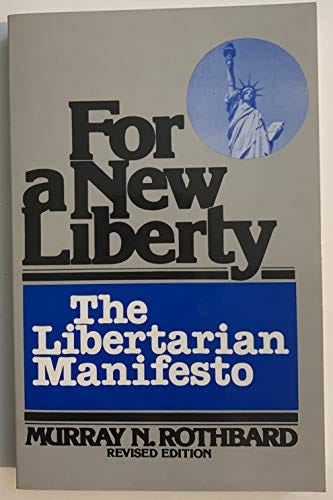
Here’s my plan: I’ll lead off each discussion of Murray Rothbard’s For a New Liberty with (a) a brief summary of the chapter of the week, and (b) some critical comments. But this is your book club, so in the comments feel free to not only to discuss my summary and critique, but any thoughts you had on the chapter at hand.
Summary
Since this book appeared in 1978, it’s hardly surprising that Rothbard tries to pull readers in by discussing the recent electoral success of the Libertarian Party. But this is only a hook — before you know it, he’s giving you a quick libertarian revisionist history of the United States:
How, then, explain the amazing growth of a new party which is frankly and eagerly devoted to ideology?
One explanation is that Americans were not always pragmatic and nonideological. On the contrary, historians now realize that the American Revolution itself was not only ideological but also the result of devotion to the creed and the institutions of libertarianism.
The next several pages cover America’s colonial and revolutionary history. Rothbard defends the view that has since become standard in libertarian circles: The American revolutionaries subscribed to an explicitly libertarian political philosophy of “life, liberty, and property,” which in turn led them to radical anti-government views:
Thus, the well-known theme of “separation of Church and State” was but one of many interrelated motifs that could be summed up as “separation of the economy from the State,” “separation of speech and press from the State,” “separation of land from the State,” “separation of war and military affairs from the State,” indeed, the separation of the State from virtually everything.
The subtext, of course, is that libertarians are the rightful modern spokesmen for the Founders, and that modern American political thought has betrayed its noble origins. Rothbard then recounts the story of the Fall – how the American libertarian experiment failed to endure despite its intrinsic merit:
Slavery, the grave antilibertarian flaw in the libertarianism of the Democratic program, had arisen to wreck the party and its libertarianism completely.
The compromise with slavery leads to the Civil War, which soon redefines the political landscape. The statist Republicans become the new agenda setters, and socialism becomes the voice of radical opposition to the status quo. The decaying libertarian intellectual movement falls into moderation, gradualism, and utilitarianism, and loses its practical and intellectual influence. But now it’s back from the dead, and ready to get America and the world back on track:
We have seen why libertarianism would naturally arise first and most fully in the United States, a land steeped in libertarian tradition. But we have not yet examined the question: Why the renaissance of libertarianism at all within the last few years? What contemporary conditions have led to this surprising development? We must postpone answering this question until the end of the book, until we first examine what the libertarian creed is, and how that creed can be applied to solve the leading problem areas in our society.
Critical Comments
It’s easy to see why libertarians love this kind of history. “We’re not pushing some weird new idea. We just want to fulfill the promise of the American Revolution.” And when you read the writings and speeches of the era, they sure sound a lot more like modern libertarianism than they sound like modern liberalism or conservatism.
My concern is that this affinity is mostly rhetorical. Patrick Henry and Thomas Jefferson give rousing speeches on behalf of human liberty. But slavery wasn’t just a “grave antilibertarian flaw”; it made the whole Revolution absurd. Of course, every revolutionary didn’t own slaves; but even to make common cause with the slaveholding philosophers of freedom to fight against minor British taxes is a libertarian travesty.
The consequences of the Revolution were as flawed as its origins. In practical terms, its main effect was to open up Indian lands to colonial genocide. A nationalist might manage to awkwardly applaud despite the ugly facts; but a libertarian?
Still, if Rothbard’s only point is that 18th-century political thought discovered many important truths, and modern libertarianism revives and refines these truths, I’m on board. But don’t expect me to cheer for the likes of “libertarian” Andrew Jackson, architect of the Trail of Tears.
The post appeared first on Econlib.
Bryan is sounding a bit too much like Ken Burns in attacking what was a genuinely libertarian ideological orientation of the American Revolution. For his part, Murray Rothbard wrote a massive five volume history (_Conceived in Liberty_ https://mises.org/library/book/conceived-liberty ) explaining his thesis about the Revolution as being the product of a long ideological, religious, and political struggle between liberty and power in the American colonies of Britain. One can scarcely do justice to his take on the libertarian nature of the Revolution without addressing the mountain of evidence he brings up in this monumental work of his.
Moreover, Rothbard didn't characterize slavery as being the "grave anti-libertarian flaw" of the American Revolution. Rothbard was specifically talking about the enormous success that Jackson and Van Buren had achieved in reducing the size and power of the federal government in line with libertarian principles, but noting that the Democratic failure to address the slavery issue according to the same libertarian principles was a grave flaw in their program that ultimately wrecked all their political achievements. I think there is more that one could add to this story (especially Polk's turn towards imperialism and conquest of western territories, which sparked a renewed conflict over the westward expansion of slavery), but Rothbard wasn't wrong about the specific point he was making.
I don't have enough space here to argue in detail for all things that are wrong with dismissing the libertarianism of the American Revolution as an absurdity, but I can at least state a few basic points:
(1) The vast majority of Patriots who actually instigated the Revolution were neither slave-owners nor interested in making war against natives. They created an underground organization, calling themselves the "Sons of Liberty," and advocated an ideology that was unmistakably libertarian (as confirmed by highly-respected historians like Bernard Bailyn, not just by Rothbard) to justify their struggle against the imposition of a corrupt mercantilist system upon America by British Tories. In what sense was their struggle not a genuinely libertarian revolution?
(2) Slave-owning Patriots who claimed to support the Revolution on libertarian grounds were not all hypocrites. Some of them (a notable example being Thomas Jefferson) supported emancipation, but were concerned about the ability of black freedmen to function in a white society and to get along peacefully with their former masters and thus looked towards gradualist forms of abolition, often coupled to colonization proposals. Someone like Rothbard would undoubtedly scorn such gradualism as a _de facto_ subordination of libertarian principle to other values, but it doesn't necessarily imply hypocrisy by those advancing such views, nor by the non-slave-owning Patriots who embraced them as allies in the fight against the British Empire.
(3) There is nothing in libertarianism that endorses land ownership claims that aren't founded upon actual physical possession of the land. This principle is crucial when analyzing the conflicts between white settlers and natives, because in many instances nobody was in physical possession of vast tracts of wilderness when the whites first showed up. The sense of moral outrage that modern progressives (and Bryan unfortunately) try to stir up about an alleged "invasion" of native lands by whites is based on the anti-private ownership philosophy of Jean-Jacques Rousseau that romanticizes the "noble savage" as a model of virtue, not on the libertarian-oriented philosophy of John Locke. This doesn't mean that Patriots didn't commit atrocities against natives, but it does give more credence to the grievance mentioned in the Declaration about the British instigating merciless savages to slaughter Patriots, a fear that was realized two years later in massacres at Wyoming, Pennsylvania and Cherry Valley, New York.
The principle of original appropriation by actual possession (what Locke described as "mixing labor with land") is also crucial in understanding conflicts between settlers and politicians, both in the British Parliament and in the colonial legislatures, who were attempting to grant vast tracts to their favorites instead of recognizing homesteading claims by the settlers. Settlers in Vermont and neighboring areas revolted against the New York and New Hampshire governments over this issue, but almost no historians apart from Rothbard even bother to notice this phenomenon, let alone explain the libertarian struggle of Vermonters over land ownership rights that was running in parallel with the American Revolution. Other frontier struggles between settlers and quasi-feudal land grantees are likewise ignored by historians who blindly accept land rights as arbitrary political constructs and fail to appreciate (as Rothbard did) the libertarian principles at stake.
I don't consider white-red relations to be genocide. No doubt there were some whites and reds who wanted to annihilate each other, but mostly it was just ordinary war and government meddling. The first white settlers had no way of knowing their diseases had already killed 90% of the natives. They arrived, found a lot of empty land, negotiated "sales" with remaining natives, and the language and cultural problems led to confusion over what it meant to sell property. The French and British paid different tribes to fight on their side, and the winners got the spoils of war, including revenge. The Plains Indians were mostly nomads, as I understand it, and fought each other over communal rights more than they fought the Europeans, as did most peoples, including Europeans.
Still a lot of injustice, but it was not by any means mostly evil greedy whites slaughtering innocent pastural reds. It was just ordinary human greed and misunderstanding by all parties.