

After Leave won the Brexit vote in 2016, lots of thinkers who accepted the economic case for high immigration started flirting with a political case against high immigration. While the details of this political case were often vague, one word was painted on its banner: BACKLASH. The central insinuation was that staunch support for high immigration is what philosophers call “self-defeating”: When immigration gets too high, voters reliably shift their support to right-wing populists, who in turn reliably slash immigration.
I’ve long maintained that the rhetoric of “immigration backlash” is classic motte-and-bailey. If “backlash” merely means “More immigration leads to more complaining about immigration” then the claim is almost surely true, but also trivial. If we allow a lot more nuclear power, people will complain more about nuclear power, but that hardly means that pushing for lots of nuclear power is in any way “self-defeating.” In contrast, if backlash means, “High immigration in the short-run leads to low immigration in the long-run,” then backlash is non-trivial, but also speculative. How exactly do believers in backlash know that the effect sizes are that massive?
They don’t. Even in the easiest case, figuring out the sign of the effect turned out to be hard. When Leave won the Brexit vote, I wasn’t convinced that the UK government would actually leave the EU. But virtually everyone, including me, took it for granted that if Brexit happened, immigration to the UK would crash. This recent graph from The Economist shows that assumption was totally wrong.
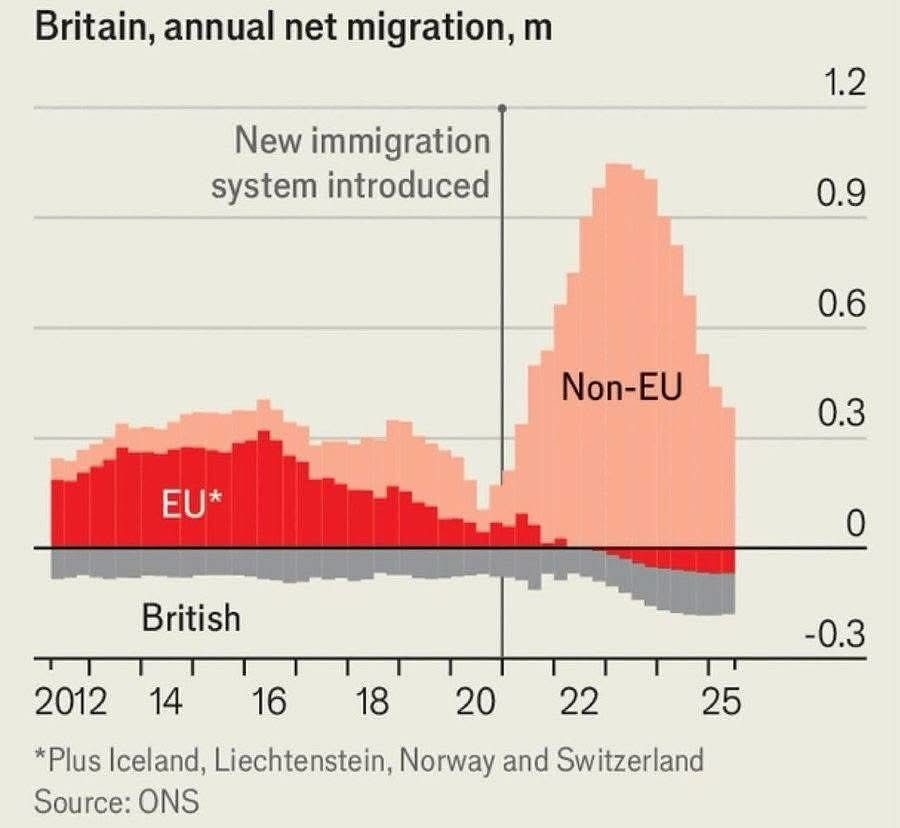
Yes, after the 2016 vote, net EU migration to the UK immediately started falling. By the time Brexit actually happened in 2020, net EU migration was near zero, and soon became slightly negative. But total net migration stayed roughly flat, briefly crashed (probably due to Covid, not Brexit), then almost immediately skyrocketed. At its peak c. 2023, total net migration was triple its prior peak c. 2015.
As a percentage of its population, this is equivalent to the U.S. raising immigration from about 1.5M a year to about 5M a year. Which, for us proponents of open borders, would be a miraculous triumph.
Upshot: If I had foreseen Brexit’s consequences, I would have been a staunch supporter of Leave. Sure, it’s logically possible that without Brexit, immigration would have risen even more. But I can’t think of any realistic scenario where that would be true. And while net migration is starting to fall, it’s still above the previous peak. If net migration fell to zero for a few years, it would take about a decade to outweigh the gains we’ve already observed. If you retort, “Wait and see,” I’m happy to bet the other way.
My point is not that Brexit’s pro-immigration effects were predictable. I didn’t predict them, anyway. My point, rather, is that everyone who raises the banner of backlash should, to quote the ancient Chinese proverb, “seek truth from facts.” They don’t have a crystal ball. They don’t perceive the hypothetical branchings of the multiverse. They just combine a reasonable yet fallible guess about the sign of an effect (“High immigration reduces political support for immigration”) with an unreasonable and fanciful guess about the magnitude of an effect (“High immigration reduces political support for immigration so drastically that pro-immigration policies are actually self-defeating.”)
Where do believers in backlash go wrong? They’re overconfident at every step.
When immigration gets too high, voters reliably shift their support to right-wing populists? Two of the biggest successes of right-wing populists happened in Poland and Hungary back when they had almost no immigrants. The crucial factors that handed Trump the 2024 election were probably inflation, plus the fallout of Biden’s dementia.
When voters shift their support to right-wing populists, do they reliably slash immigration? Brexit isn’t merely a weird counter-example. It is a canonical counter-example: One of the world’s core countries voted for less immigration — and got a lot more.
What’s going on? While immigration needs all the friends it can get, the sad reality is that many “friends of immigration” never gave the issue the supreme priority it deserves. They never accepted the moral truth that all people, regardless of their nation of birth, have a fundamental human right to work for willing employers and rent from willing landlords. They never accepted the moral truth that immigration restrictions are worse than Jim Crow ever was. They barely cared about the trillions of dollars lost from trapping labor in low-productivity countries. They never admitted that the Gulf monarchies have far better immigration policies than any Western democracy.
It’s hardly surprising, then, that a few hiccups led so many nominal friends of immigration to have second thoughts. If you think the rights to peacefully live and work anywhere on Earth are of minor importance, minor events — even quite ambiguous minor events — may change your mind. Once you take these rights with due seriousness, however, you’ll demand hard proof of massive political blowback before you’ll budge. And even then, you will steel yourself with the insight that immigration is worth losing for.
Without the 2015 migrant crisis, Brexit would have been far less likely. Immigration was not the only driver, but it decisively raised the salience of EU membership and tipped the close referendum. Likewise, the post-Brexit surge in net immigration is the primary reason Farage’s party is now polling around 30%. Across Europe, mass immigration is the single most important issue powering right-wing populism, even if it is not their only one.
For this reason, repeated references to the Gulf States as evidence that high immigration need not produce backlash are a false equivalence. Their apparent political stability rests on a fundamentally different immigration regime: migrants are permanently excluded from citizenship and the electorate. That design suppresses backlash by removing immigration from democratic contestation altogether.
If hundreds of thousands of migrant workers and their families in the Gulf were being naturalised, political instability would almost certainly follow. The lesson, then, is not that backlash fears are imaginary, but that citizenship policy is the key variable.
Advocates of liberal immigration should grapple seriously with the political limits of mass naturalisation. Ignoring those limits risks fuelling populist movements that ultimately threaten both immigration and liberal institutions themselves.
"As a percentage of its population, this is equivalent to the U.S. raising immigration from about 1.5M a year to about 5M a year. Which, for us proponents of open borders, would be a miraculous triumph".
I look forward to seeing you trumpet the great economic rewards of this open borders triumph going forward.