

At the semester’s first Philosophy, Politics, and Economics Workshop, Tyler Cowen talked about the political economy of the Mexican village of Oapan. (For all the details, see his Markets and Cultural Voices). According to Tyler, being the political leader of this village is a burden, not a blessing. As is often the case in rural Latin America, there is strong social pressure on the most economically successful villagers to take a turn at the helm. During his term, the leader is expected to basically burn up his personal fortune to pay for public services. If he persistently refuses, he loses a lot of respect… and maybe more. (Insert thinly veiled threats here).
This set-up is known as the cargo system. As one website explains:
In the context of the religious system that the descendants of the Mayan Indians practice the word “cargo” refers to a burden. These burdens are offices held by individuals within a community that consist of civil-religious duties that are to be carried out by the office holder. Office holders are required to use their own money to cover the expenses involved in carrying out these various duties, and often use all their savings in order to complete their terms.
If you want to avoid this burden in Oapan, Tyler explains that there are several common escape routes:
1. Avoid success. Those who have no money to spare aren’t pressured to lead.
2. Be a drunk.
3. Convert away from Catholicism.
Now think about how bad these incentives are. Any villager who wants to get ahead knows that if he does, he will have to either give away most of what he earns, or become a pariah, an apostate, or a drunk. Despite the low level of formal taxation, the effective marginal tax rate in Oapan is probably above Swedish levels. Tyler offered me a rough guess of 80%! With incentives that bad, it doesn’t surprise me that rural Latin America remains impoverished – though the localized art boom has turned Oapan into the exception that proves the rule.
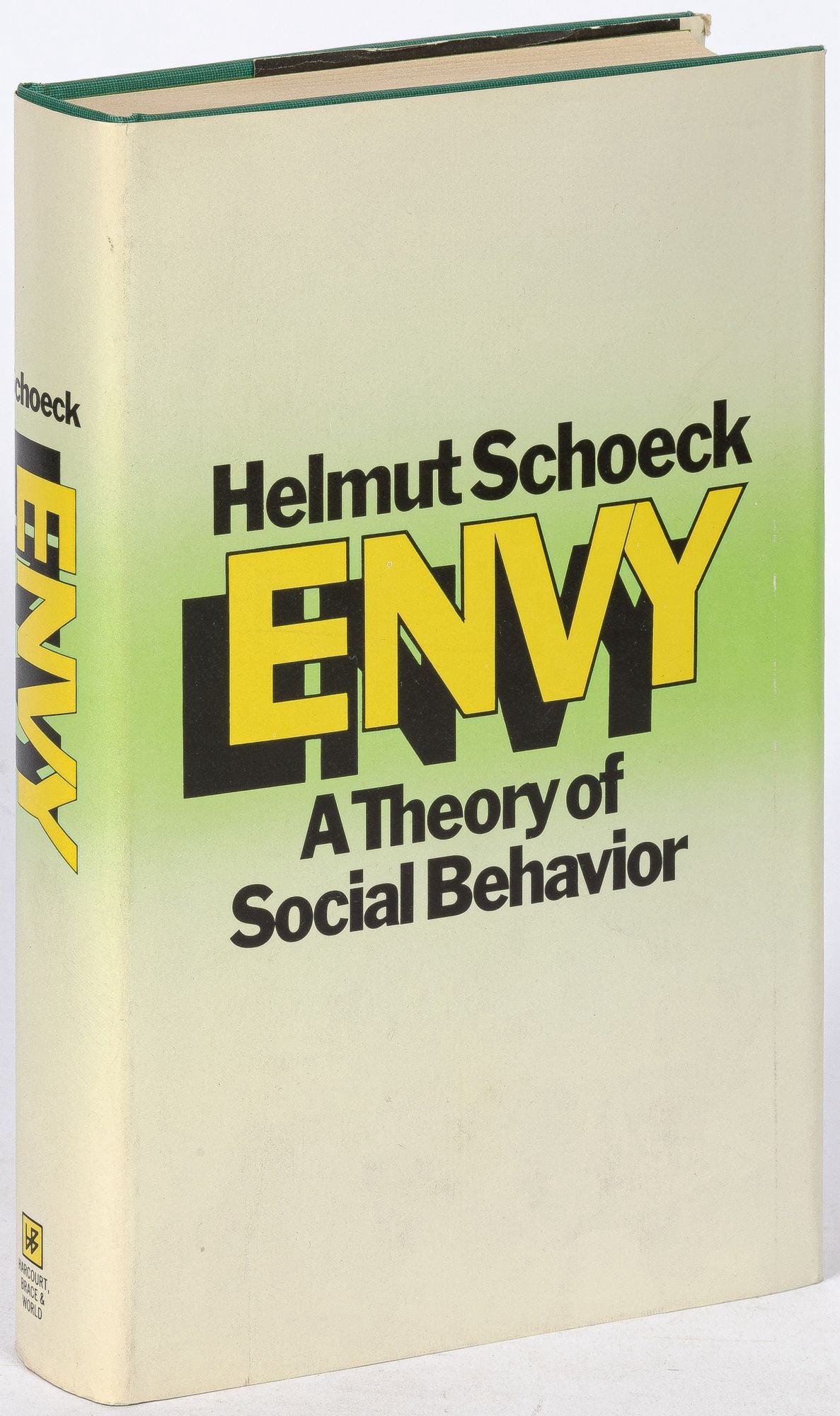
Tyler’s account immediately reminded me of one of my favorite books, Helmut Schoeck’s Envy. If Schoeck’s wide-ranging observations are correct, virtually the whole primitive world has something akin to the cargo system. If one member of a primitive tribe starts to be more economically successful than others, relatives, friends, and everyone else usually starts demanding hand-outs. As in the cargo system, this basically leaves two choices: either surrender most of your surplus, or become a hated pariah. And you know what happens to hated pariahs during a hunt! The upshot is that informal social pressure effectively gives primitive societies very high marginal tax rates – and very bad incentives.
I have a strong suspicion that these incentives of village life are a big part of the explanation for why it took so long for economic growth to take off. For hundreds of thousands of years, human beings were stuck in societies with informal norms that choked off creativity and entrepreneurship. No wonder the miracle of modernity took so long. For economic growth to really take off, the individual needed a relatively anonymous society where he could turn his back on his neighbors without worrying if an envious neighbor would sink a dagger into it.
The post appeared first on Econlib.
I remember once reading an article in "Cracked" that tried to argue against the idea that demanding the rich pay higher taxes is driven by envy and hostility. It used the analogy of Yoda and Obi-Wan telling Luke Skywalker he needed to defeat the Emperor in "Star Wars." They weren't demanding Luke step up because they hated him, they were demanding it because literally no one else could.
In theory that is a decent argument, but it isn't what politics looks like in practice. When people demand the rich pay higher taxes they usually insinuate that the rich are not paying their fair share, or that they obtained their money through illegitimate means. In "Star Wars," by contrast, no one accuses Luke of stealing his Force powers or not doing his fair share of evil-fighting.
It is pretty telling that no one says "We need money so the government can pay for stuff, we need to tax the rich because they are just so amazingly good at wealth creation that they have a lot of money. We should admire how heroic they are for creating the wealth society needs to function." I have often wondered if the left would be more successful if they embraced rhetoric that sort of rhetoric. Maybe the rich would be more amenable to paying higher taxes if doing so raised their status in society instead of lowering it. The fact that the left never tries it indicates they are too blinded by envy to try something that might actually work.
It sounds like the villages in Mexico are kind of trying to buy higher taxes with higher status, even if it isn't a conscious policy decision. The offices they expect wealthy people to perform do seem to confer some sort higher status on them. Maybe that's why the people in the village tolerate it and don't move asay. On the other hand, the low levels of growth in the area indicate that either the offices don't confer enough high status to make up for the 80% tax rate, or that 80% is too high for any amount of status for most people.
This envy also may also be behind why parts of Africa resist growth. We have an immigrant friend at church who was a successful farmer in central Africa so his neighbors ambushed him and poked his eyes out for no other reason.