

Don Boudreaux asks minimum wage supporters to answer two questions they should have asked themselves long ago.
Question #1:
Name some other goods or services for which a government-mandated
price hike of 25 percent will not cause fewer units of those goods and
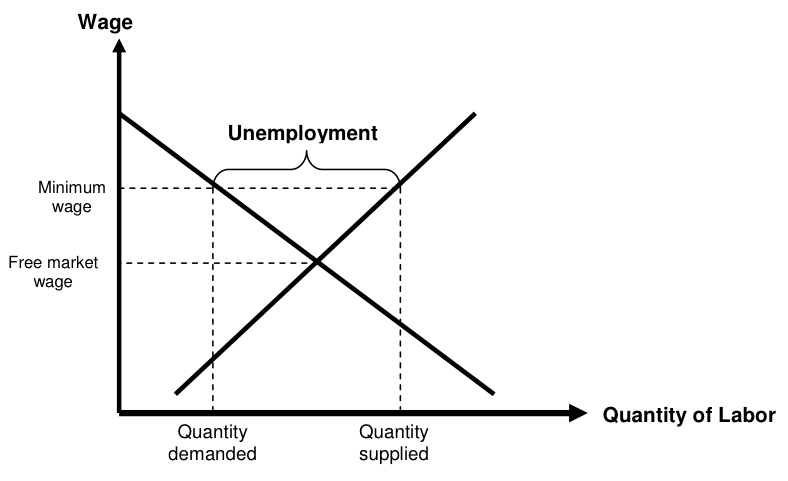
services to be purchased.Beer? Broccoli? Bulldozers? Coffee? Haircuts? Natural gas? Automobiles? Housing? Preventive health-care? Lawn-care service? Tickets to the movies? Smart phones? Subscriptions to the New York Times? Books by Paul Krugman? Professors of sociology? Assistant professors of economics? Any of these products work for you? If none of these work, surely you can name at least one other for which a 25-percent price hike will not cause fewer units of that product to be purchased. Or does low-skilled labor just happen to be the one good or service in the entire world for which a government-mandated 25-percent rise in the price that its buyers must pay for it will not diminish buyers’ willingness to buy it?
Seriously, name just one other good or service for which you believe that a government-mandated price-hike of 25 percent will not reduce the quantity demanded of that good or service.
Question 2:
[B]ecause if Mr. Obama’s full proposal is enacted the national minimum wage will also from here on in be indexed to inflation, here’s another challenge to anyone who dismisses as unscientific or ideological the standard economic argument against the minimum wage: name one other good or service whose real price, according to economic theory, should never fall relative to the prices of other goods or services?
The least-bad answers to Boudreaux’s Question #1 that occur to me probably salt and soap. As Oskar Lange asked in 1937: “[W]ould a decline of the price of soap to zero induce them [the “well-to-do”] to be so much more liberal in its use?” By the standard of 1937, almost everyone in the First World is well-to-do today. For Question #2, I’m utterly stumped.
The post appeared first on Econlib.
I can't think of many goods where monopsony power exists because I'm lucky enough to live in a world where it's rare, even in labor markets. The one possibility that comes to mind is the relationship between the government and defense companies like Raytheon, but even those companies are allowed to sell to foreign governments, albeit after jumping through some hoops.
I don't think it's that unreasonable to believe monopsony power mostly occurs in the labor market, but I also wouldn't consider the minimum wage to be the first line of defense against poverty. Its proper application may be in a very small number of areas where options for employment are few, should they exist.
If the market price for the good is already more than 25% above the legally mandated floor, than a 25% rise in that floor will have no effect. If the least-skilled jobs in the economy already pay $15/hr, then a rise from $7 to $10 will not change the amount consumed.