

The United States almost bans nuclear power. Yes, the government allows existing nuclear plants to keep running, producing 19% of all U.S. electricity. But getting a new nuclear reactor approved — much less a whole new nuclear plant — is next to impossible.
Two new reactors came online in 2023 and 2024, each taking over a decade to build. Construction on the last previous reactor began in 1973, and finished (after long interruptions) in 2016. “Construction time” and “construction cost” are driven mostly by regulation. Construction on the earliest U.S. nuclear plant started in 1956. Without the benefit of any learning curve, the plant came online only four years later. Per-kilowatt construction cost multiplied 5-10x between the 70s and today.

Given this draconian regulation, you might think that Americans absolutely detest nuclear power. If you take a hasty look at public opinion, however, that looks totally false. In 2010, for example, the General Social Survey asked: “Which statement best describes your own view about increasing the use of nuclear power to generate electricity in the U.S.?” Proponents outnumbered opponents about 2:1.
Relatively speaking, however, nuclear is definitely unpopular. In 2010, the General Social Survey measured Americans’ hopes for the future of energy. Nuclear power was virtually the least-preferred option:

What’s going on? Sifting through the GSS, the U.S. public embraces virtually every specific scientifically illiterate anti-nuclear fear you’ve ever heard of. Let’s walk through the key questions in General Social Survey, one by one.
Question #1: “In general, do you think that nuclear power stations are dangerous to the environment?”
Result: Even though nuclear power has a fantastic track record for both cleanliness and safety, Americans greatly fear environmental harm. And the fear has gotten markedly worse over time.
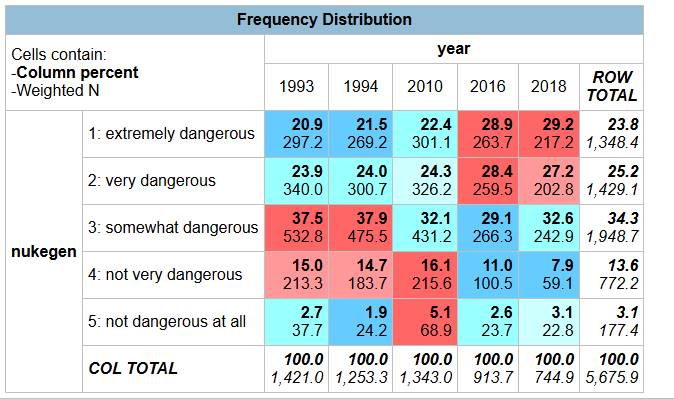
Question #2: “Within the next five years, how likely is it that an accident at a nuclear power station will cause long-term environmental damage across many countries?”
Result: This question was only asked in 2000, but the fear was again intense — and totally baseless in hindsight. Fukushima didn’t even cause long-term environmental damage in Fukushima, much less anywhere outside of Japan.

Question #3: “And do you think that nuclear power stations are...”
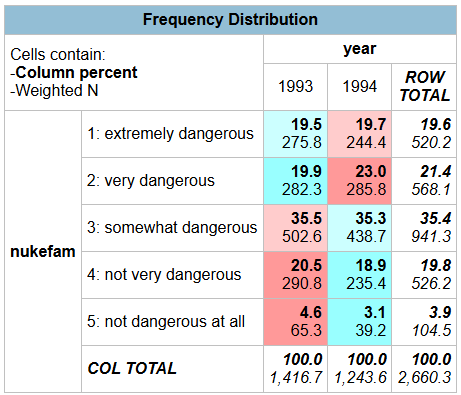
Result: At least in the early 90s (the only time the GSS asked), fear was intense, despite nuclear’s great track record.
Question #4: “In your opinion, how true is this? Some radioactive waste from nuclear power stations will stay dangerous for thousands of years.”
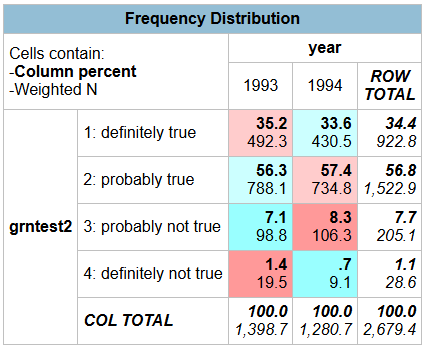
Results: At least in the early 90s, fear of nuclear waste was intense. Apologists for the public could, of course, insist, “Nuclear waste is very dangerous for thousands of years… if you eat it.” But given standard disposal and storage methods, nuclear waste is totally safe on arrival. As far as we know, it’s never harmed anyone. So while “Some radioactive waste remains dangerous for thousands of years” is true in a trivial sense, “All nuclear waste is already safe” is true for practical purposes.
Given the totality of public opinion, it’s easy to see why power-hungry politicians are unlikely to make building nuclear reactors easier, much less easy. Normal Americans aren’t anti-nuclear fanatics, but they share the fears of anti-nuclear fanatics. So if a politician proposes mild deregulation, the fanatics (in collaboration with the media) will loudly paint nightmarish scenarios that resonate with normal Americans. So politicians fear for their careers — and keep draconian regulation in place.
Furthermore, since normal Americans like almost every energy alternative more than they like nuclear, politicians can’t easily reply, “The gains of nuclear far outweigh the dangers.” Instead, they have to pander to an audience that, while willing to tolerate strictly regulated nuclear power, strongly prefers renewables. Cost? Reliability? These are major issues for serious energy analysts, but normal Americans prefer a pile of wishful thinking. So our dysfunctional status quo continues.
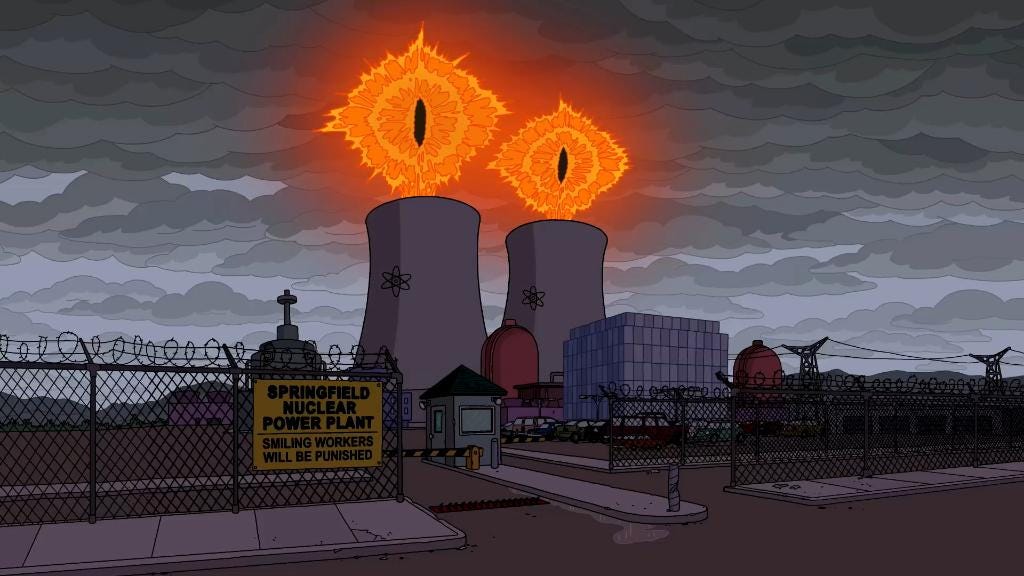
This is an advertising problem. The political left absolutely wants only wind mills and solar panels around the world. The wind mill and solar manufacturers have successfully co-opted the political left. How come nuclear operators did not even try to do the same to the right? Propaganda/advertising works, but only if you actually participate. Perhaps engineers are simply above the idea that they have to be effective communicators?
Nuclear power has tail risks that dwarf other energy sources' by many orders of magnitude. People assume the prevalence of those tail risks are higher than they actually are, but the risks are there nonetheless and they have been vividly embedded into the public imagination by Chernobyl, Three Mile Island, and Fukushima. Proper maintenance and operation of a nuclear power plant is going to follow a distribution, and it's a mathematical fact that someone's going to get stuck with the worst-run, most accident-prone reactor. The only surefire way to avoid a nuclear meltdown in your backyard is to impose unfeasible safety standards.
From a political standpoint, it's always going to be a losing battle to convince average people that their e.g. 1% estimate of catastrophe should actually be 0.001%. The Nuclear fission industry lost the battle to convince humanity that its tail risks could be ignored when it had multiple public catastrophes, including ones as recently as 2011.