

How socialist was Germany under National Socialism? I first started pondering Nazi economic policy during the collapse of the Soviet bloc.
Since the end of World War II, mainstream culture had energetically covered Nazi crimes, but largely gave the Soviet bloc a pass. Yet in the late 80s and early 90s, a long list of long-forgotten Soviet crimes loudly entered the Western conversation: Lenin’s coup against Russia’s first democratic government; Stalin’s agricultural collectivization; the Gulag; the Molotov-Ribbentrop Pact; the Katyn massacre; mass deportations to Siberia; and more. Once there was widespread recognition that self-righteous Soviet socialists had committed many Nazi-level crimes, the etymology of “Nazi means ‘National Socialist’” intrigued me. If the world’s most famous brand of socialists turned out to be total monsters, could the world’s most famous brand of monsters turn out to be total socialists?
Most responses to this question were, as usual, driven by ideology. Conservatives and libertarians gleefully underscored the etymology: “I keep telling you, ‘Nazi’ means ‘National Socialist’!” Liberals and socialists scoffed at the childish naivete of the question: “Of course the Nazis called themselves ‘socialists.’ They were a bunch of liars!”
Even as a teen, I knew enough socialist history to scoff at such scoffing. After all, socialists have a long history of denying that other socialists are socialists. In the late 1920s, for example, the Comintern started insisting that so-called “social democracy” was actually “social fascism,” the “moderate wing of fascism.”* Democratic socialists, for their part, routinely retroactively strip revolutionary socialists of their socialist credentials once things turn ugly enough. Stalin wasn’t really socialist, Mao wasn’t really socialist, and neither is North Korea.
Upshot: Even if the Nazis were the sincerest of socialists, mainstream socialists would almost certainly deny them the label regardless of the facts.
During the 90s, I tracked down some major economic histories of Nazism, especially Hitler’s Social Revolution by David Schoenbaum and Nazi Economics by Avraham Barkai. Both books seemed to strongly confirm that the Nazis were indeed highly socialist in both theory and practice. Unlike Marxist-Leninists, the Nazis had enough common sense to refrain from general expropriation. But the same goes for Germany’s non-Leninist Marxists during the Weimar Republic. Indeed, Germany’s Social Democratic Party (SPD) remained officially Marxist until 1959, and still claims to be “socialist” to this day. At least according to Schoenbaum and Barkai, Nazi economic policy implemented a much more draconian system of state economic control than the SPD ever had.
Still, I felt lingering doubts. Qualitative history lends itself to confirmation bias. Even when you have some quantitative measures of economic policy, it’s easy to put extra weight on the measures that deliver the answer you’re looking for. I’m not immune to motivated reasoning. I loathe and despise both socialism and Nazism, so it’s pleasant for me to equate them. I freely admit it.
What to do? I could spend a year reading more about this topic. I could even spend a few years getting to the research frontier so I could credibly publish on the question, “How socialist was Germany under National Socialism?” But while this is a fascinating issue, the opportunity cost of seriously deepening my understanding is just too high.
Or to be more precise, the opportunity cost was too high. AI has drastically slashed the costs of quantification — and simultaneously drastically increased the credibility of quick quantification. So instead of spending years on this topic only to be dismissed as ideologically biased, I asked ChatGPT to score Germany from 1910-1960 using the Fraser Institute’s Economic Freedom of the World index. I further asked: If Nazi Germany existed today, where would it rank compared to the 165 countries currently in the sample?
Here’s the output.
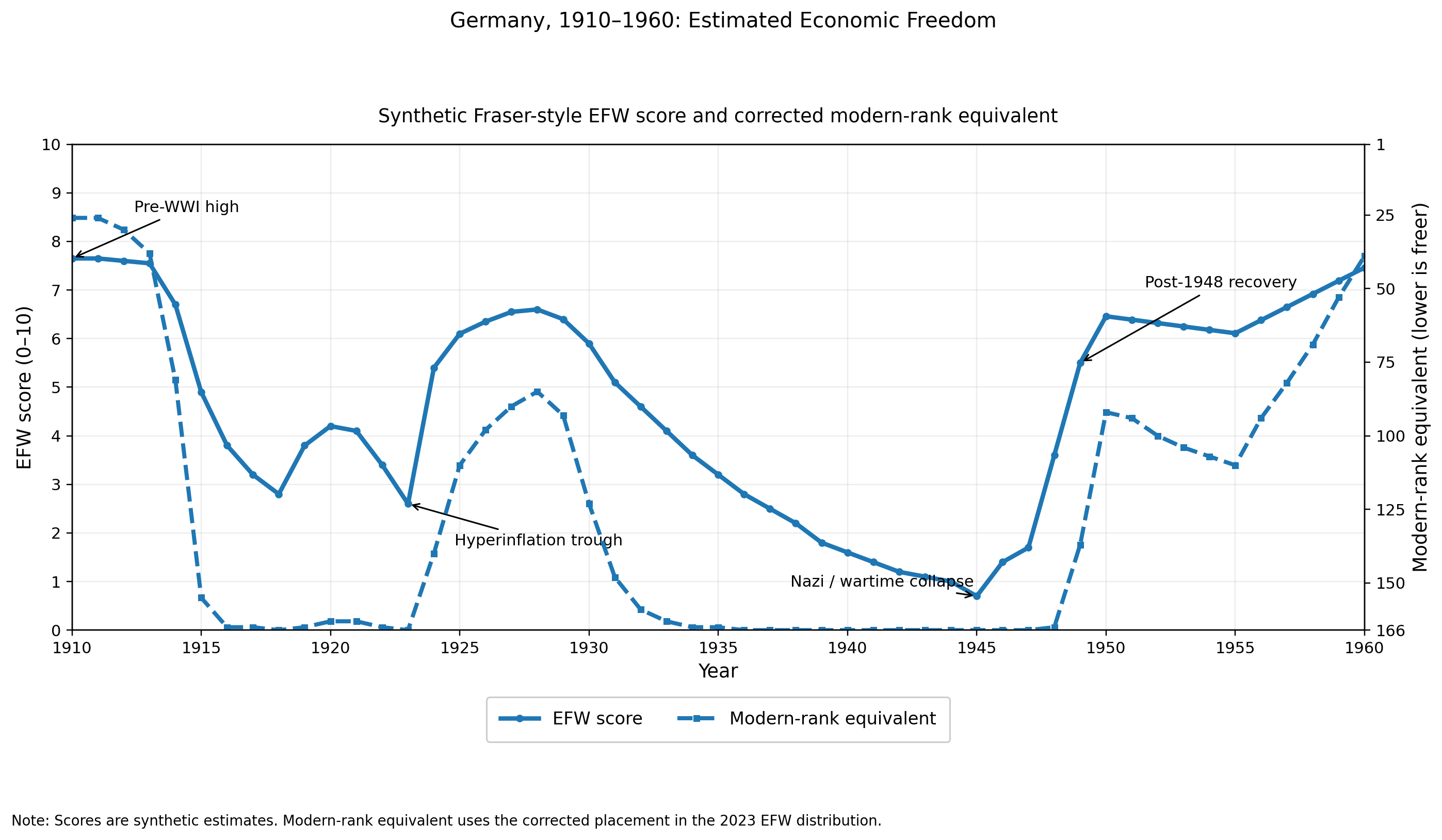
What do we see? Germany had fairly high economic freedom before World War I. This collapsed during World War I and the subsequent hyperinflation. By modern standards, Germany 1916-1923 would be virtually the most socialist country on Earth — though remember that due to lack of credible data, Fraser doesn’t score Cuba, Eritrea, or North Korea.
After the end of the hyperinflation, German economic freedom briefly recovers, peaking at 6.6 right before the Great Depression. Then there’s a total collapse. When the Nazis take over in 1933, Germany is already down at 4.1. If it were a modern country, that would be just freer than Sudan, Zimbabwe, and Venezuela.
Measured in rank order, Nazi Germany keeps falling, hitting rock bottom — #166 out of 166 — by 1936. But in absolute score, Nazi Germany falls every single year, from 3.6 in 1934 to 0.7 in 1945. What’s going on? Here’s ChatGPT:
Germany’s 1931 crisis brought extensive capital controls, bilateral clearing, and official exchange-rate management, hurting the trade/capital-mobility area. The Nazi Four-Year Plan centralized labor mobilization, restricted imports, imposed wage and price controls, allocated raw materials, and systematized expropriation of Jews, which crushes Fraser’s legal/property, trade, money, and regulation areas. The 1948 rebound reflects the Deutsche Mark reform and the broad elimination of price controls in the western zones.
It’s tempting to blame total warfare: “Any country fighting a major war will get rock-bottom Fraser scores.” But Germany’s average economic freedom score during World War I (4.3) exceeds its peacetime score under Nazi rule (3.1). The Nazis were not “forced” to accept socialism to fight World War II. They embraced extreme socialist policies as soon as they gained power.
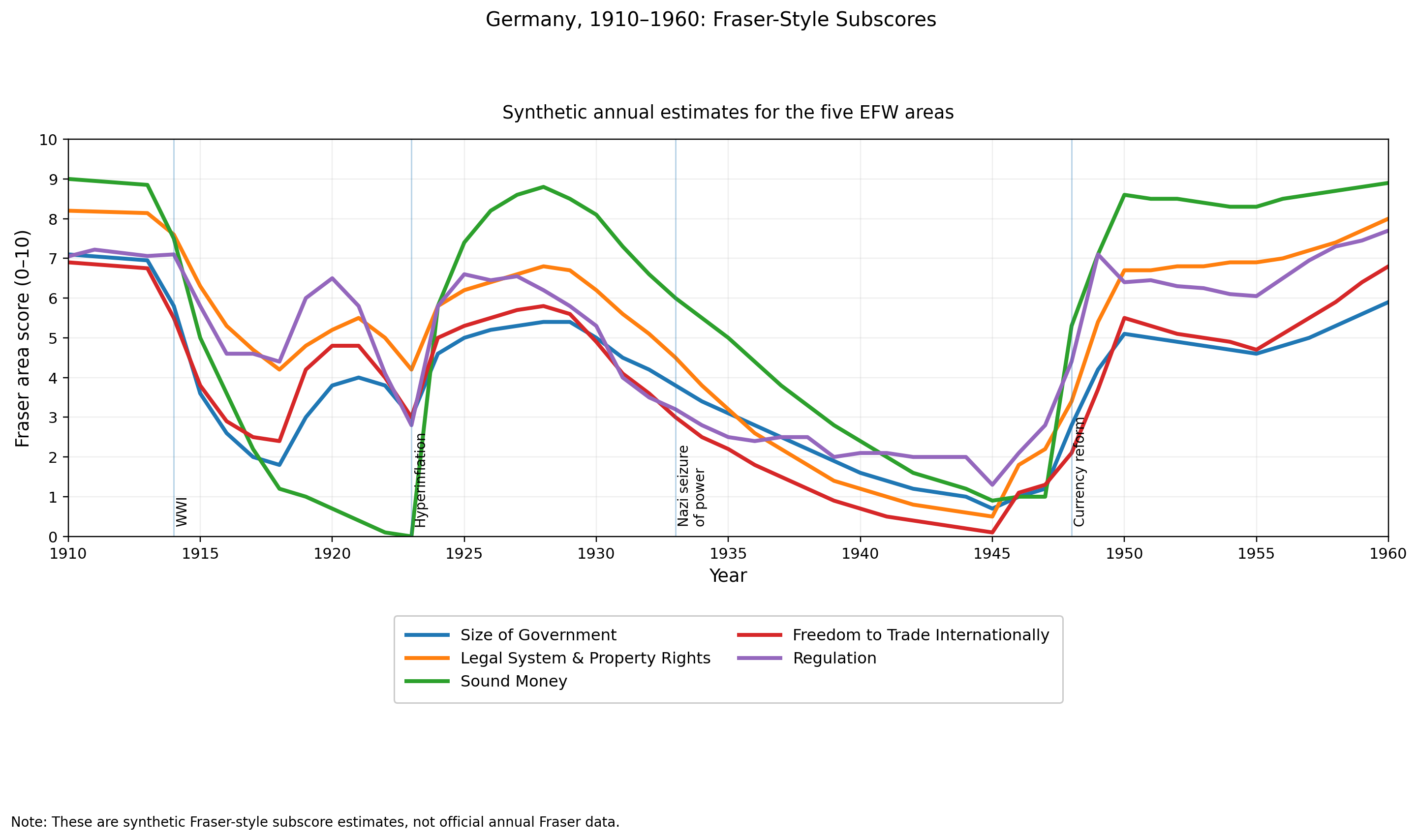
What if we look at the breakdown by Fraser subscore? Again, the Nazis do terribly on five out of five, a pentafecta: Size of Government, Legal System & Property Rights, Sound Money, Freedom to Trade Internationally, and Regulation.
Most objections to these results will be thinly-veiled sectarian dogma. Most notably:
“The Nazis didn’t nationalize everything, so they weren’t socialists.” By that standard, even Stalinism wasn’t socialist, because Stalin allowed private agricultural plots. The sensible synthesis is that capitalism versus socialism is, per the Fraser index, a continuum. The Nazis were very close to the pure socialist pole of that continuum. If Nazi Germany doesn’t qualify, then almost no self-styled socialist regime would.
“The Nazis weren’t democratic and egalitarian, so they weren’t socialists.” This excludes history’s leading self-styled socialist regimes, all of which were inegalitarian dictatorships. While plenty of modern socialists are only too happy to bite this bullet, they’re not just rewriting history; they’re rewriting socialist intellectual history. As Kristian Niemietz explains in Socialism: The Failed Idea that Never Dies, democratic socialists have a long-standing habit of accepting and apologizing for dictatorial socialist regimes for years or decades. Seriously, if “dictatorial socialism” is a contradiction in terms, why bother even coining the redundant phrase “democratic socialism”?
The best objection to the ChatGPT scores, honestly, is an unrelated dilemma: “The Nazis had years of stunning military success. So either socialism is actually a tolerably productive economic system, or the Nazis weren’t socialists. Choose one.” My response: While socialism is terrible for consumer welfare, it’s pretty good for military success. Why? Because total government control is the only feasible way to maximize the production of “guns” over “butter.” It’s a crude system well-suited to the crude goals of conquest, slavery, and mass murder.
War Socialism was especially effective when combined with the famed conscientiousness of the German people. Most nationalities under socialism would have been far more prone to slacking, cheating, and corruption, especially in the absence of Soviet-style terror. But the Germans were deeply obedient and loyal to their regime. Only in the last half of World War II did the Nazis start executing thousands (and, by 1945, tens of thousands) of ethnic Germans per year to maintain discipline. Mark this under the “dark side of trust.”
If anyone wants to re-do my questions using other LLMs, I’ll happily post your results. But given the quality of modern models, I strongly expect my findings to replicate. When mainstream socialists deny that the Nazis were socialist, we should take that as seriously as Catholics denying that Protestants are Christian. To a true believer, these marginal theological differences mean the world. To a reasonable person, however, such hypersensitivity is yet another symptom of true believers’ petulant fanaticism.
* In 1935, the Comintern added that fascism was “the open terrorist dictatorship of the most reactionary, most chauvinistic and most imperialist elements of finance capital,” implying that democratic socialists are actually the moderate wing of the open terrorist dictatorship of the most reactionary, most chauvinistic and most imperialist elements of finance capital.
I feel like you're conflating "socialist" and "economically unfree". "Socialist" is an essentially contested concept and effectively a vague tribal allegiance signal. From a neutral point of view, it points in the direction of a particular kind of economically unfree regime specifically focused on limiting freedom to own private property, engage in entrepreneurship or participate in the market. And here lies the problem - no matter how constrained Nazi-era German companies like Krupp, IG Farben, Siemens or Daimler-Benz might have been, they still were allowed to exist and compete.
It would be interesting to compare this to chatgpt's scores for other countries during the same time period, including the USSR, France, Spain and the USA.
Would you be willing to share the exact prompt you used to make the results as comparable as possible?