

[Originally published in 2014].
When most people stare at this table (courtesy of Greg Mankiw), they see strong evidence that the U.S. tax system is highly progressive.
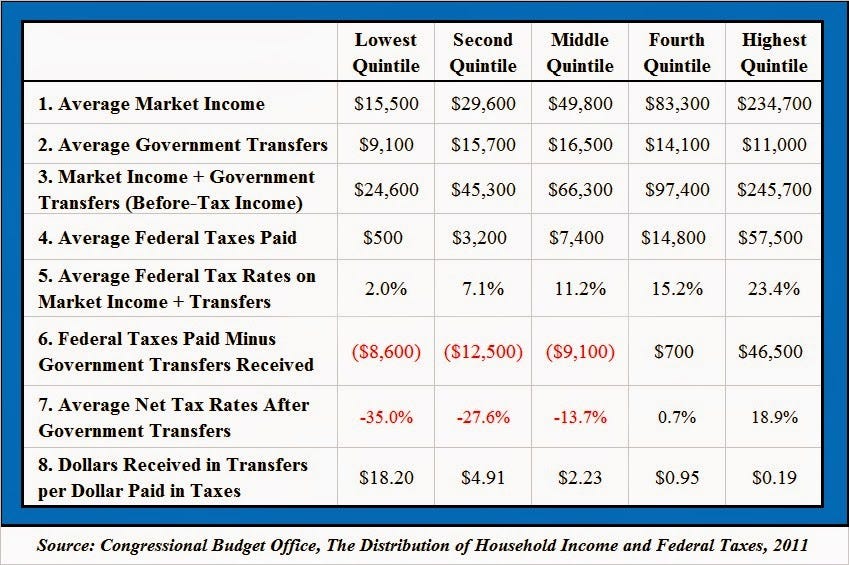
If you calmly peruse the table, however, a stranger pattern emerges – a pattern neither liberals nor conservatives will expect. Look closely. While taxes are highly progressive, transfers have an upside-down U-shape. Households in the middle quintile get the most money. The richest households actually get more money than the poorest. Think about how many times you’ve heard about government’s great mission to “help the poor.” Could there be any clearer evidence that such claims are mythology?*
If government really wanted to help the poor, it wouldn’t tax everyone to fund everyone. It would raise only taxes required to help the genuinely poor, then say “mission accomplished.” Relative to the status quo, that means big tax cuts and stringent means-testing. Picture a world where the lowest quintile continues to receive whatever it gets now, all other quintiles get zero, and the government refunds all the savings with tax cuts. Then ask yourself, “Why not?”
* Yes, I know that rich households have more people, but the basic pattern remains.
The post appeared first on Econlib.
"If government really wanted to help the poor, it wouldn’t tax everyone to fund everyone. It would raise only taxes required to help the genuinely poor, then say “mission accomplished.”"
Defenders of universal benefits are completely explicit about why they prefer this approach and the reason is pretty obvious: they think that broad-based benefits secure more support for the benefits (which in turn helps the poor). That's a perfectly reasonable instrumental argument for this being the best way to help the poor, given political feasibility. This is often called the paradox of redistribution in the literature.
As an aside the inference from the table that the government is splashing welfare state benefits on the wealthy is faulty. I believe a lot of this is social security and medicare (the former of which is partly driven by lifetime earnings). So these don't reflect a generic pool of general taxation that could be freely redistributed to the very poorest.
Because the government has purposes other than wealth transfer.
The things it needs to do cannot be done via private means - and the things it does even when they would be better done privately funnel money to government insiders to keep themselves alive.