

[Originally published in 2009.]
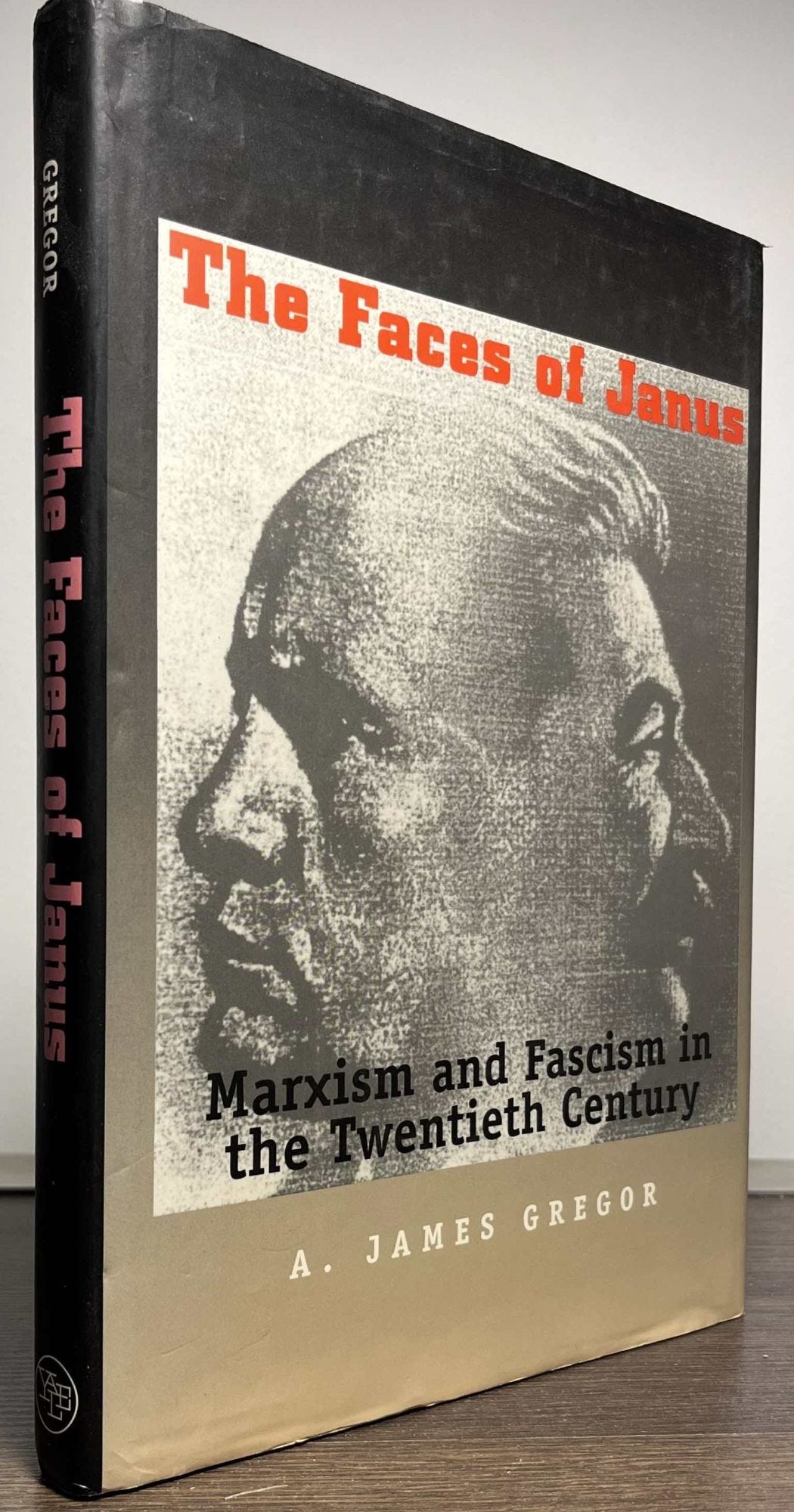
While preparing my promotion packet, I came across my old review of A. James Gregor’s outstanding The Faces of Janus: Marxism and Fascism in the Twentieth Century. Highlights:
Gregor provides an elegant and thoughtful history of what one might uncharitably term the “Big Lie” of Marxism: that Marxism is diametrically opposed to the theory and practice of fascist dictatorship. In this work, he probably does more than anyone else to show that the mutual hostility between fascist and Marxist movements has always primarily been a case of the orthodox hating the heretic more than the infidel.
Gregor begins his account by summarizing his major findings on Mussolini’s apostasy from orthodox Marxism. As Gregor’s earlier work shows, Mussolini’s fascism kept much of the basic Marxist outlook intact, but fiercely rejected its internationalism. It would be “better politics” to unite all social classes within a nation for struggle against rival nations. In response, orthodox Marxists throughout Europe joined together not to critique Mussolini’s arguments, but to impugn the integrity of any socialist wicked enough to buy into them. As Gregor explains:
For Italian Marxists, the next step in the logic of denial was to conceive of Fascism itself, together with its Marxist “apostates,” as venal and opportunistic. The final step was to see Fascism, in its entirety, as the suborned “tool of reaction”—since only monied “reaction” could offer sufficient benefits to those who sought to profit from their apostasy. (p. 21)
This initial response to fascism grew by leaps and bounds; the Communist International soon codified it. After various refinements, Georgi Dimitroff provided the official Stalinist interpretation of fascism as “the open terroristic dictatorship of the most reactionary, most chauvinistic and most imperialist elements of finance capitalism.” (p. 31) Gregor then expertly traces the evolution of this notion under post-war Stalinism and the awkward period of de-Stalinization, when the “fascist” features of Stalin’s rule became especially difficult to overlook.
Probably the most novel aspect of this work is its fascinating history of the Sino-Soviet split, and of each side’s efforts to pin the “fascist” label on the other. As Gregor explains:
By the end of the 1960s, Soviet theoreticians were prepared to argue that the “Chinese leadership” had transformed itself into an “anti-Marxist, anti-socialist, chauvinistic and anti-Soviet… bourgeois-nationalistic” movement of reaction… In their account, Soviet thinkers had recourse to the same list of descriptive traits that Western academics had employed for some considerable time to identify fascist political and social systems. (p. 71)
Maoists in China similarly began to describe the Soviet Union as a fascist state, arguing that the Soviet leadership had in some sense betrayed socialism in order to take the “capitalist road.” The danger of fascist subversion of socialism was omnipresent:
“[B]ourgeois” classes were to be found in both the Soviet Union and Maoist China, where private property had long been eliminated and the means of production socialized. As long as any inequality existed anywhere, class distinctions existed by entailment. Where there were classes, one would find fascism. (p. 79)
To the modern mind, it is hard to take this fascist name-calling seriously. But what Gregor helps tease out is not that both sides were wrong, but rather that both sides were right.
The post appeared first on Econlib.
"I don't like capitalism. Therefore anything I don't like is capitalism. So fascism is capitalism. Also, the flu, anchovy pizza, and rainy days - capitalism." Got it.