

I need six pillows to sleep comfortably. Two under my side, two between my legs, one against my back, and one to hug. That’s too many pillows to pack, so when I’m on the road, I have to figure out how to hit my pillow quota. Fortunately, Walmart doesn’t just make obtaining pillows convenient throughout the United States. It makes it dirt cheap. Every Walmart I’ve visited has the same $3.44 pillow for sale, so I routinely buy them wherever I go, and just abandon them when I leave.
I’ve done this over and over, yet only on my last trip to Wyoming did I reach a profound economic epiphany. I have bought Walmart pillows in dense urban areas. I have bought them in suburbs. I have bought them in rural areas. And the price is always $3.44… plus tax. Even in Mexico, the pillow’s peso price was almost exactly equivalent to $3.44 plus tax.
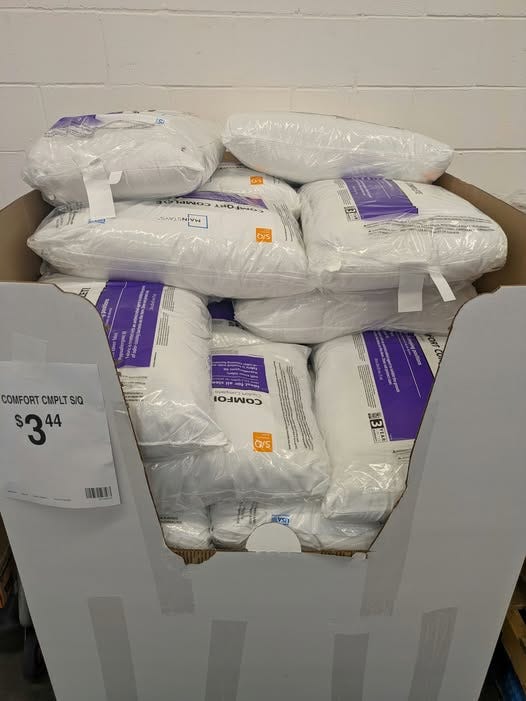
Which has a shocking implication: The degree of local competition has absolutely no effect on the price of the pillow. There could be dozens of competing stores selling pillows in a one-mile radius. There could be three, two, or one competitor. Or Walmart could be the only source of pillows in 50 miles. I get the same low, low price in every one of these scenarios.
If you’re not puzzled, you should be. Virtually every model in industrial organization predicts that the degree of local competition will matter massively for pricing. Sure, you could insist, “There’s a global market for pillows, so naturally one price prevails all over the world.” Wholesale may be global, but retail is still mostly local.
Now if the Walmart $3.44 pillow was the only product with uniform pricing regardless of market conditions, you could dismiss it as a fluke. But the same pattern holds across virtually all of Walmart’s vast inventory. Groceries, clothes, housewares, pharmaceuticals: Exceptions to the rule of uniform Walmart pricing exist, but you have to consciously look for them to find them.
Once you accept this incredible truth, other incredible truths are not far behind. Walmart is far from the only store that sets its prices without paying the slightest attention to the degree of local competition. Costco does exactly the same thing! Most Costco products are available at all Costcos. And — rare exceptions aside — if one Costco charges $10.73 plus tax for a product, all of them do.
I’m not the first economist to notice the facts of uniform pricing. Most notably, DellaVigna and Gentzkow’s "Uniform Pricing in US Retail Chains." (QJE 2019) shows that uniform pricing in chain stores is ubiquitous. There are a few other papers on the topic, especially in banking. But as far as I can tell, no economist has treated these facts as a strong refutation of the entire structure-conduct-performance paradigm, either the classic Joe Bain version or its modern reincarnations. Instead, the field of industrial organization continues to fret about the potentially negative effects of modest changes in concentration on price, despite massive glaring evidence that large changes in concentration often have zero effect on price.
That’s right, zero.
Left-leaning economists will probably find some way to put a negative spin on these amazing facts. Which says a lot more about their anti-market bias than about how well markets work. Seriously, if national chains were sharply varying their prices to take advantage of local monopoly power, left-leaning economists would almost certainly be loudly lamenting business behavior and calling for regulation and lawsuits. Since we see the opposite, the only rational and fair-minded response is to admit that regulation and lawsuits are severely overrated.
I wonder if fear of anti-trust law plays a role. Differential pricing could be taken as evidence of price discrimination, which would be evidence of exercising monopoly power and… maybe you'd be able to argue against it but it's not worth the hassle.
Wow! I had no idea.
This refutes not only the Joe Bain et al views, but also even the views of some of my professors at UCLA. Ben Klein, for example, taught me that companies will set prices depending on local competition.