

The Afterword for the 15th anniversary edition of Selfish Reasons to Have More Kids was originally much longer, primarily because it included three point-by-point replies to critics. My editor thought these replies were too inside baseball for wide release, so I’m running them here instead.
I’ve offered all critics the opportunity to reply in writing, podcast, or both.
First up: Nate Hilger.
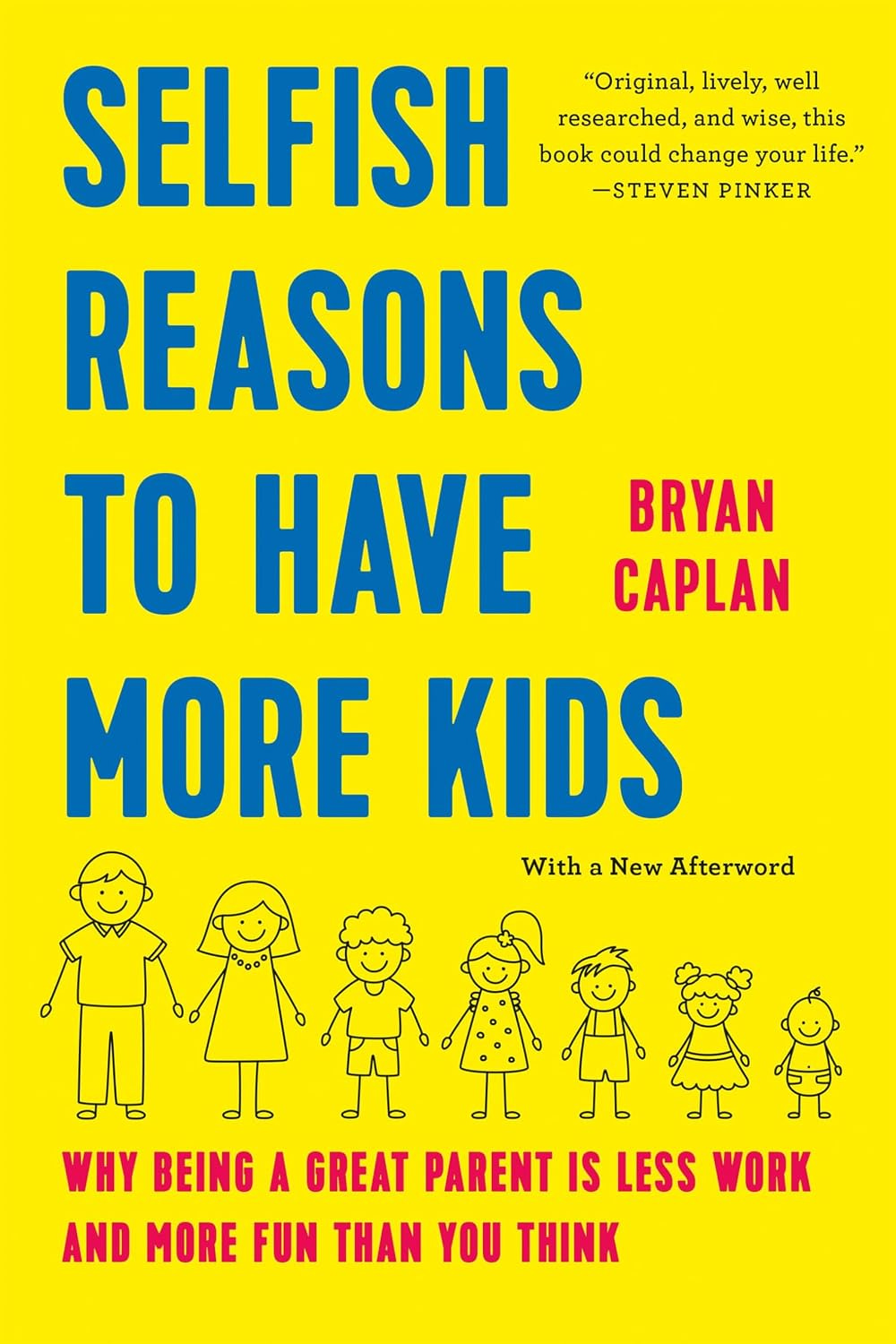
Why do kids turn out the way they do? Critics often caricature my position as “genetic determinism,” but a better caricature would be “parental irrelevantism.”[i] Better, but still unfair. What the book states is: “The best available evidence shows that large differences in upbringing have little effect on how kids turn out. While healthy, smart, happy, successful, virtuous parents tend to have matching offspring, the reason is largely nature, not nurture. At least within the observed range, parenting has little effect.”[ii]
Researcher Nate Hilger’s article “Stop Pretending That Intensive Parenting Doesn’t Work” probably provides the most wide-ranging critique of my position here.[iii] It is a two-pronged attack. The first prong: Due to restriction of range, adoption studies dramatically understate the effect of family environment.
People who choose to adopt children are a select group; they tend to have some preferences and circumstances in common, and they tend to offer children comparably advantaged home environments. Inferring that parents don’t matter because these children end up doing similarly well is like inferring that height doesn’t matter in basketball because all NBA players are pretty good.
At minimum, this is a gross exaggeration. To get in the NBA, you have to be the best of the best. To adopt a child, you merely have to be “fit for adoption.” Besides showing financial stability, you face a background check, a medical exam, and a home study. Since these are modest bars, and the total number of children available for adoption has been tiny for decades, the only superlative trait shared by families that adopt is incredible luck.[iv]
In earlier decades, standards for adoption were laxer yet. In Bruce Sacerdote’s famous Korean orphan study, eligible parents only had to be 25% above the poverty line to adopt.[v] Hilger bizarrely cites this very study to claim that “once we impose suitable adjustments for the restricted-range problem… more advantaged parents (who tend to follow the intensive-parenting handbook) can increase their children’s lifetime income by more than $1 million.” But not only was the Sacerdote study’s range restriction trivial; his study clearly reported that kids adopted by the very richest families grew up to be, not more than $1 million richer, but no richer than kids adopted by the very poorest families.[vi]
Range restriction is even milder in standard twin studies, which compare identical twins raised together to fraternal twins raised together. At worst, these studies fail to count families that refuse to respond to researchers and/or government data collection agencies. Some twin studies (especially in Scandinavia) are based on administrative data, bringing range restriction down to zero. Yet as the book in your hands explains, twin studies generally reach the same conclusion as adoption studies: even large differences in upbringing have little effect on how kids turn out.
If the range restriction problem were as severe as Hilger claims, parents should still take adoption (and twin) research to heart. Why? Because people who deliberate on optimal parenting styles are at least as range-restricted as people who adopt! Which is why Selfish Reasons reassures readers: “If the typical adoption agency would consider you a suitable parent, you’re good enough to let your children reach their potential.”[vii]
The second prong of Hilger’s attack: He cites a long list of studies that allegedly show specific ways that parenting deeply matters.
Data confirm that parents are right to seek out better neighborhoods, early-care environments, and K-12 schools. Kids should be in smaller classrooms and taught by better teachers. Tutoring, college-guidance counseling, and test prep matter significantly, as does actively managing children’s complex health and behavioral problems… (copious links omitted)
My book explicitly acknowledges the possibility of such “magic bullets,” but let’s review Hilger’s sources. How many of the studies to which he appeals actually report a large effect of parenting on major adult outcomes?
Better neighborhoods. Chetty and Hendren find that “For children growing up in low-income families, each year of childhood exposure to a one standard deviation better county increases income in adulthood by 0.5%.”[viii] This isn’t merely a tiny effect; it is a tiny effect on a small subset of children.
Better early-care environments. Hilger cites two different pre-K studies, both with largely low-income samples. According to Gray-Lobe et al., winning a pre-K lottery in Boston raised the probability of high school graduation by 6 percentage points, and the probability of ever attending a four-year college by 5.9 percentage points. There was no measured effect on academic performance, even in elementary school, but a .17 standard deviation improvement in high school disciplinary outcomes.[ix] Baker et al. similarly finds no effect of Quebec’s universal child care on cognitive outcomes, but reports moderately bad effects by age 12-20, most notably an extra .073 standard deviation risk of poor health.[x] The reasonable reading is not “High-quality pre-K is incredibly important for middle-income kids” but “It’s not even clear if pre-K is good or bad for lower-income kids.”
Better K-12 schools. Abdulkadiroğlu et al. only tangentially discusses the benefits of better K-12 schools, reporting that students admitted by their first-choice school perform .07 standard deviations better.[xi] The thrust of the study, oddly, is that when parents strive to get their kids into “the best schools,” the benefits remain meager because the strivers confuse prestige with actual learning.
Kids should be in smaller classrooms and taught by better teachers. Krueger reports that small classes raise school performance by 4 percentage points, expanding by another percentage point per year thereafter.[xii] Not only is this a small effect; Hilger neglects to mention that he personally co-authored a 2011 follow-up study finding that (a) the cognitive benefits of smaller classes disappear by grade 8, and (b) the effect on earnings remains undetectable at age 27.[xiii] Hilger also cites Chetty et al. 2014, which claims that raising teacher quality by a full standard deviation in one grade boosts adult earnings by 1.3%.[xiv] If scaleable, this implies large total social benefits, because a high-quality teacher could plausibly help a thousand students over the course of a career. But from any one parent’s point of view, 1.3% is a rounding error.
Tutoring, college-guidance counseling, and test prep matter significantly, as does actively managing children’s complex health and behavioral problems. Guryan et al. reports short-run math score gains of .16 and .37 standard deviations in two separate studies.[xv] Carrell and Sacerdote finds that “intensive, boots-on-the ground” coaching raises college attendance by 15 percentage points for women, with no effect on men; weaker treatments don’t work for either sex.[xvi] According to Buchmann et al., premium SAT prep raises test scores by 30-40 points.[xvii] Case et al. detects effects of family income on the health of both biological and adopted children, but the magnitude is tiny: To raise self-reported health of older children by a single step on a 1-5 scale, you must multiply family income almost 350-fold.[xviii]
Hilger urges thinkers like me to “stop pretending that intensive parenting doesn’t work.” If I ever claimed that the effect of parenting was precisely zero, the research he cites would show that I slightly overstate my case. Since I eschewed such overstatement, however, Hilger has unwittingly provided additional evidence in my favor. By his own admission, the familial cost of his intensive parenting is high; a close reading of his favorite papers shows that the benefit for his children is low. If “Suffering for a year will raise your lifetime earnings by 1%” wouldn’t motivate you, neither should “Suffering for a year will raise your child’s lifetime earnings by 1%.”
[i] “a better caricature would be ‘parental irrelevantism.’” Bryan Caplan. 2011. “Genetic Determinism vs. Parental Irrelevantism.” Bet On It.
[ii] “What the book actually states is…” SRtHMK: 34.
[iii] “Researcher Nate Hilger’s article ‘Stop Pretending That Intensive Parenting Doesn’t Work’” Hilger, Nate. 2022. Atlantic.
[iv] “the total number of children available for adoption has been tiny for decades.” Van Dam, Andrew. 2024. “Who’s Most Likely to Adopt — or Get Adopted.” Washington Post; Wikipedia. 2024. “Adoption in the United States.”
[v] “…eligible parents only had to be 25% above the poverty line to adopt.” Sacerdote, Bruce. 2007. “How Large Are the Effects from Changes in Family Environment? A Study of Korean American Adoptees.” Quarterly Journal of Economics 122(1): 121.
[vi] “not more than $1 million richer, but no richer than kids adopted by the very poorest families.” Ibid: 138.
[vii] “Which is why Selfish Reasons states...” SRtHMK: 84.
[viii] “Chetty and Hendren find…” Chetty, Raj, and Nathaniel Hendren. 2018. “The Impacts of Neighborhoods on Intergenerational Mobility II: County-Level Estimates.” Quarterly Journal of Economics 133(3): 1163-1228.
[ix] “According to Gray-Lobe et al.…” Gray-Lobe, Guthrie, Parag Pathak, and Christopher Walters. “The Long-Term Effects of Universal Preschool in Boston.” 2023. Quarterly Journal of Economics 138(1): 363-411.
[x] “Baker et al. similarly finds…” Baker, Michael, Jonathan Gruber, and Kevin Milligan. 2019. “The Long-Run Impacts of a Universal Child Care Program.” American Economic Journal: Economic Policy 11(3): 1-26.
[xi] “Abdulkadiroğlu et al. only tangentially discusses…” Abdulkadiroğlu, Atila, Parag Pathak, Jonathan Schellenberg, and Christopher Walters. 2020. “Do Parents Value School Effectiveness?” American Economic Review 110(5): 1502-1539.
[xii] “Krueger reports that small classes raise school performance…” Krueger, Alan. 1999. “Experimental Estimates of Education Production Functions.” Quarterly Journal of Economics 114(2): 497-532.
[xiii] “Hilger neglects to mention that he was a co-author of a 2011 follow-up study…” Chetty, Raj, John Friedman, Nathaniel Hilger, Emmanuel Saez, Diane Whitmore Schanzenbach, and Danny Yagan. 2011. “How Does Your Kindergarten Classroom Affect Your Earnings? Evidence from Project STAR.” Quarterly Journal of Economics 126(4): 1593-1660. For detailed commentary on this famous and influential study, see Caplan, Bryan. 2011. “Teachers and Income: What Did the Kindergarten Study Really Find?” Bet On It.
[xiv] “Hilger also cites Chetty et al. 2014…” Chetty, Raj, John Friedman, and Jonah Rockoff. 2014. “Measuring the Impacts of Teachers II: Teacher Value-Added and Student Outcomes in Adulthood.” American Economic Review 104(9): 2633-2679.
[xv] “Guryan et al. reports short-run math score gains …” Guryan, Jonathan, Jens Ludwig, Monica Bhatt, Philip Cook, Jonathan Davis, Kenneth Dodge, George Farkas et al. 2023. “Not Too Late: Improving Academic Outcomes Among Adolescents.” American Economic Review 113(3): 738-765.
[xvi] “Carrell and Sacerdote finds…” Carrell, Scott, and Bruce Sacerdote. 2017. “Why Do College-Going Interventions Work?” American Economic Journal: Applied Economics 9(3): 124-151.
[xvii] “According to Buchmann et al….” Buchmann, Claudia, Dennis Condron, and Vincent Roscigno. 2010. “Shadow Education, American Style: Test Preparation, the SAT and College Enrollment.” Social Forces 89(2): 435-461.
[xviii] “Case et al. detects effects of family income on the health…” Case, Anne, Darren Lubotsky, and Christina Paxson. 2002. “Economic Status and Health in Childhood: The Origins of the Gradient.” American Economic Review 92(5): 1308-1334. For ages 9-17, the coefficient on ln(family income) is -.171, with lower scores indicating better health. To lower the score by one full point, you have to raise ln(family income) by 5.85, which is the same as multiplying it by exp(5.85)=347. (p.1330) Using their coefficient for children ages 0-8, you have to multiply income by over 4000 to get a one-point health gain!
Wow, Bryan. I learned a lot from this post.
Interesting. There was a recent substack that went kind of viral, also related to this topic: https://violetagordeljevic.substack.com/p/everyone-wants-a-child-like-eileen?utm_source=share&utm_medium=android&r=h4w8x