

The best way to experience Shakespeare is on t.v. with the English subtitles on. Read Shakespeare, and you miss the visual cues; watch it performed, and you can’t make out the words.
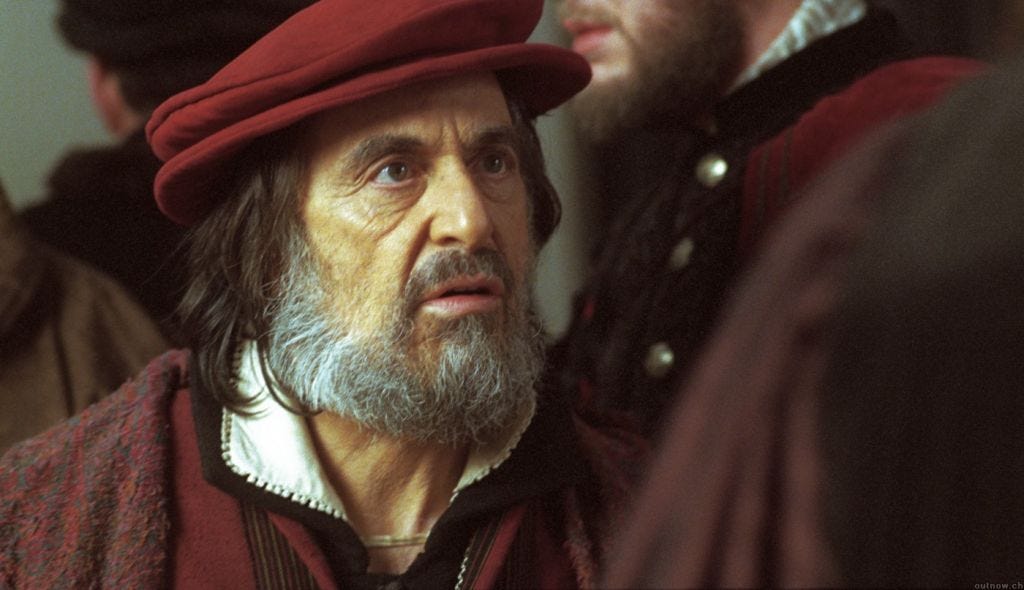
My latest foray into Shakespeare is the Al Pacino version of The Merchant of Venice. Days later, I still can’t get over the brazen legal sophistry used to cheat Shylock out of his pound of flesh. The “arguments” come down to:
1. Shylock’s contract was for a pound for flesh. Since it doesn’t mention blood, he has to somehow extract the flesh without spilling any blood.
This bond doth give thee here no jot of blood.
The words expressly are “a pound of flesh.”
Take then thy bond, take thou thy pound of flesh,
But in the cutting it, if thou dost shed
One drop of Christian blood, thy lands and goods
Are by the laws of Venice confiscate
Unto the state of Venice.
You could just as well invalidate a contract to sell a house by saying that the air inside still belongs to the seller. “The words expressly are a house: Then take thy bound, take thou thy house, But in entering it, if thou dost breathe one breath of air…”
2. Shylock’s contract is for a pound of flesh. If he takes infinitesimally more or LESS (!), he’s guilty of murder.
Therefore prepare thee to cut off the flesh.
Shed thou no blood, nor cut thou less nor more
But just a pound of flesh. If thou tak’st more
Or less than a just pound, be it but so much
As makes it light or heavy in the substance
Or the division of the twentieth part
Of one poor scruple—nay, if the scale do turn
But in the estimation of a hair,
Thou diest, and all thy goods are confiscate.
Imagine if we applied this approach to the sale of a pound of wheat: “if thou tak’st more or less than a just pound…”!
Oh, and then Shylock has to convert to Christianity to avoid execution.
You could say that everyone knows these legal arguments are nonsense, but in the age of the Chewbacca Defense, I have to wonder.
The post appeared first on Econlib.