

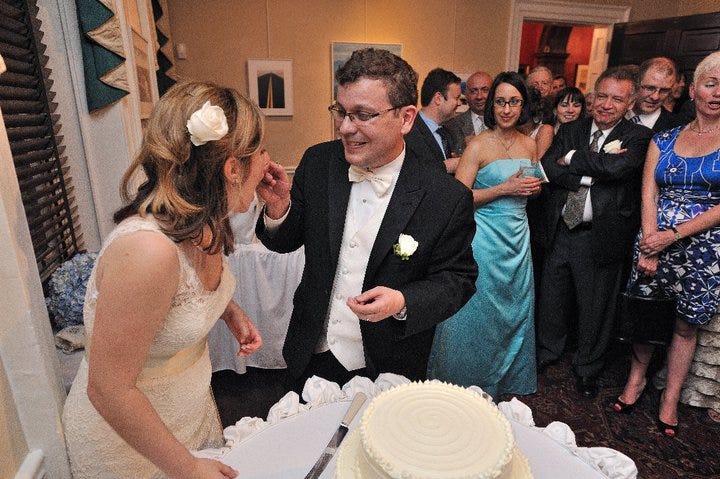
I knew Ilya Somin when he was single and striving to find a good match. It took a couple of years, but I was over the moon when I got invited to his wedding. Now Ilya has two precocious children with his wife, Alison. In this guest post, Ilya shares the main lessons he learned from his experiences as well as relevant research. Enjoy, and if any of this proves useful (or to avoid confirmation bias, useless or counterproductive), please let Ilya and me know.
The plight of young lonely singles (particularly single men) is once again in the news. Back in 2022, I wrote a Facebook post about how people seeking relationships, but failing at it, can improve what might be called their dating strategy. I was inspired to do so by Bryan Caplan’s discussion of Scott Alexander’s “rationalist” approach to dating. I recently reupped the post, and Bryan Caplan asked if he could reprint it on this substack. What follows is a modestly revised version of what I wrote, which I hope might be helpful to people in the same situation that I once found myself in.
I will start by noting I am not an academic expert on dating and relationships, nor am I any kind of professional dating guru. Far from it. But what I learned may be useful to some people, in part for those very reasons. If I could make this strategy work, the same may be true for others.
It so happens that, like Scott Alexander, I too didn’t get married till I was 37, and I too needed a “rationalist” approach. I was a near-total failure with the opposite sex until I decided to take exactly that approach to the issue when I was around 27. It took time to work. But it fundamentally transformed this aspect of my life - culminating in the good fortune of meeting my future wife (Alison Somin) in 2008.
I studied both the academic literature on dating, and the popular/self-help literature. Both had useful insights that I implemented. Yes, I know, it’s an unromantic, nerdy way of proceeding. But, for those lacking in natural social skills and charisma, it can be a lot better than the alternative.
Friends sometimes say I should write a book about this topic. It would probably sell better than my actual books, but no such work is in the offing. Still, here are a few things I learned that may be of value to others in the same boat where I was back then:
1. Think carefully about exactly what you want, and what qualities are essential in a partner, and which ones less so. Are you looking for a short-term relationship, or a more permanent one? Is it essential that the other person share your religion and/or your political views, have various common interests, and so on? If you’re looking to get married, do you want kids, and how many? It’s best to ask these kinds of questions in advance. If you know what you’re looking for, you’re more likely to find it, and less likely to waste time, or end up in a dysfunctional situation.
2. Scott Alexander is right that dating is a numbers game. The more opportunities you take to meet people and ask them out, the more likely you are to succeed. Plus, doing these things repeatedly improves your skills! You may be surprised at how much. On-line dating apps, social events, events related to your interests, and much else are all opportunities to increase your odds, and improve those skills. I met my future wife at a party sponsored by an academic organization we had both won fellowships from. I went to that event in large part because I thought it would be another opportunity to increase the odds of meeting the right person. And so it was!
3. As a corollary to point 2, you have to get used to dealing with rejection. Unless you’re a famous athlete, actor, rock star, or other type of celebrity (maybe even if you are), some people you ask out are going to say “no,” or just ignore you. Move on and keep trying. One success more than offsets numerous setbacks. Plus, each setback can help improve your skills. Rejection at online dating websites should be particularly easy to accept. Don’t set too much store by what a person who’s never met you or seen you decides. Plus, they might reject or ignore you for reasons having little or nothing to do with you, such as they aren’t monitoring their account on that site, they recently started a relationship with another person, and other such things.
4. Social science research shows that women, particularly highly educated ones, care a lot about the education credentials of men they might potentially date. Friends had advised me that I should not put down on dating site profiles that I have degrees from Harvard and Yale (it would look pretentious, they said). After I read the research, I ignored my friends’ advice and put this stuff in the profiles - modesty be damned. Right away, the number of favorable responses on those sites increased! You can argue women are being superficial here. I actually think this kind of selectivity can be rational behavior, given constrained information. Regardless, it’s worth taking account of. Read up on what women want (or men, if that’s who you’re focusing on), and then make sure people know you have it. When you do, that is - I’m not advocating deception!
5. On average, women prefer men who are self-confident and know what they are doing, or at least seem to. Don’t act shy and apologetic when starting a conversation and/or asking someone out - even if that’s how you feel (it’s certainly how I often felt!). As they say in sports, “act like you’ve been there before.” Don’t take this to the point of being an arrogant jerk, which is both bad in itself, and tactically unwise. But even coming off as a jerk is less likely to sink your chances than coming off as a loser who believes he’s unworthy of the other person’s attention.
6. Related to point 5, if the woman says “yes” to a date, be prepared with a plan for what to do! Being a “man with a plan” is better than putting the onus on the woman to come up with one, and helps further convey the message that you are confident and know what you’re doing. You can say this relies on sexist assumptions. Why shouldn’t women have to do an equal share of date planning? I don’t disagree, in theory. But, at least in my experience (and self-help experts say the same), having a plan works better than asking the other person to come up with one, and certainly better than giving her a lecture on how feminist theory requires her to do the planning. But if the woman says no to your plan and suggests her own instead, by all means do it (within reason)! This happened only a few times in my experience, and saying “yes” was the best approach every time.
There’s much more to be said. A book could indeed be written about it. I actually did expound on these issues in a bit more detail in a 2023 Strangers on the Internet podcast, with legal scholar Irina Manta and psychologist Michelle Lange (they invited me after reading my original 2022 post).
But the above is at least a potentially helpful start. I will add that none of this advice will turn you into Casanova. The point is not to come up with a fool-proof strategy for success, but to give yourself a fighting chance.
Finally, I recognize some of the above points are mainly useful to men seeking women rather than vice versa. Obviously, I know more about the former than the latter. But there’s a lot of info out there on both scenarios (and on dating strategy for gays and lesbians, too). “Rationalism” can work for you regardless of gender and sexual orientation! That said, I do warn that the academic literature on what men (on average) look for in women probably won’t make your view of human nature more optimistic.
For the love of God- yes. Everything Ilya states here is spot-on. I am a 60 year old woman, happily married for 35 years, and this is great advice. Similar to advice I give my kids and younger friends. It works. Be brave, be bold and get out there, guys. You can do this!!
Fairly basic advice from Ilya but I suppose basic advice is what some people need.