

[I’m at the University of Wisconsin, Madison the rest of the week! You and all your friends and family are invited to a BBQ at my sons’ apartment on Saturday night at 6:30 PM. 624 West Washington Ave., Madison, WI 53703. 5th floor balcony. Please RSVP acceptances ONLY in the comments.
When I started writing The Case Against Education, I expected a chorus of critics to appeal to the empirics of economic growth: “If education is mostly signaling, why do macroeconomists find a large effect of education on GDP?” From the start, I planned to rebut this argument with an appeal to “reverse causation”: Much of the alleged effect of education on GDP is in fact an effect of GDP on education. After all, regardless of education’s actual economic benefits, any government that gets an infusion of cash is likely to spend a good chunk of the windfall on education.
When I delved into the empirical growth literature, I was surprised to learn that macroeconomists struggle to detect much effect of education on growth. In most data sets, the national education premium is a small fraction of the private education premium. I also discovered a handful of papers testing for reverse causation from GDP to education, suggesting that the economic benefits of education are even smaller than they look. I was glad the reverse causation papers existed, but they were only moderately convincing. I’d hardly call them a smoking gun.
During my trip to Qatar this summer, however, I saw the smoking gun in all its glory. The gun’s name is Education City. It’s a vast complex, populated by eight different universities and about 11,000 students, in a country with under 3 million people, a supermajority of them guest workers. Estimates of the total cost of building Education City are hard to pinpoint, but there is little doubt that the Qatari government spent billions on the project. The six foreign universities based in Education City get about $400M annually.
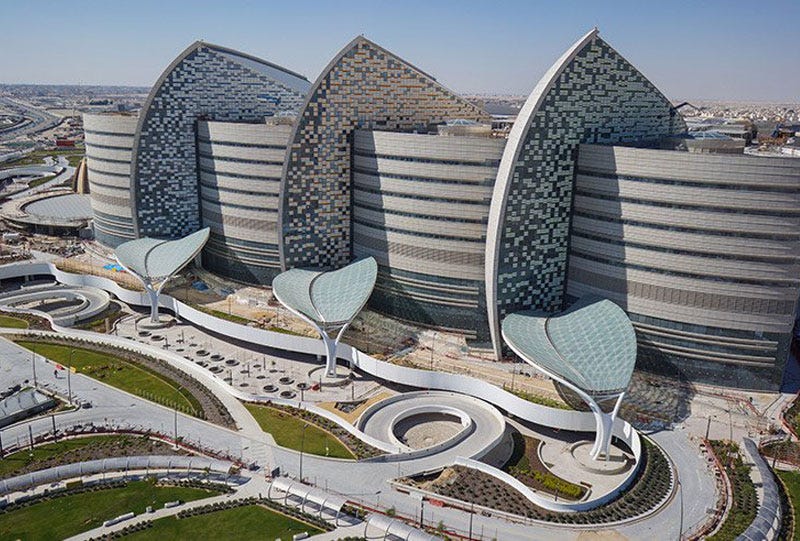
To belabor the obvious, the overwhelming cause of Qatar’s immense wealth is not education, but fossil fuels. Annual industry profits vary widely with global fuel prices, but they exceeded $40B in 2022. There is no chicken-and-egg problem here. Qatar got rich decades before it got educated. Phase 1: Import foreign energy talent to capitalize on abundant natural resources. Phase 2: Spend billions on a vast range of prestige projects. Qatari GDP caused Qatari education; Qatari education did not cause Qatari GDP.
Will Education City eventually yield economic benefits? The university spokesmen assured me that higher ed was already working economic wonders, but I could only roll my eyes. Most of the programs they’re offering are totally disconnected from Qatar’s comparative advantage:
Our higher education offerings—ranging from undergraduate to postdoctoral degrees—include programs in media, international affairs, business, computer science, medicine, engineering, cultural heritage, knowledge management, and arts.
Granted, Education City is gorgeous. Dipped in gold, really. I had fine fun touring around, witnessing the wonders that Qatar, like United Arab Emirates, has built by the power of mass migration. But the whole project screams not “investment,” but “vanity project.” Also known as “waste.”
At minimum, Qatar is an existence proof: reverse causation from GDP to education definitely happens. But on reflection, it is much more. Almost any country that strikes oil — literally or figuratively — would act like Qatar. Education is drenched in Social Desirability Bias, so almost every demagogue wants to fund it generously. Not “whatever the cost,” because education is hardly the only product drenched in Social Desirability Bias. But education is so beloved that the U.S. has had three “education presidents” in my lifetime alone.
To their great dismay, most of the world’s ruling demagogues aren’t swimming in petro-dollars. They can’t afford to build another Education City, or anything comparable. So they make do. If and when they get their hands on extra cash, they loudly give education a sizable cut of the loot. Like the Qataris, they loudly promise immense long-run benefits. And like the Qataris, they carefully avoid asking pointed questions about the curriculum.
Not all curricula are equally terrible, so not all education is equally economically wasteful. But standard estimates of education’s economic benefits are always even smaller than they look. Why? Because demagogues run the world. “Every citizen of our great country deserves the best possible education” is music to humanity’s ears. Anyone who seeks to rule fellow humans is well-advised to blast such music so loud they can’t even hear the wonkish words “reverse causation.” Education isn’t wonderful, but spending taxpayer money on education is a wonderful way to gain and hold power.
It is possible that there is not reverse causality in Qatar, as Step 1 in your process is effectively "bring in a lot of skilled people who were educated elsewhere." As such, education is still driving the GDP growth, it is just that it isn't education that happened in Qatar that Qataries got themselves. Qatar isn't a closed system by any stretch, and the average years of education of workers in Qatar probably spiked as all those foreign skilled workers came in.
That said, if you include the source countries' GDP changes over time in the calculation I wouldn't be surprised to find that GDP and years of education suggest that there isn't much effect. Qatar benefitted in getting very specifically usefully educated people; they were probably not importing many grievance studies majors to run their oil fields.
What a great piece.
It is *so* hard to argue against - or even find flaws in - Bryan’s logic on almost every topic that is not fully open borders.