

[I wrote this piece 17 years ago. Since then, the country has flourished, with per-capita GDP increasing by roughly 50%.]
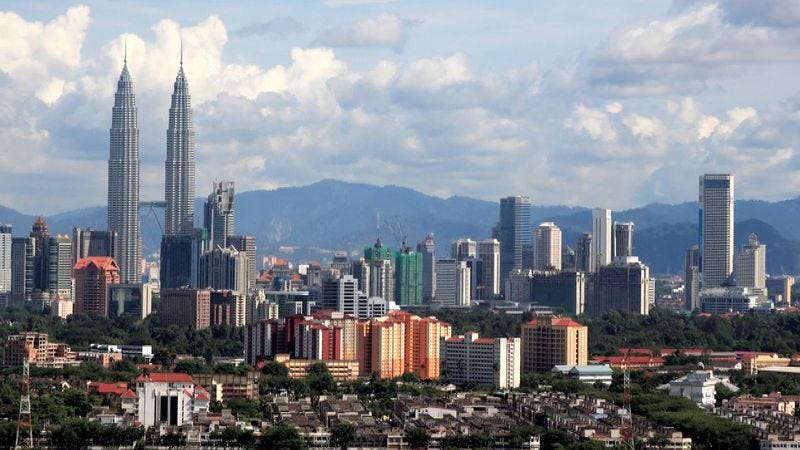
People often point to Malaysia as a good example of a “moderate Muslim nation.” So when I took a side trip to Kuala Lumpur and Malacca, I was curious to see moderate Islam with my own eyes. What’s it like to be a believer – or a non-believer – in a country that’s 60% Muslim?
What I saw:
1. At least in KL, there was a nearly uniform distribution of styles of dress – everything from Asian Britney Spears to burkhas without eye slits. No one seemed to notice or care.
2. Muslim teens in conservative dress freely held hands and engaged in other PDAs. The head scarf is a much weaker signal of behavior than it is at GMU.
3. The big KL bookstore I wandered carried not only Discover Your Inner Economist and Radicals for Capitalism, but also Richard Dawkins’ The God Delusion.
4. Most of the public propaganda focuses on Malaysian nationalism, not Islam. It’s offensive in its own way; how can you talk about the wonders of “Malaysian unity” without mentioning bloody anti-Chinese pogroms of the 60s? But I saw no evidence of an official effort to treat non-Muslims as dhimmis.
5. I saw no public signs of anti-semitism – even in the display on the Palestinian conflict in the Islamic Arts Museum.
6. There were two big Muslim controversies going on during my visit. A council of mullahs had ruled that yoga and “tomboyism” were contrary to Islam. But at least one major newspaper, the New Straits Times, reported on these fatwas with thinly-veiled contempt. From an interview on pengkid (“tomboyism”) with the Malaysian Department of Islamic Development director-general:
Q: What is the actual definition of “pengkid”?
A: Pengkid refers to a married woman or maiden whose appearance or image is like that of a man… A woman may be dressed as a woman, but her behaviour may be like a man, or it might be a combination of this. She might also have a sexual desire for women.This brings it “hampir” (close) to the practice of lesbianism.
Q: Is it close to, or is it actually lesbianism?
A: We can’t say that all people who are pengkid are lesbians. That wouldn’t be right. That’s why I say it is “hampir”.Hampir means she doesn’t do that act, but she is heading that way. For instance, Islam forbids people from coming close to zina. That means, not only is the act forbidden, but any act that may lead to the actual act is also forbidden…
Actually, we are trying to save these women (from becoming lesbians).
Later in the interview:
Q: Is there any proof that if a woman dresses as a man, she will become a lesbian? What is the link between clothes and lesbianism?
A: Perhaps this is something that is different between the Islamic perspective and non-Islamic perspective.Our approach is based on a rule of the maxim in Islamic jurisprudence – that we prevent the opportunity for some thing bad to happen. We believe this is a good approach in preventing something bad which is forseeable, based on research and other issues.
[…]
Q: The niat (intention) of the fatwa is one thing, but its application is another. What is going to happen if someone who has heard of this fatwa starts harrassing a woman whom he feels is dressed or behaving like a man?
A: Let’s forget about the possibility of harassment by men.Q: We can’t.
A: Alright. But what if the woman who behaves like a man attracts the attention of other women. Doesn’t that also present a threat of harassment?
Overall, I’d say that the journalists’ bias against fundamentalist Islam was stronger than the liberal bias of the New York Times.
I only spent three days in Malaysia. I suspect that rural areas would be less moderate than major cities like KL and Malacca. Nevertheless, I think that most Westerners would be shocked by the pluralism and tolerance that I saw. The experience echoed a passage from a book I bought in a KL mall:
Take a view of the Royal Exchange in London, a place more venerable than many courts of justice, where the representatives of all nations meet for the benefit of mankind. There the Jew, the Mahometan, and the Christian transact together, as though they all professed the same religion, and give the name of infidel to none but bankrupts. There the Presbyterian confides in the Anabaptist, and the Churchman depends on the Quaker’s word. At the breaking up of this pacific and free assembly, some withdraw to the synagogue, and others to take a glass. This man goes and is baptized in a great tub, in the name of the Father, Son, and Holy Ghost: that man has his son’s foreskin cut off, whilst a set of Hebrew words (quite unintelligible to him) are mumbled over his child. Others retire to their churches, and there wait for the inspiration of heaven with their hats on, and all are satisfied.
Yep, that’s from Voltaire, a writer who spent centuries on the Catholic Church’s Index of Forbidden Books.
The post appeared first on Econlib.
Yea, I've also been to Malaysia. I remember seeing a muslim couple where the girl is wearing a hijab and the guy is grabbing her butt, in public.
Nonetheless, I found that Malaysia had kinda a "sad vibe". People didn't smile much. People didn't seem happy. I also noticed that Sharia law applied. For example, on bars, you would see signs that said: "Must be 21+ and non-muslim".
As you are probably also aware, there is a kind of affirmative action for the Muslim Malay majority. They are preferred for spaces at universities (I met many Chinese Malysians studying in Singapore probably for this very reason!), they get discounts on land, business ventures must have at least one Muslim Malay partner, etc. This system kinda holds Malaysia back and I believe it was one of their major disagreements with Singapore. Hence why Singapore is a separate country today. (And much more economically successful!)
But contrast Malaysia with Indonesia. They speak almost the same language and Indonesia is actually 87% muslim (more than Malaysia) but Indonesia is a lot poorer (they have got their own problems). However... Indonesian Muslims are much more "chill" than Malaysian Muslims. For example, I rarely saw the hijab and when I did it (for example, on a televised concert), was often loose and didn't cover all the girl's hair (Muslim cleavage? Haha). Also, I remember reading an article about an alcohol shortage in Indonesia. They had a state-run corporation that imported alcohol. A spokesman for the company said they based the quantities on the numbers of tourists and non-muslims. Then, they interviewed a bar owner who said: "well, there you go! That's the problem right there! Most of my customers are Muslims!" Hahaha!
And generally, I found Indonesians were happier than Malaysians. Despite being a lot poorer. Honestly, Indonesians seemed a lot more like Filipinos than Malaysians.
Sir, if you get the opportunity, you should visit Indonesia. (And Philippines while you're at it!)
I don't think you are far off the mark. Although as you say it is difficult to strip out the capital city effect. Kabul was a lot more moderate seeming than Herat or Jalalbad!