

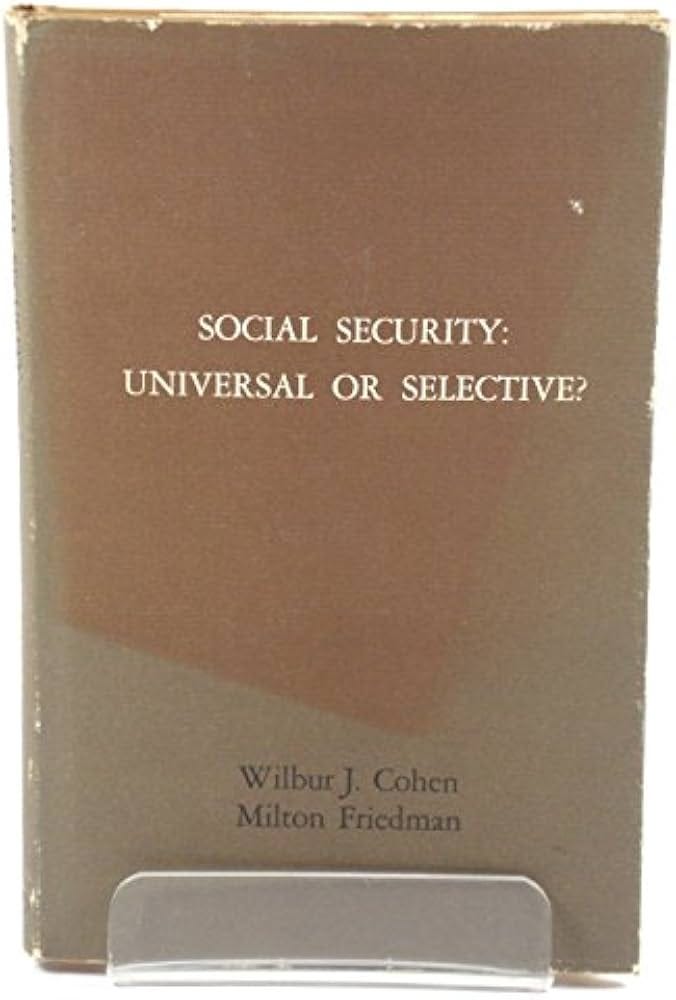
Did you know that in 1971, Milton Friedman debated former HEW Secretary Wilbur Cohen on means-testing Social Security? Until two weeks ago, I sure didn’t. To be honest, neither debater is at the top of his game. Cohen makes a lot of “The status quo must be fine because it’s so popular” claims, and Friedman keeps harping on the fact that Social Security is redistribution masquerading as “insurance.” But it’s still a fascinating exchange. Today let’s start with the Cohen highlights.
Cohen twice rejects means-testing on political economy grounds. In his main statement, he claims the following without evidence or even explanation:
I also oppose any wholesale substitute for the social security system, whatever its name (such as a negative income tax, a guaranteed income or what have you) that makes payments only to the poor. A program for the poor will most likely be a poor program.
But in his rebuttal, at Cohen fleshes out his story.
…Mr. Friedman attacks the idea that American social security is primarily a system of redistribution of income to middle income people. Actually I think he is probably right about that. But, that is part of the system’s political sagacity. Since most of the people in the United States are in the middle income, middle class range, social security is a program which appeals to them. Anyhow, to the extent that he is right that there is a transfer of money from low income people to middle income people, the situation could be improved by certain changes in the financing. You don’t have to do away with the entire social security system to rectify that.
But let me emphasize that the reason why the Office of Economic Opportunity and other such programs don’t get appropriations, don’t get support from the taxpayer, is simply that they do not appeal to the middle class, middle income person. True, if you are an economist, you may exclude all matters of politics from your thinking. But to do so is not reality, Milton. [Laughter.]
And so I say that the essence of social security, with its appeal to middle income people, is desirable and those things that are legitimately criticized about the system could easily be remedied by certain changes. My major objection to the negative income tax as a complete substitute for social security is that I am convinced that, in the United States, a program that deals only with the poor will end up being a poor program. There is every evidence that this is true. Ever since the Elizabethan Poor Law of 1601, programs only for the poor have been lousy, no good, poor programs. And a program that is only for the poor-one that has nothing in it for the middle income and the upper income-is, in the long run, a program the American public won’t support.
You’d think these admissions would generate massive cognitive dissonance in Cohen. His view really does amount to, “Trickery is the only way to provide for the needy. Social Security is popular because voters simple-mindedly focus on their gross benefits, instead of their net benefits.” But Cohen is perfectly fine with this trickery – or, as he calls it, “rhetoric.”
Mr. Friedman calls a lot of the things he doesn’t like about social security rhetoric. And that gets me to a point I want to stress. My point is that economists do not determine all of the choices and options and attitudes prevailing in this nation. People do live by rhetoric. You can’t understand what goes on in the United States if you don’t understand something about rhetoric. And think of all the people in this audience who would be out of a job if we didn’t have such a thing as rhetoric. [Laughter.]
I believe in rhetoric because it makes a lot of things palatable that might be unpalatable to economists. [Laughter.]
In any case, Cohen is just factually wrong about the sustainability of expensive, means-tested programs. The American public supports vast spending on programs that target the poor, and has done so for decades. Medicaid alone costs hundreds of billions of dollars a year. And if you’re inclined to pardon Cohen for mistakenly forecasting the future, remember that when he spoke, plenty of expensive means-tested programs had been around for decades.
I rarely criticize economists for underestimating the American voter. But Cohen forces my hand. Trickery does sustain universal social programs, but transparently selective social programs can and do flourish at the same time. As former HEW secretary, he must have known this, so I guess we should interpret his mistakes as “rhetoric.”
The post appeared first on Econlib.
it seems at least slightly ironic that Caplan points to Medicaid as proof that the American people will pay for poor-only programs, when the right has made enormous efforts over decades to cut or eliminate many poor-focused programs exactly like Medicaid, and at time when a rampant right is indeed doing exactly that.
Social Security System is challenged as you well know and any number of fixes have been suggested. I have my own which as an over 66 year old i would willing give up my SS, but not for free; it would require allowing my IRA account to be freely( no tax) converted to the equivalent of a Roth IRA in return for no future gov payments to me of SS.
I have run this by several who find it meritorious, but of course like many things question its feasibility.
Prof Caplan, if interested in seeing it in a bit more detail( some big picture calculations) please send me your email.