

Here’s a guest post by an anonymous Bet On It reader. Related: The 15th-anniversary edition of Selfish Reasons to Have More Kids should release later this year, with a new afterword by me. My original afterword was too long, so when the book comes out, Bet On It will also feature three new essays responding to Nate Hilger, Scott Alexander, and Lyman Stone. Hopefully I’ll be able to persuade all three to do podcasts with me as well.
Bryan,
I greatly enjoyed Selfish Reasons to Have More Kids.
As the youngest of 10 kids, I feel existentially obligated to promote the idea that people should have more kids! The next one could always be your best one yet! (Or possibly the black sheep who reads too much Bryan Caplan!)
Over the course of the book, you won me over to the central premise which I was reluctant to accept at first. Namely, despite my strong intuition that parental investment plays a big role in children’s success, I came to accept that the literature was airtight in saying it clearly does not.
And so, I committed to invest less in each of my kids and to have more kids – I explain it to my wife this way: if we put in 25% as much effort per child and have four times as many kids, who are each 95% as good as an only child at full investment, that’s a gain of 2.8 quality-adjusted kids! (4 × 0.95 - 1)
But then after winning me over to this scientific consensus, you shattered your hard-won victory when you shared the story of your two sons homeschooling under your direct supervision.
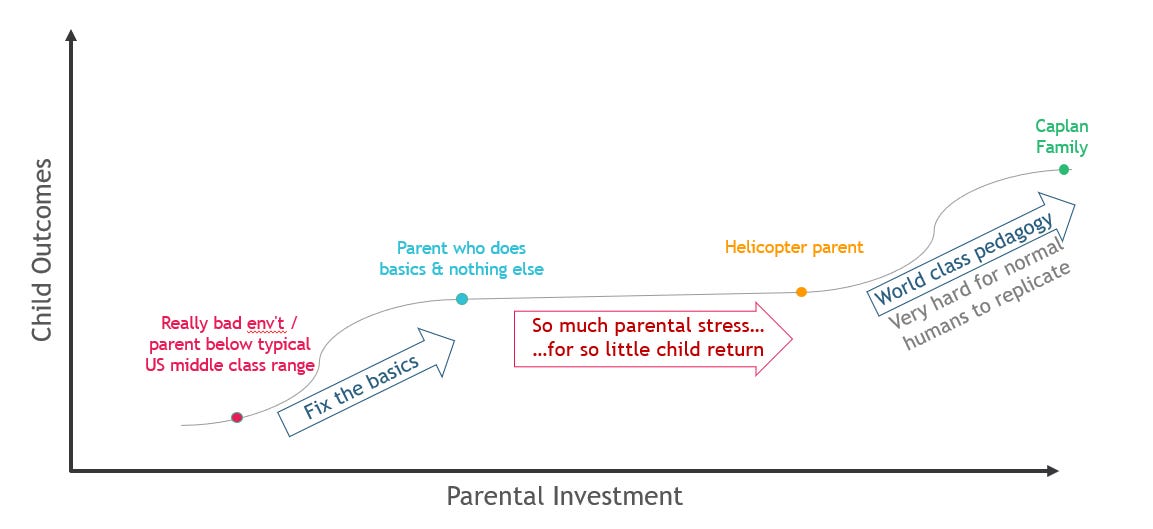
And so I dutifully replaced BC Hypothesis #1 (Parental investment doesn’t matter) with BC Hypothesis #2: Most parental investment doesn’t matter, unless you make some extraordinary investment in your kids that is above and beyond the typical range of variation.
I came to envision two S Curves. At the bottom end of parental investment, where parents have not invested enough (or for broader environmental reasons cannot invest enough) to provide basic stability in home life and kids are subject to malnourishment and/or abuse, the return to parental investment is very high – this is basically what I think you’re referring to with gains from international adoption.
After protecting your child from abuse and starvation, it seems like all the “cognitively enriching” activities most parents subject their kids to (piano lessons, volunteering for the PTA, dragging kids to the museum) don’t matter. This plateau at the top of the first S curve is where all the helicopter parents are burning investment with zero return above and beyond not abusing their children.
But there’s a second S curve you can ascend if you have a PhD in Economics, are a gifted teacher, leverage your occupational flexibility to directly instruct your children, expose them to college level coursework and facilitate opportunities for them to engage in academic publishing. And if you do this, you can substantially outperform the first S curve.
The Two S Curves
I have to admit I was inspired. But I was also discouraged. It was obvious to me I would never ascend the second S curve given I have less occupational flexibility and could not replicate the education you gave your sons even if I had the time to do so.
I am converging on a third hypothesis, though, which is that parental investment doesn’t matter not because the investments parents would have to make are gargantuan but because useful investments are routinely passed over in favor of low-value ones.
A statistician of days past might have observed that medical investments in bloodletting, applying leeches, or executing frontal lobotomies failed to produce results any better than not treating patients at all. And while they might argue it is because physicians hadn’t reached key efficacy thresholds, an equally valid hypothesis is that their methods were worse than useless!
Perhaps volunteering for the PTA and enlisting one’s kids in travel sports are the bloodletting of modern parenting.
My own experience in trying to find high ROI investments unextraordinary people can make may be instructive since I don’t have the same educational resources to give my kids as you have.
After listening to Roland Fryer’s results on getting kids to improve math scores by directly incentivizing kids to complete math homework, I was intrigued by the idea that in education we are constantly trying to improve learning outcomes by boosting supply (better textbooks, more engaging teachers, a personal tutor, some new edtech gadget) and yet rarely think to directly subsidize demand (immediate monetary reward for demonstrated knowledge).
I decided to begin paying my daughter to work her way through Khan Academy’s Math modules, with payouts triggered after scoring 100% on a unit’s final assessment. To earn this money, she has to complete each unit by a deadline calibrated to working 10 minutes a day (roughly one video and one 4-5 question quiz). All in all, it works out to about $3/day.
As I set the deadlines she would need to earn these payouts, the pace works out to a little over three grades of math per year – a rate of progress I was skeptical of at first.
Yet, when I began this program ~15 months ago, she was working her way through Khan’s fourth grade math curriculum (for reference she is ten years old) and is now about to take the eighth grade final course assessment. And I’m impressed that when I watch her working through problem sets she can correctly apply the order of operations, factor equations, model basic probability, diagram inequalities and do a number of things I recall not encountering or mastering until my Algebra 2 course during my freshman year of high school.
On current trajectory, she will sit for her first AP exam in sixth grade. Reflecting on that, there are some interesting lessons in what I’ve seen so far:
1 My daughter is achieving impressive learning gains without ruining her childhood. Ten minutes a day easily fits into a car ride or a quick checklist item before unlocking screen time.
2 Those gains at low cost are due to the much better efficiency of our learning setup
2a She only watches videos on what she needs to learn next (usually at double speed)
2b She spends most of her time on direct assessment vs passive instruction
2c She gets immediate feedback on assessments (vs written homework)
2d No massive gaps for summer or holidays limiting the need to repeat material
2e Learning without classmates present has a major advantage – peers cue a student’s mental energy towards social standing, not mastering the nuances of adding and subtracting negative integers!
2f She’s getting paid…
2g …to hit deadlines which gives her a reason to push things forward
2h Only a perfect score unlocks funds – any hazy understanding of material that would otherwise compound across units gets identified and fixed early
3 Quantifying the efficiency gain vs traditional education (in both dollars & time) is staggering
3a I pay $1100 / year and my daughter spends 60 hours to master 3 grades of math*
3b In contrast, the education system spends 270 hours and $2,000 in allocated education expense to produce one year of math learning**
3c That’s roughly a 6x advantage on money and 13x advantage on time***
4 We underestimate how much math mastery is attainable at a young age. The next concept in math is usually not too great of a leap for even a young child to make if they’ve mastered the prior content.
Case in point, I was surprised at what I was able to achieve with my preschool aged son when he showed some curiosity in what his sister was doing. Building on his basic understanding of counting, we were quickly able to build to addition and subtraction, which we reinforced with a flash card app. Then we expanded to multiplication and division, then reinforced through repeated drilling with the app (again, while he was still in preschool).
As we worked through it, I was impressed at how relatively easy each of the hops is from counting to addition to multiplication to exponentiation (with the latter two just being iterative addition and iterative multiplication, which when I first introduced to my kids, I had them track the number of remaining iterations on their fingers); and yet, kids don’t normally encounter multiplication until 3rd grade and exponents until 6th grade.
While I continue to tweak learning methods, payout structures, and iterate on how to create more measurable gains in literacy, I am building more confidence in this third hypothesis: notwithstanding the futility of most parental investment, relatively ordinary parents can achieve meaningful gains (at least in numeracy and literacy) through relatively ordinary means. For us, that was simply connecting a widely available, free learning platform with demand-side stimulus. I’m very confident that more sophisticated parents and instructors can vastly improve on the above.
As for whether any of this matters, I’m taking your word for it, Bryan, that numeracy and literacy are the two general purpose skills education confers, and I’m determined to at least confer those!
Thanks, REDACTED
P.S. If you have not had a chance to read Edward Nevraumont’s review of Alpha Schools, there are many similar themes, and your work is referenced repeatedly.
P.P.S. Although I’m very much afraid to put my contact info on an online forum, a number of people in my direct network have asked me to help them set up their own Khan payout schedule. If any are interested, or if, like me, you love to talk education and still cannot lose your idealistic love of it even after both reading and fully accepting the insights of The Case Against Education, feel free to contact me at the special purpose inbox khan.system.bc.substack@gmail.com
*My cost estimate = $3/day × 365 ≈ $1,100, Time estimate = 10 minutes/day × 365 days ≈ 60hrs
**Public school time estimate: Assumes 90 mins in-class & HW × 180 days | Public school cost in my state is $12,000 / pupil, on the logic of math being 1/6 of the courses taught, I apply 1/6 of per pupil funding
***Monetary advantage compares ~$360/grade of math mastered ($1,100 / 3) vs $2,000 for one grade | Time advantage compares 20 hrs/year of math (i.e., 60 / 3) vs 270 hrs/year of math
The best investment is parents having a primary or part time business in which children can gainfully participate, the earlier the better. As simple as this.
Why parents need to have business? Because idiotic US laws prohibit children under 12 to work for hire in other than family businesses and severely limit 12-18 employment, unless in family business.
What business? Somewhat depends on what skills you want to teach, but any business is better than none. Margaret Thatcher worked in her parents store. I helped my father to publish math books and textbooks for middle and high schoolers. My kids worked in my IT consulting side gig. My friend’s kids worked in family online shop business.
My parents did this it me in the early 00s - offering a quarter for every book report during the summer. 30-50 hours of work for ~5$ to buy a new beanie baby was a really good deal for 10 year old me. My reading and writing level ended up being much higher than my peers.