

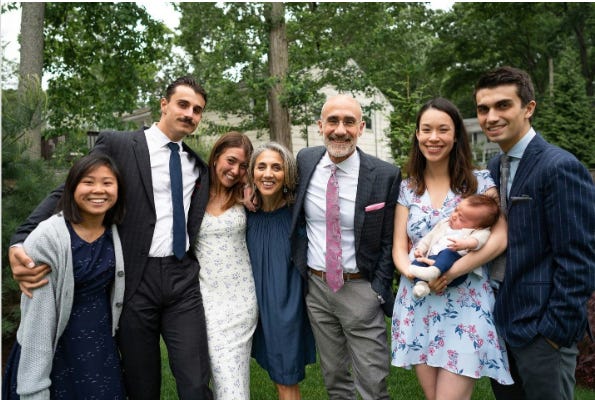
Arthur Brooks‘ personal experience with international adoption beautifully complements the science:
When the moment of truth came, my name was called, I entered the room, and a Chinese official plopped a baby into my arms. I braced myself, and — nothing happened. She didn’t cry. She didn’t scream. She just held onto my shirt with her tiny fists and stared up at my face. To me it was as if we had been together since the moment of her birth.
[…]
Today, my daughter is a freshman in high school. She spends too much time on Instagram but is killing it in her classes. And what about our giving experiment? In truth, I don’t know or care what my daughter has done for my income or health. But my happiness? It spikes every time she looks at me and I remember the magic day we met.
Despite this, international adoption has become less common. And governments around the world are to blame:
Back in the United States with our new daughter, Ester and I felt we were part of a foreign adoption movement. We were sure that enlightened public policy would continue to loosen regulations, which would make for more and more miracles like ours. Blended international families of choice were the wave of the future, we thought, and a reflection of an increasingly shared belief in a radical solidarity that transcended borders and biology.
We were wrong. The year we adopted turned out to be the high-water mark in foreign adoptions and the number has dropped ever since. By 2016 it had fallen 77 percent from its peak, to 5,372. This is the lowest total in three and half decades.
What happened? The answer is not a lack of need. Indeed, according to the Christian Alliance for Orphans, there are more than 15 million children around the world who have lost both of their parents.
Part of the reason is the policies of foreign governments, which have made foreign adoption harder, for both nationalistic reasons and because of worries about corruption and human trafficking. Our own government has contributed as well: Foreign adoption plunged all through the Obama administration as the State Department imposed new hurdles in the name of curbing abuses, which are a significant worry for parents adopting from some countries (although not China, where virtually all the children, like my daughter, were abandoned at birth).
Motivated by good intentions or not, these changes have left thousands of orphans unadopted. This is too high a price to pay for bureaucratic screw-tightening.
In my family, we have a catchphrase: “I don’t think about what could go wrong. I think about what could go right!” It’s poetry, of course; I’m full of precaution. But I stand by the spirit of our poem. To take the case of international adoption: We’re paranoid about the microscopic risk of accidentally snatching a poor family’s wanted baby – and barely cognizant of the fantastic opportunity regulation snatches from the hands of orphans around the world. Social Desirability Bias – and the demagoguery it fosters – is not only mindless, but heartless.
P.S. Happy Thanksgiving to the Brooks family and to all of you!
The post appeared first on Econlib.
Brooks is looking at the decline but ignoring the reason. In 2005, China had almost 2 births for every death, and the GDP per capita was less than $1400 USD. This year, there are 2 births for every *3* deaths, and the inflation-adjusted GDP per capita has almost quintupled. There are fewer children, virtually no unwanted children, and much less chance that the child will be born into poverty. Under those circumstances, parents would simply rather keep their kids, rather than give up for adoption or let them become wards of the state.
Couldn't agree more! So many do-gooders seem to only make things worse. The other "negative" raised about foreign adoptions is how the family looks different and the kids have issues because of this, being "taken" to another country, etc. I'm an adoptive mom, and although it's a lot easier for me/us--since I'm Indian and so's my daughter and we pass for biologically related, making at least the physical appearance aspect of it easier--I've long argued this with people who go on and on about the "negatives" of foreign adoptions. No doubt it comes with its challenges. But I ask why we cannot clearly see the horrific alternative of abandoned children living as orphans in state institutions of states that can barely care for their adult citizens. The whole push against foreign adoptions is very disturbing and baffling to me at a deeply personal level...