

You’ve seen my table on Americans’ shockingly high net worth. To refresh your memory:
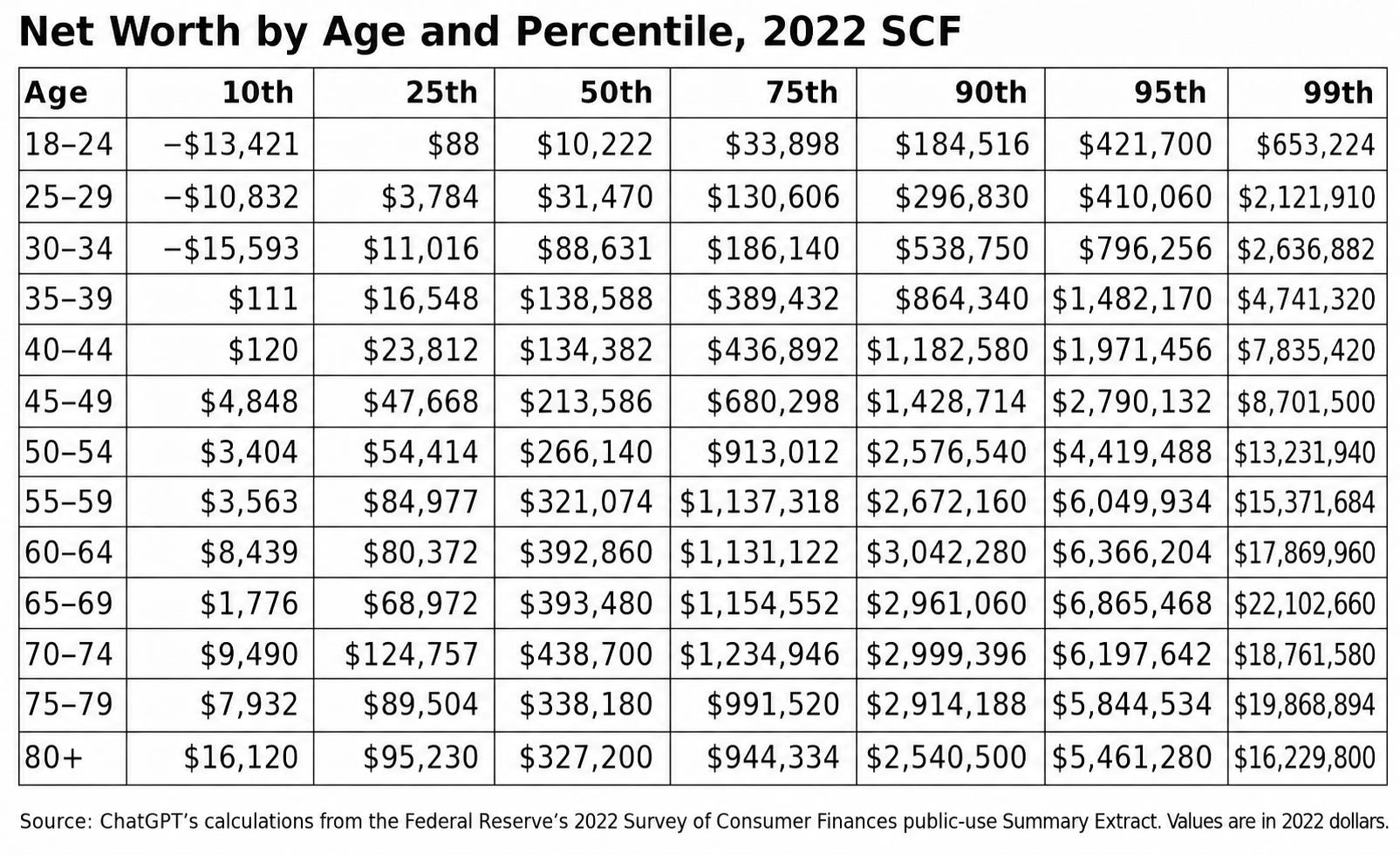
How much of that net worth comes from housing? It’s a surprisingly complicated question. If you use exact percentiles, you wind up basing your answer on how much home equity the one household at the 25th percentile of total net worth happens to hold. To get a meaningful answer, then, you’ve got to switch to bands of net worth, then take an average. Here’s what you get:
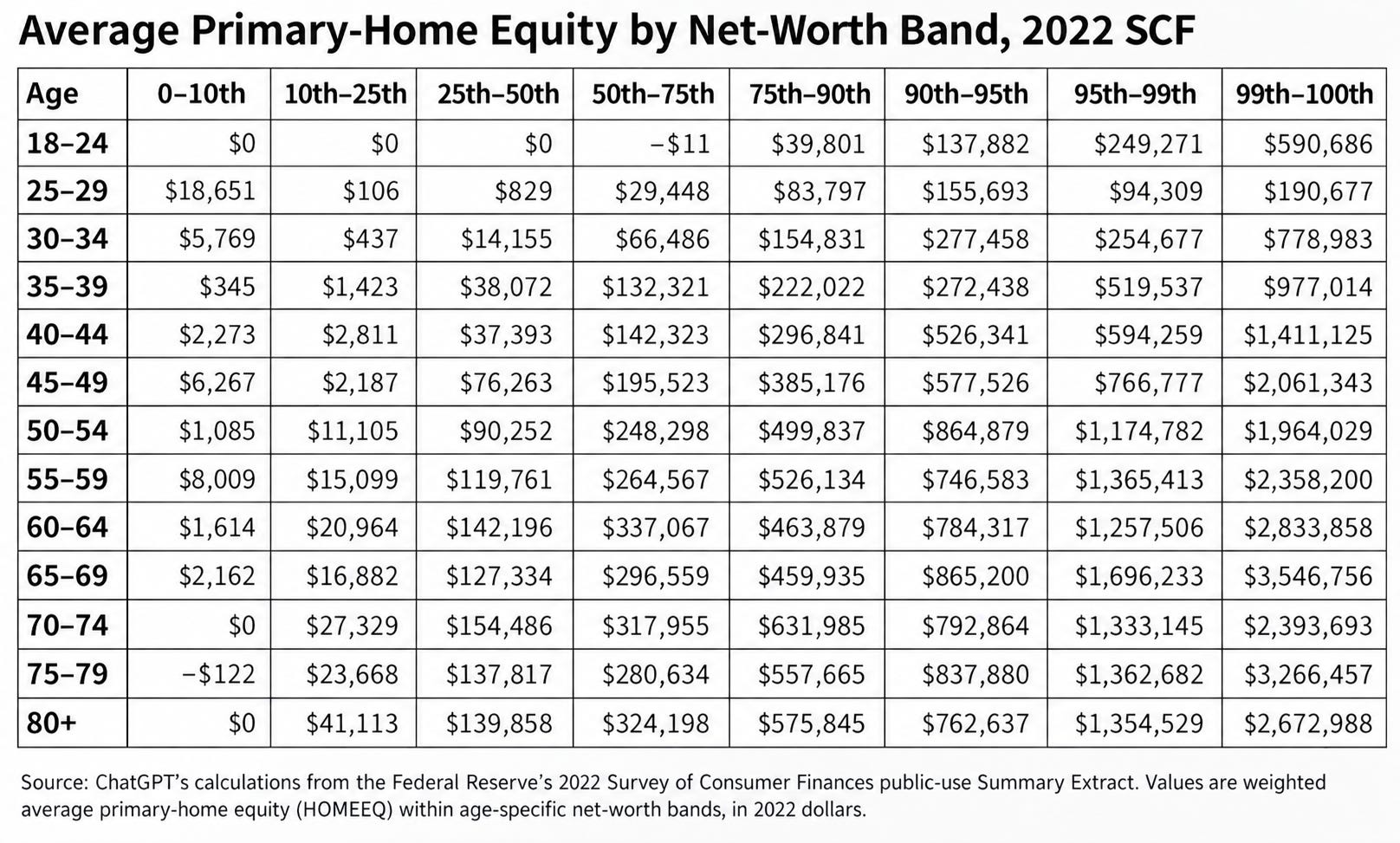
I honestly found the results a little puzzling, but they check out. In the cells that read $0, literally zero households have any home equity. And the overall patterns are still eye-opening:
Age is the great underrated factor. If you want to know how much home equity someone owns, knowing their percentile for their age is less informative than simply knowing their age. Almost everyone starts with low housing wealth, yet a large majority end up with massive housing wealth.
Total net worth falls slightly with age. Housing wealth, in contrast, doesn’t seem to fall at all. On average, Americans do not cash out their homes for living expenses, even though modern financial markets make it easy to do so via negative mortgages, home equity loans, and simple downsizing. Instead, the American elderly sit on their massive housing wealth until they die.
Without Social Security, permanently sitting on massive housing wealth would be hard to do! For the 25th-75th percentiles of total net worth, housing is their main asset. To live at all comfortably without Social Security, most of these people would have to rely on their housing wealth. Horrors? Au contraire. This wouldn’t just be better for taxpayers; it would be better for young families, who could move into the homes of the elderly when they downsize to pay for their retirements.
While total housing wealth naturally rises with total net worth, it falls as a share of net worth. The very poor rent. The middle class lives in their main asset. The upper-middle class and rich own great homes, but have plenty of other assets to live off of in retirement.
“Paying off your mortgage” early is a common financial priority for the middle class. But given the mortgage interest deduction, it’s probably a foolish priority. Instead, they should make the minimum monthly payment on their mortgages, then invest their excess savings in a diversified portfolio of stocks and other high-yield assets. That’s exactly what I did, and the results speak for themselves. While I won’t own my home outright until I’m 80, my net worth is much higher than it would have been if I fetishized being “debt-free.”
"mortgage interest deduction" is only for the estimated 10% that itemize their deductions now that the standard deduction has increased so much from earlier decades. It also depends in whether you have a 3% mortgage interest rate that you got at just the right time or a 6% one. I don't imagine most financial experts would recommend borrowing at 6% to invest the proceeds.
Counterpoint: You’re a (tenured?) professor.
Many families don’t have the job security to expect that they’ll be earning an income with zero interruptions until retirement.
So, even if they’re completely ignoring the potential benefits of your investment strategy, we can at least posit that they’re semi-rationally prioritizing lightening their debt load in case of a loss of income. Since, after all, a mortgage payment is the single biggest fixed expense that drags on one’s finances during a period of unemployment.