

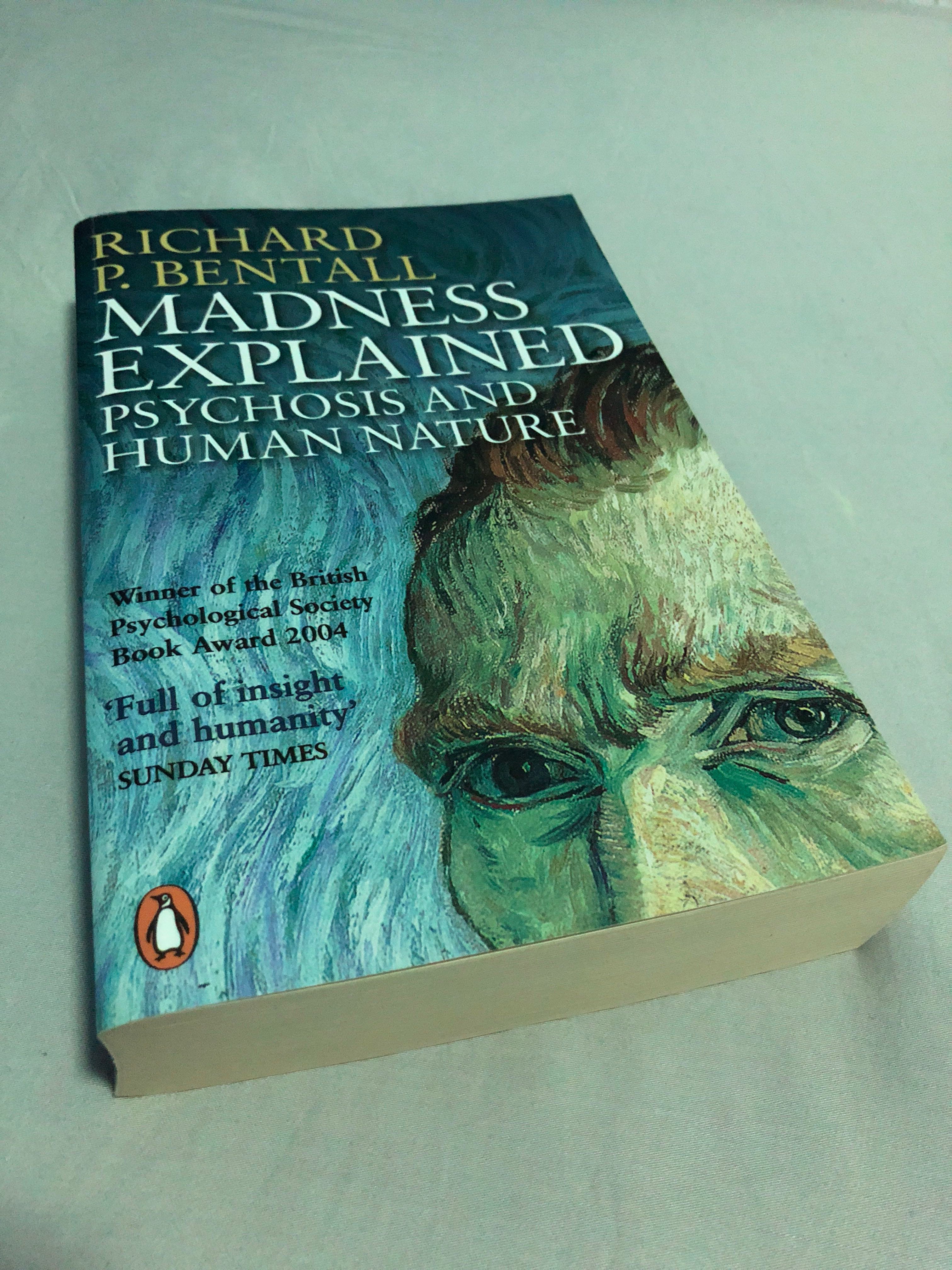
I finally got around to reading Richard Bentall‘s Madness Explained. It’s a fun book, but as expected, it falls short of its ambitious title.
Bentall’s been criticized as a Szaszian, and it’s easy to see why. Like Szasz, Bentall is highly critical of the official DSM classifications of mental illness, and notes that many people who fit the textbook definitions of mentall illness lead productive and independent lives. He even holds the revolutionary view that apparently incoherent psychotic babbling often turns out to make a great deal of sense – so-called “word salads” are closer to poetry than they are to radio static.
In the end, though, to call Bentall a Szaszian is unfair to both. For all his disagreements with mainstream psychiatry, Bentall is not ready to say that the “mentally ill” are just people with extreme preferences – and he is certainly not ready to declare that mental illness is a pseudo-scientific excuse for being a permanent parasite on family and society.
So what is Bentall’s deal? He thinks that we learn as much or more about mental illness with old-fashioned empirical psychology (both experimental and field) than we do with biochemistry. For example, he finds that West Indian immigrants to Britain have unusually high rates of paranoia. Bentall argues that an old-fashioned psychological explanation – immigrants find it harder to trust (and be trusted by?) people from a different culture – fits the facts well.
To take another case: Bentall argues that people who claim to “hear voices” are just misinterpreting ordinary silent speech. Most people who do this live normal lives: “as many as ten times more people experience voices than receive treatment for psychosis.” Hard to believe? Here’s more:
When Marius Romme compared voice-hearers who had been diagnosed as suffering from a mental illness with others who had not, he found remarkably few differences in the experiences of the two groups. Both patients and non-patients experienced a combination of positive and negative voices, but the proportion of positive voices was greater in the non-patients. The non-patients in contrast with the patients often felt that they had some control over their voices… A majority in both groups reported that their voices played a role in regulating everyday activities, for example by issuing instructions.
Bentall is full of interesting observations like this. But in the end, I don’t see that he’s “explained madness” in any deep sense. A minority of people are weird, and a minority of this minority are so weird that other people wind up supporting them while desperately trying to change them. What’s Bentall’s explanation for why people belong to either group in the first place? I still don’t know.
At the end of the day, Bentall sees little point in figuring out which official mental illness a troubled person has. Instead, we should find out what symptoms, if any, are bothering him, and work from there. In his conclusion, he even writes that:
If people can sometimes live healthy, productive lives while experiencing some degree of psychosis…, if the boundaries between madness and normality are open to negotiation…, and if our psychiatric services are imperfect and sometimes damaging to patients, who not help some psychotic people just to accept that they are different from the rest of us? Fear of madness may be a much bigger problem than madness itself.
Great rhetoric, but what a blind spot! Bentall ignores the fact it’s often family members, and not the mentally ill themselves, who refuse to “accept” the symptoms. So what does Bentall recommend if the patient says he’s fine, but his family wants to drug him until he behaves? I say: Respect the rights of the mentally ill, but don’t let them take advantage of you. What’s Bentall’s alternative?
The post appeared first on Econlib.
In the last quote from the book, "who" should be "why." I think.
Does “hearing voices” make you crazy? I hear a consistent voice, which is my own inner voice, which I identify with my conscious-thinking self. But sometimes, that voice says negative things, and I have to correct it. This leads to a situation where there are two inner voices: one saying profoundly negative, catastrophic things, the other offering skepticism, optimism, and encouragement. What I have just described is a completely normal state of affairs. A person thinks, “I hate this person! Wait, no, don’t say that -- that’s not fair, they have positive and negative traits...”
Every psychological disease, illness, or condition is merely an extremely disintegrated, disorganized manifestation of a common trait. Think about it like this: imagine having a back muscle that was super strong, but only on the right side of your body. Having strong back muscles is good, but if only one side is strong, then it creates an imbalance, and can bend the spine (sclerosis).
Mania, for example, is just having high energy. The problem with mania isn’t the high energy itself, but the inability to focus, direct, and manage that energy in a productive way. Depression isn’t a problem in small amounts: say you get sad for 5 minutes a day, and cry, and then go about the rest of your day in a productive manner -- that’s not pathological. Anger issues are sensible in the right context: it makes sense to get angry if someone punches you in the face. Every emotion we feel, and every aspect of psychic phenomenon (hearing voices, feeling a surge of energy, feeling depleted, feeling violent, being “Random” or silly or non-sensical) have their proper time and place. If you are not able to babble incoherently, sdljflsdkjf, then you are not a fully-functioning human being.
The mental disease model says: “this person has a pathogen which has attached to their brain, like a parasite, which we can remove or shrink with therapy or drugs.” The mental extremism model says: “this person has mental functions, and this particular function has become too strong or dominant, or too weak or brittle.” We can see why the former model appeals from a victimological perspective: “help, I’m being attacked by a mental illness!” The latter model states that there is a clear hierarchy of superior and inferior mental performances, and some people are better or worse in a given environment.