

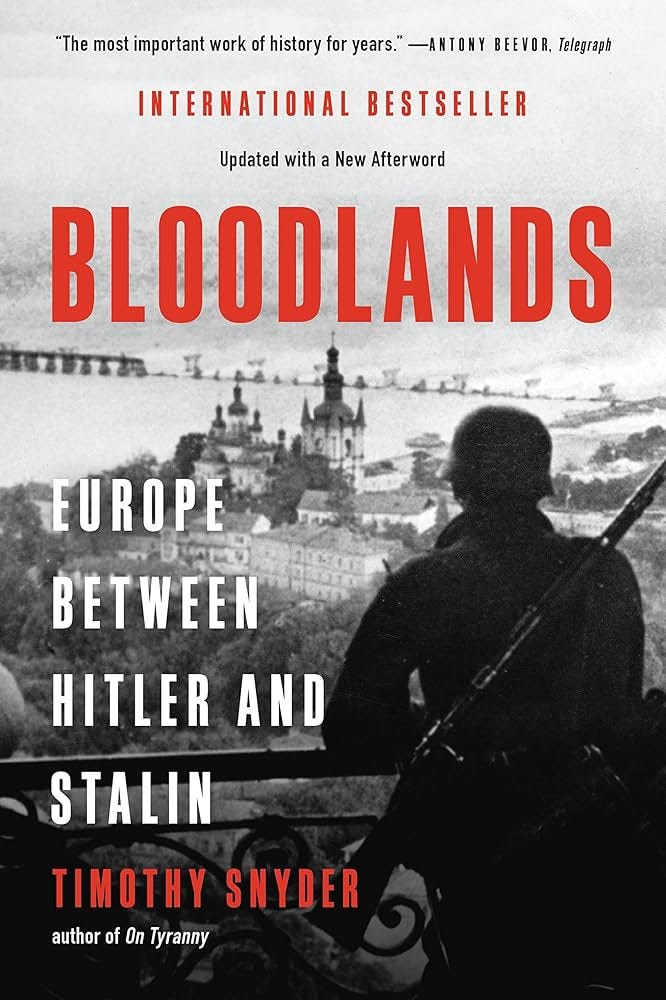
Bloodlands documents the most horrifying single example of group-serving bias I’ve ever read. Fair warning: This is not for the faint of heart.
In October 1941, Mahileu became the first substantial city in occupied Soviet Belarus where almost all Jews were killed. A German (Austrian) policeman wrote to his wife of his feelings and experiences shooting the city’s Jews in the first days of the month. “During the first try, my hand trembled a bit as I shot, but one gets used to it. By the tenth try I aimed calmly and shot surely at the many women, children, and infants. I kept in mind that I have two infants at home, whom these hordes would treat just the same, if not ten times worse. The death that we gave them was a beautiful quick death, compared to the hellish torments of thousands and thousands in the jails of the GPU. Infants flew in great arcs through the air, and we shot them in pieces in flight, before their bodies fell into the pit and into the water.”
At first glance, the policeman’s mentality defies belief. His army invades a country, and almost immediately begins mass murdering babies. The policemen/murderer writes home to tell his wife, “They’d do the same to our babies” – as if mass baby murder were familiar behavior for conquering armies in modern Europe. He never asks himself, “Is it possible that our enemies would have left our babies alone if we’d left their babies alone?” While the policeman grasps at his paranoid straws, he adds in a gratuitous reference to the Soviet secret police – as if Jewish babies were somehow complicit in the GPU’s crimes against Soviet citizens.
On reflection, though, I have to wonder how many people around the world would express equally demented arguments if their group engaged in equally barbarous behavior. What would it take to bring the typical human being even to silently condemn his own group as “the bad guys”? How many would secede in disgust – even in the privacy of their own minds?
The post appeared first on Econlib.
Our species evolved, and our nearest-cousin species live still, in bands which fight viciously from time to time, and require the fullest loyalty of every member. Of those who don't prevail, read Euripides' The Trojan Women, for a start.
It is not to be expected that such evolution should leave no mark on our psychologies. Over the last forty millennia (that is, since agriculture was invented) our groups of mutual defense have become much larger; but our brains have changed little, nor our psychology since the earliest records from which psychology can be deduced.
I do not deny that, from the lofty seat of philosophy, *we* and *they* are symmetrical. I merely observe that people don't think that way, and are not to be scorned for it: we are evolved creatures, not specially created angels.
Science fiction to the contrary notwithstanding, if intelligent aliens are ever discovered, more likely than not they will share this foible; for they, too, will be evolved.
"On reflection, though, I have to wonder how many people around the world would express equally demented arguments if their group engaged in equally barbarous behavior".
There's no shortage of evidence throughout human history for how readily one group will butcher another.