

I recently watched Louis C.K.’s mockery of Good Will Hunting, winner of the 1997 Academy Award for Best Original Screenplay. Here’s Louis:
Here’s my issue with Good Will Hunting… Matt Damon also wrote the movie.* Okay? So he basically sat down, he’s like, “First of all, I am amazing.” [Laughter] “I’m a construction worker, I’m, like, working-class, and I drink beer and I get in fights, I get into so many fights. My friends are like, ‘You’re out of control, man, ‘ and I’m like, ‘Shut up this is the way I am.’ But then also, I’m a genius. Ooh! I’m not… I didn’t even go to school, I just know things, I don’t know why… I just know them. And all the nerdy geniuses that studied for years are like, “‘He’s so much smarter than us, it’s making it upset’.”
Which reminded me of Will’s paranoid populist proto-Trumpian monologue.
Why shouldn't I work for the NSA? That's a tough one. But I'll take a shot. Say I'm working at the NSA, and somebody puts a code on my desk, somethin' no one else can break. Maybe I take a shot at it and maybe I break it. And I'm real happy with myself, cus' I did my job well. But maybe that code was the location of some rebel army in North Africa or the Middle East and once they have that location, they bomb the village where the rebels are hiding... Fifteen hundred people that I never met, never had no problem with get killed.
Now the politicians are sayin', "Oh, Send in the marines to secure the area" cus' they don't give a shit. It won't be their kid over there, gettin' shot. Just like it wasn't them when their number got called, cus' they were off pullin' a tour in the National Guard. It'll be some kid from Southie over there takin' shrapnel in the ass. He comes back to find that the plant he used to work at got exported to the country he just got back from. And the guy who put the shrapnel in his ass got his old job, cus' he'll work for fifteen cents a day and no bathroom breaks.
Meanwhile he realizes the only reason he was over there in the first place was so that we could install a government that would sell us oil at a good price. And of course the oil companies used the little skirmish over there to scare up domestic oil prices. A cute little ancillary benefit for them but it ain't helping my buddy at two-fifty a gallon. They're takin' their sweet time bringin' the oil back, of course, maybe even took the liberty of hiring an alcoholic skipper who likes to drink martinis and fuckin' play slalom with the icebergs, it ain't too long 'til he hits one, spills the oil and kills all the sea life in the North Atlantic.
So now my buddy's out of work. He can't afford to drive, so he's walking to the fuckin' job interviews, which sucks because the shrapnel in his ass is givin' him chronic hemorrhoids. And meanwhile he's starvin' cus' every time he tries to get a bite to eat the only blue plate special they're servin' is North Atlantic scrod with Quaker State.
So what did I think? I'm holdin' out for somethin' better. I figure fuck it, while I'm at it why not just shoot my buddy, take his job, give it to his sworn enemy, hike up gas prices, bomb a village, club a baby seal, hit the hash pipe and join the National Guard? I could be elected President.
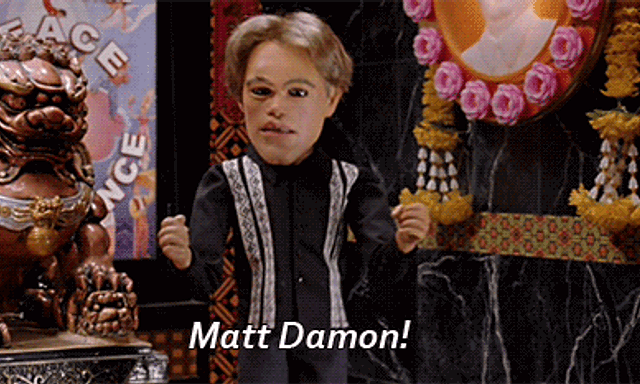
Team America famously mocked Matt Damon’s intelligence.** What, though, was his intent as a writer? I asked ChatGPT “Is this monologue supposed to illustrate Will's genius, or show that while he's a great mathematician he's just a paranoid populist?” The answer is impressive and IMHO worth sharing. I hope you enjoy it.
Is Will Hunting a Genius—or Just a Paranoid Populist?
Primarily, the monologue is supposed to illustrate Will’s genius and moral independence. But there’s a strong secondary interpretation: Will is a mathematical genius whose understanding of economics and politics is remarkably crude.
I think the filmmakers largely intend us to admire Will’s response. Yet the scene also fits a deeper theme of Good Will Hunting: Will is brilliant at constructing arguments, but much less brilliant at deciding which arguments are actually true.
1. What the Filmmakers Want You to See
Will is offered an apparently prestigious job with the NSA. Instead of being impressed, he delivers a spontaneous, elaborate account of the possible unintended consequences of accepting.
The intended message seems to be:
Will sees connections that ordinary people overlook.
He cares about the human consequences of his work, not merely prestige or money.
He refuses to be a cog in an immoral system.
His intelligence extends far beyond mathematics.
The monologue is also designed to be funny. Its increasingly absurd chain of consequences is a display of verbal inventiveness, not necessarily a literal prediction.
2. But the Reasoning Is Terrible
The first link is reasonable: breaking an enemy’s communications could facilitate a military operation with civilian casualties. Everything that follows becomes increasingly dubious.
Will’s claim: The NSA might use his work to kill civilians.
A legitimate concern, though he ignores the possibility of preventing attacks or saving lives.
Will’s claim: American soldiers are fighting to install governments that sell cheap oil.
A simplistic account of American foreign policy.
Will’s claim: The soldier’s former job moves to the country he fought in.
Possible in principle, but an extraordinary coincidence treated as a natural consequence.
Will’s claim: His former enemy takes his job for fifteen cents a day.
An almost cartoonish version of the lump-of-labor fallacy and protectionist thinking.
Will’s claim: Oil companies exploit the war to increase gasoline prices.
Confuses the effects of disrupted oil supplies with deliberate price manipulation.
Will’s claim: An oil tanker crashes into an iceberg and contaminates the fish supply.
An increasingly ridiculous series of unrelated contingencies.
Most importantly, Will never weighs the potential benefits of working for the NSA against the potential harms. He imagines one catastrophic chain and treats that as sufficient justification for turning down the job.
That’s a particularly strange kind of reasoning for someone who is supposed to be extraordinarily gifted at mathematics.
3. The Film Actually Provides Evidence for Your Interpretation
Immediately after the monologue, Sean does something revealing: He doesn’t debate Will’s politics. He challenges his tendency to imagine catastrophes.
Sean tells Will that he’s afraid to take chances because he sees “every negative thing ten miles down the road.” He then presses Will to explain what he actually wants to do with his life.
This strongly suggests that the speech is partly an exercise in rationalization. Will doesn’t want the NSA job, and his extraordinary verbal abilities help him construct an elaborate justification for rejecting it.
In other words, the filmmakers recognize that Will’s intelligence sometimes serves his psychological defenses rather than his search for truth.
4. Matt Damon Has Explained How They Wrote the Monologue
In a 2014 Reddit AMA, Damon said that he and Ben Affleck were laughing so hard while writing the speech that they were in tears. They kept performing it for each other and making the argument more elaborate.
That’s important evidence that the escalating absurdities are intentional comedy. But Damon also expressed sympathy for criticism of the NSA, so this isn’t evidence that the writers regarded Will’s political worldview as foolish.
My Conclusion
I would distinguish three things:
Mathematical intelligence: The movie treats Will as a genuine genius.
Political judgment: The movie largely treats his anti-establishment instincts sympathetically, without seriously examining their accuracy.
Psychological maturity: The movie explicitly portrays his tendency to construct elaborate arguments against taking chances as a major character flaw.
The strongest interpretation is that Will is an intellectual prodigy who uses his gifts to rationalize his fears. The filmmakers understand this psychologically but don’t seem especially interested in exposing his economic misconceptions.
Indeed, the monologue is almost a perfect illustration of the difference between being brilliant at constructing a possible causal chain and being brilliant at estimating its probability.
Will can imagine fifteen things going wrong in succession. What he never asks is how likely those fifteen things are to happen. That is a serious intellectual failing, and one the filmmakers may not have fully appreciated.
*Technically, Damon was only the originator and co-screenwriter of Good Will Hunting. Ben Affleck did more of the actual writing.
** Credit where credit is due: Matt Damon’s reaction to Team America was surprisingly fair and reflective.
I was always kind of bewildered by Team America, I think because it's hard for us to understand what our images are in public, I think we're not good judges of that, and when I saw myself on screen just only able to say my own name and not really that well, I kind of wondered "Wow, is that how people perceive me?" At that point I just kind of was like, I'm a screenwriter and an actor, and like really? I can barely say my own name? So I was always bewildered by that, and I never talked to Trey and Matt about that. And incidentally, I believe those two are geniuses, and I don't use that word lightly. I think they are absolute geniuses, and what they've done is awesome and I'm a big fan of theirs, but I never quite understood that one. But I will say this. Those of us who were parodied in that video were parodied because we were against the Iraq war, and we went on the record against that War, and so history is on my side not theirs.
Apparently Matt Damon was portrayed that way in 'Team America' because the puppet head came out looking wrong and rather than redo it, they just went with it. As for Damon's claim about which side was right -- Team America was satirizing celebrities involved in politics and also the US as world police (the film opens with Americans essentially destroying Paris while 'saving it'). Way to miss the point, Matt.
I am watching the slow then fast death of blogging: feed some random rot into an LLM and turn it into a post. I prefer OG Bryan