

When I was in 5th grade, I read a fun little book called Donkey’s Can’t Sleep in Bathtubs and Other Crazy Laws. Since I didn’t know any economics at the time, the idea of “crazy laws” was novel to me.
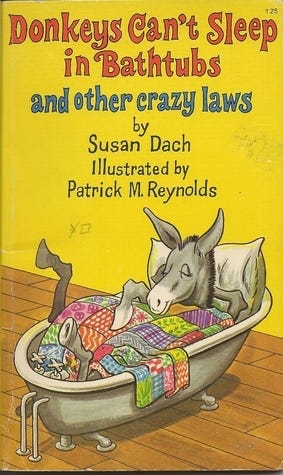
My mature reaction: Even today, it’s striking how almost all of the book’s crazy laws are full prohibitions — the titular law aside, other examples include “You can’t keep ice cream cones in your back pocket,” “You can’t wake a sleeping bear to take a picture,” and “Women can’t drive in housecoats.” The same mentality that looks at petty problems and thinks, “There ought to be a law” almost never thinks, “This calls for a $.37 Pigovian tax.” No doubt some Panglossian economists will appeal to information costs or whatnot, but the most credible explanations, as usual, are economic illiteracy, action bias, and sheer demagoguery.
To be fair, the book often provides rationales for seemingly “crazy laws.” For example, horse thieves sometimes used back-pocket ice cream cones to lure horses. But why respond to this situation by punishing an isolated horse-stealing tactic, instead of just saying, “We’ve already got a law against horse theft. Who cares how you steal them?” Or perhaps, “Let’s increase the probability and/or severity of punishment for horse theft.” From this perspective, the rationales fail, and we should indeed regard the laws discussed as crazy.
Not as crazy, however, as a long list of laws almost everyone considers perfectly reasonable, like hyper-regulation of nuclear power. Even I was amazed when I discovered this graph in the Journal of Economic Perspectives.

Nuclear power was ultra-safe in the 70s and remains ultra-safe today, but the cost of building plants is now 5-10x what it used to be. Crazy regulation is the only credible explanation. Indeed, in a free market, the learning curve for a new technology would probably have brought costs down. And unlike laws about donkeys in bathtubs, the cumulative cost to society of draconian nuclear regulation plausibly comes to trillions of dollars.
This is what you should be teaching your kids!
My own favorite confused law is nothing like donkeys in bathtubs or ice cream cones in back pockets. Instead, it's a law that fills no need and is needlessly complicated.
From https://loweringthebar.net/2021/09/assorted-stupidity-147.html:
"If you've been wondering whether it's illegal to defraud an innkeeper, the answer in California is yes, according to this post by the firm of Greg Hill and Associates. The post explains that "defrauding an innkeeper" is the crime of obtaining something without paying for it. Now, you and I might just call this "theft," but for whatever reason California has a statute specifically criminalizing the getting of "food, fuel, services, or accommodations" from a "hotel, inn, restaurant, boardinghouse, lodginghouse, apartment house, bungalow court, motel, marina, marine facility, autocamp, ski area, or public or private campground," without paying for it, such as by absconding after the thing has been got. See Cal. Penal Code § 537. So if you "dine and dash," or I guess flee from a bungalow court after staying the night there, this is the crime you just committed. Now you know."
I presume the basic intent was to add extra punishment for crimes by travelers, who were harder to track down than locals.
I don't know when the law was first written, but my instinct says in the early days of automobiles when people were a lot more mobile and could dine and dash more easily. But trains existed, and people had horses, so I don't know how much cars mattered.
Then there's that long list of locations. Doesn't mention bed and breakfast establishments; is it legal to steal from them?
And why only "food, fuel, services, or accommodations"? Does a box of Hamburger Helper count, since it hardly counts as food by itself? Is it OK to steal pens for sale, since they are goods, not services or accommodations?
Why not ban just plain theft? Oh wait, it is already banned, but under a dozen different names -- robbery, burglary, shoplifting, embezzlement, conversion.
Why not ban assault and other crimes? Surely all crimes by travelers and outsiders are just as deserving of extra punishment, not just those specific varieties of theft.
It's my major complaint with how laws are written. All that extra verbiage just creates more uncertainty and scope for loopholes. Why not just ban "theft"? Everybody knows what it means -- don't take people's stuff. Make the punishment a fine for some multiple of the loss, associated damages, and the expense of investigation and prosecution. Throw in a multiplier for deterrence if you want. If you want jail time, use the same standard conversion rate for people found factually innocent after a false conviction.
But simplicity is not the lawyer's friend.
If the only people that put ice cream in their back pocket are horse thieves, then you've made it easier to catch horse thieves without bothering anyone else.
It is sort of why I don't find "if you outlaw guns then only outlaws will have guns" in itself to be very persuasive. Yes, it becomes a lot easier to identify outlaws; they're the ones with the guns.