

“Crypto-Communist” is a word with a strong conspiratorial crackpot connotation. But it simply means “secret Communist,” and the history of the Cold War is packed with bona fide examples. Fidel Castro ruled Cuba for two years before he admitted he was a Communist. Ho Chi Minh joined the Comintern in 1920, but spent decades posing as a Vietnamese nationalist. Enver Hoxha, long-time dictator of Albania, similarly joined the Comintern in the early 1930s, but pretended to be a mere anti-fascist during World War II. Nelson Mandela wasn’t only a crypto-Communist; he was on the Politburo of the South African Communist Party since the early 1960s. Alger Hiss was merely the most infamous of the American crypto-Communists. The case of Juan Negrín, last prime minister of Republican Spain, is more controversial. But Burnett Bolloten, author of the magisterial The Spanish Civil War: Revolution and Counterrevolution, deemed him a crypto-Communist, and I believe Bolloten.
Who cares if a successful politician is a crypto-Communist? Anyone with a hint of sense. Communism is a murderous totalitarian doctrine, and Communist governments largely practice what they preach. Furthermore, once Communists take over a government, getting rid of them is like pulling teeth.
Once you admit the notable prevalence and grave danger of crypto-Communist politicians during a particular era, there is a clear-cut contemporary implication: A notable share of current and would-be leaders who say they aren’t Communists are probably lying. If you’re living through this era, this raises a thorny question: “How do we identify the crypto-Communists before it’s too late?”
Needless to say, you can’t just publicly ask them, because they’ll lie. You could do a thorough background check, but the people who know the most are usually fellow Communists eager to protect their own. So you’re usually left with three admittedly imperfect heuristics.
Heuristic #1: Communist rhetoric. If you habitually voice the views of the Communist Party, it is reasonable to suspect that you’re a Communist. Remember, Communist Parties often strategically moderate their rhetoric, especially when they’re weak.
Heuristic #2: Communist policies. If you habitually push the policies of the Communist Party, it is reasonable to suspect you’re a Communist. Remember, Communist Parties often strategically moderate their policies, especially when they’re weak.
Heuristic #3: Communist ties. If you habitually ally with the Communist Party, or if you have an atypically high share of Communist friends, it is reasonable to suspect you’re a Communist. Remember: While apolitical people could easily have Communist ties by coincidence, ambitious people choose their ties more strategically.
When historians cover the Cold War, they routinely discuss cases where the U.S. supported the overthrow of a democratically elected leader who, in hindsight, definitely wasn’t a Communist. Iran’s Mossadegh, Guatemala’s Árbenz, Chile’s Allende, Congo’s Lumumba, and Indonesia’s Sukarno are the textbook examples.
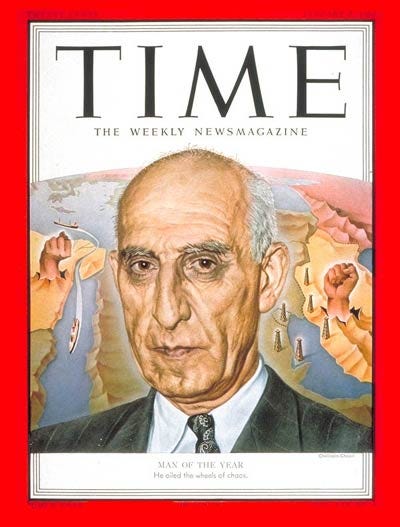
I’m usually suspicious on both counts: How “democratic” were their elections really, and how confident should we be that the overthrown leaders weren’t crypto-Communists?
But even if we accept both premises, the key point is that it was hard to identify crypto-Communists at the time. Barring a definitive examination of Communist Party archives or damning testimony from Communist Party insiders, contemporary actors had to rely on my three heuristics: If he talks like a Communist, acts like a Communist, and fraternizes with Communists, there’s a good chance he is a Communist.
The crucial question then becomes: How high does the probability that a major national leader is a Communist have to be before drastic action is justified? Back in 2020, for example, I estimated Bernie Sanders’ probability of being a crypto-Communist at 15.8%. Which, to my mind, is disqualifyingly high. American checks and balances will protect you? Probably, but is that good enough?
If you delve deeper into the game theory, you discover the underlying logic of anti-Communist “paranoia.” Ambitious Communists hide their true identity because most people understandably don’t want to be ruled by Communists. This leads people to harshly punish the best predictors of Communist affiliation. Which in turn leads crypto-Communists to avoid displaying these predictors. Which makes any lingering predictors suspicious: Given strong incentives to avoid Communist rhetoric, policies, and ties, why don’t you scrupulously avoid Communist rhetoric, policies, and ties? If you answer, “Communist rhetoric, policies, and ties aren’t so bad; in fact, we have much to learn from them,” it’s time to sound the alarm.
Doesn’t the same logic hold for crypto-Nazis and crypto-fascists? Naturally. The main difference is that since World War II, both of these groups have had much lower quality human capital than Communists. This makes them less of a threat, and easier to depose. But the basic logic of “They won’t admit their true views, so we have to probabilistically infer their true views from their rhetoric, policies, and ties” is ironclad. And yes, the anonymity of the internet reveals that even in Western countries, full-blown Communists and fascists are not rounding errors (though neo-Nazis probably are).
The hardest fact for game theory to explain is that most members of these totalitarian sects aren’t crypto. Especially in a democracy, why admit to being something most people fear and hate? The best explanation, though, is easy: For followers, unlike leaders, politics is almost entirely expressive. The main reason they proclaim their allegiance to Communism or fascism isn’t to win, but to revel in the cruelty of politics.
The problem with this attitude is that it is often the fear of crypto-communists that bring them about. Ultimately, if you play out the consequences this kind of suspicion brings about the harms it seeks to prevent.
We saw just this dynamic happen with racism in US politics recently. People start fearing people are secret racists -- and no doubt a few are -- but to suss them out you start demanding more and more extreme rhetorical denouncements of that view. After all, whoever is least willing to distance themselves from communism/racism is most under suspicion.
The problem is that as the demands get more and more absurd at some point people start refusing to comply and they get evicerated as a racist or communist by one side and pushed into the open arms of the actual racists and communists.
So sure, it is true that conditional on someone having lefty views they are more likely to be a communist and conditional on them having right leaning views they are more likely to be a racist. But it is both good manners and good tactics to presume most people are what they say they are until they show otherwise. Yes, go ahead and accuse them of being inclined to implement X bad policy (including ones with bad racial or communist type effects) but throwing around the identity style accusations (you are secretly one of them) isn't a good idea.
Would Deng Xiaoping be considered a crypto-capitalist?