

I met famed sociologist Fabio Rojas at UC Berkeley when he was sixteen years old. We’ve been the best of friends ever since. He was best man at my wedding. And decades later, we’re still arguing about ideas, art, and life. When his Facebook review of Barbie connected the movie to my Don’t Be a Feminist, asked him to expand and expound. Here’s Fab:
I wanted to see Oppenheimer this weekend, but I discovered that it was sold out. Rather than go home, I bought a ticket for Barbie, my second choice. I'm a fan of kid's movies and not just the stuff pitched at boys. I enjoyed Frozen, I sat with my daughter through many episodes of My Little Pony: Friendship is Magic and I own some old Power Puff Girls DVDs. Even though I never owned a Barbie doll, I figured that I would enjoy seeing how this particular toy line would be brought to life.
Barbie is not what I expected. The movie adopts an adult tone and is much more political than the trailers implied. It completely embraces a brand of modern feminism that has attracted its fair share of critics, including the author of the Bet On It substack. I found myself arguing with the movie. At the same time, I found the movie to be enjoyable and inventive. Given my mixed reactions, Bryan has asked me to share my thoughts.
Let's start with aesthetics. Visually, it exploits the pink theme well. The director, Greta Gerwig, shows us Barbie Land, where homes are pink and built like toys. And I love the fashion - pinks, pastels, and plaids forever! The film showcases a lot of A-list actors, who make the film very easy to watch. Margot Robbie is great in the lead and Ryan Gosling excels. In terms of pacing, the film moves along nicely. It never drags and it is always interesting. In the long run, this will be remembered as a very entertaining movie.
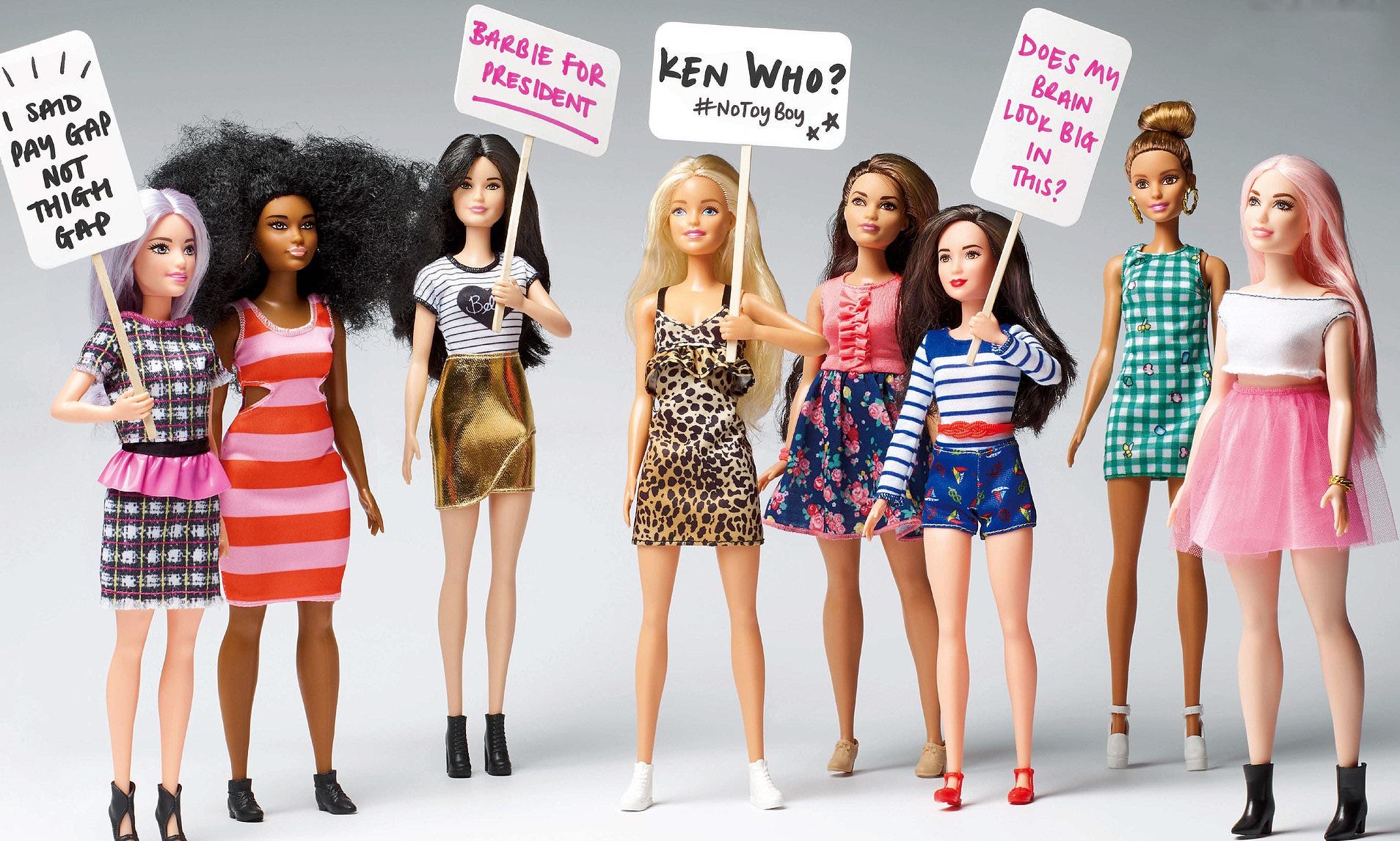
That being said, this is not a kid's film. Rather, it's a fun and humorous political allegory told in a very adult style. Barbie is a postmodern production that makes constant references intended for a mature audience, like a clever Jane Austen joke, an homage to Stanley Kubrick (!) and a discussion of tax evasion (!!). More importantly, the film has a strong progressive viewpoint and a particular audience in mind: college educated 35-year-olds who have a degree in gender studies. I am not exaggerating. The film openly discusses theories of patriarchy at multiple points.
As I watched the film, I started quibbling and arguing with its depiction of the "real world." Basically, Barbie advocates the type of feminism that Bryan critiques in his book, Don't Be a Feminist. Bryan argues that the distinctive feature of the modern feminist movement is a strong preference for bias, discrimination, and exclusion as the default explanation for gender inequalities. Here is Bryan discussing this perspective:
What then is a reasonable definition - a definition that identifies a central point of contention between feminists and non-feminists? Something like this: Feminism is the view that society generally treats men more fairly than women.” (p. 4, italics in the original)
Indeed, at a number of points, Barbie characters say things that seem to directly support this description. For example, Alan, a minor character, literally says, "I'm a man with no power, does that make me a woman?" I emphasize that this is not what the filmmaker believes. Rather, it’s a nod toward what the film maker might believe about real world gender relations. At another point, Barbie directly describes why Barbie Land is a mirror image of the Real World, “Basically, everything that men do in your world, women do in ours.”
This theme runs throughout the film. When Barbie shows up in California, she is almost immediately harassed by a man. When Ken and Barbie visit Mattel headquarters, it is run exclusively by men. Women work as the secretaries. As I mentioned earlier, the film has characters who openly talk about patriarchy. Ken’s big lesson from visiting the “real world” is that he should return to Barbie Land and forcibly establish a dude-ocracy.
I do not live in a "men rule" world. All I need to do is look around me to see women in positions of authority. The president of my university is Pamela Whitten. The current president of my professional association is Prudence Carter, a highly accomplished scholar at Brown University. Three of the last four chairs of my department have been women. There are broader social trends as well. For example, recent data show that a modest majority of medical students are women, as recently reported by the Association of American Medical Colleges. Also, there’s been marked changes in the legal profession. According to the American Bar Association, women now make up about 55% of law school students, 38% of practicing attorneys, and 22% of equity partners. And of course, some of the world’s largest and most powerful nations have elected female heads of state such as the United Kingdom, Germany, and India.
Barbie’s description of Mattel itself is somewhat off the mark. When you watch the film, the executives are all depicted as men with one exception. The ghost of Barbie’s inventor and Mattel co-founder, Ruth Handler, remains in the building. What do we learn if we actually visit Mattel’s Board of Directors website? Five of eleven Board members are women, including the President of Quinnipiac University, the CEO of a major Latin American business conglomerate, and the leader of a large investment firm. To be completely fair, Barbie has a more accurate depiction if you stick to the executive leadership, where only the human resources director is female.
I’m not critiquing Barbie because I think men and women are completely on equal footing. Rather, the strong patriarchy story is incomplete for modern society. The YouTube movie critic “Deep Focus Lens” summarizes things best when she remarked that the “real world” depicted in the film felt more truthful as a setting in the 1960s rather than the 2020s. Social science research backs up this intuition. For example, a 2022 meta-analysis of 70 audit studies in Science Advances found that the degree of pro-male or pro-female bias in hiring depends a lot on factors like the income level of an industry.
"It's complicated," as they say, and I suspect the filmmakers know this, even if they don’t make a big deal out of it. For example, after Ken is liberated from his subservient role in Barbie Land, he tries to rule in the real world and fails. People tell Ken that success requires training for leadership. Your gender is not enough. Barbie also admits that the male executives are well intentioned. After satirizing Mattel's current president, the movie admits that he’s so invested in the company because he wants to make little girls happy - but not in a creepy way!
In the end, I enjoyed Barbie despite my disagreements. We can appreciate what the film gets right. It is absolutely true that toys in the pre-Barbie age assumed that mothering was the only thing girls were interested in doing. Men certainly do things that are noxious and undermine women. The film also recognizes that the fantasy world of Barbie Land has its own drawbacks and plenty of problems. Even if Barbie isn’t completely correct in its account of the real world, I’m glad the film is out there for people to see and discuss.
Saw the movie last night, I (humbly) think you are missing the deeper message in the movie, which (at least from my perspective) is actually a critique precisely of that "brand of modern feminism."
"I emphasize that this is not what the filmmaker believes. Rather, it’s a nod toward what the film maker might believe about real world gender relations. "
I think that you're right, that's not what the filmmaker believes, but rather than a "nod toward," is actually a satire/critique of what the filmmaker thinks other people think about real world gender relations. When you actually walk through the movie, all the statements that characters make that fit that "brand of modern feminism" are actually undermined by the events in the story. Sure, at no point does a thinly veiled stand-in for the director break the fourth wall and make that critique of "obviously Barbie isn't a fascist, who would think that?" but the film implicitly does it in a way that can't possibly be an accident. If I were posting this on Marginal Revolution, I might use the term "Straussian."
Even the long speech the real-world mom - about the demands on women - gives to Barbie is full of items that are not "things imposed on women by men" and even though the shallow context of the scene makes it seem like it might be - it's more of an intra-woman debate.
At the end of the movie, it very much stands up for the conservative idea that, contra that "brand of modern feminism", that there are actual real-world differences (but certainly that they don't lock anyone into anything) between men and women (what is the first thing the director shows the character that is an "non-human idea" doing when she actually becomes a real human?), that ideas and aspirations and themes in movies, toys or media should not replace the real world practical dreams and needs of real humans, and the by-far most strongly implied message: that the human parental impulse (theoretically rejected in the opening 2001-parody, and implicitly by Mattel's/everyone's revulsion of "Midge") is actually vastly more meaningful than anything else in the movie? After all, who are the people and relationships who actually matter in this movie? The real world mom and her daughter. Barbie and Ken and their feelings and relationships don't actually matter, they're just ideas - they only matter how they reflect into the real world (explicitly outlined by the mom's thoughts directly affecting idea-Barbie)
What is the most important, climactic scene in the movie, where the director really DOES insert a stand-in for their voice? A mother/God/Geppetto literally breathes life into the clay of (giving birth to) their non-human created idea, giving them true human/woman life - and with the explicitly listed-by-the-camera necessary traits of: exhalation, heartbeat, attachments to friends/family, acceptance of the need to grapple with mundane reality and.... visits to the gynecologist's office.
I'm not a member of that "brand of modern feminism" - or social conservatism. But I have eyes, and I can see where the movie lands.
I appreciate the sentiment of this post, but these examples/arguments are hardly convincing. You say "I do not live in a "men rule" world. All I need to do is look around me to see women in positions of authority." and then a few sentences later use "women now make up about 55% of law school students, 38% of practicing attorneys, and 22% of equity partners" as an example of that...from my perspective 55% of students --> 22% of equity partners is actually quite a terrible example of what you are trying to prove. Regardless of the reasons for this (I'm guessing we would actually agree on them), this example doesn't help your argument. You also just cherry pick examples of women in leadership positions...is it supposed to be impressive that the UK (and 2 other countries you listed!) has, at some points in the past, elected a female leader?
Additionally, you write: "Barbie’s description of Mattel itself is somewhat off the mark. When you watch the film, the executives are all depicted as men with one exception". You then go on to talk about how the board of Mattel actually includes women, and then finally come back to "To be completely fair, Barbie has a more accurate depiction if you stick to the executive leadership, where only the human resources director is female". They WERE sticking to executive leadership in the movie, so not sure why you went on the tangent about the board at all. At least you came back to disprove your own point.