

[Originally published in 2011 as a reply to my then co-blogger, David Henderson.]
David says I “overstate” the extent of human cowardice. If, per the title of his post, I claimed that people “always” avoid war, he’d be right. But these are my original words:
Yes, the man in the street often says he’s rather die than yield an inch to the hated enemy. But the vast majority are happy to free ride.
With my true position firmly in mind, David’s numbers actually augment my case. The Pearl Harbor bombing was ideally designed to provoke our martial sentiments. It wasn’t just an attack on American soil; it was a dastardly sneak attack. And according to David:
When World War II began for the United States on December 8, 1941, the
United States had a draft. Meanwhile, though, about 100,000 to 140,000
people a month entered the military in the first 3 months of that war.
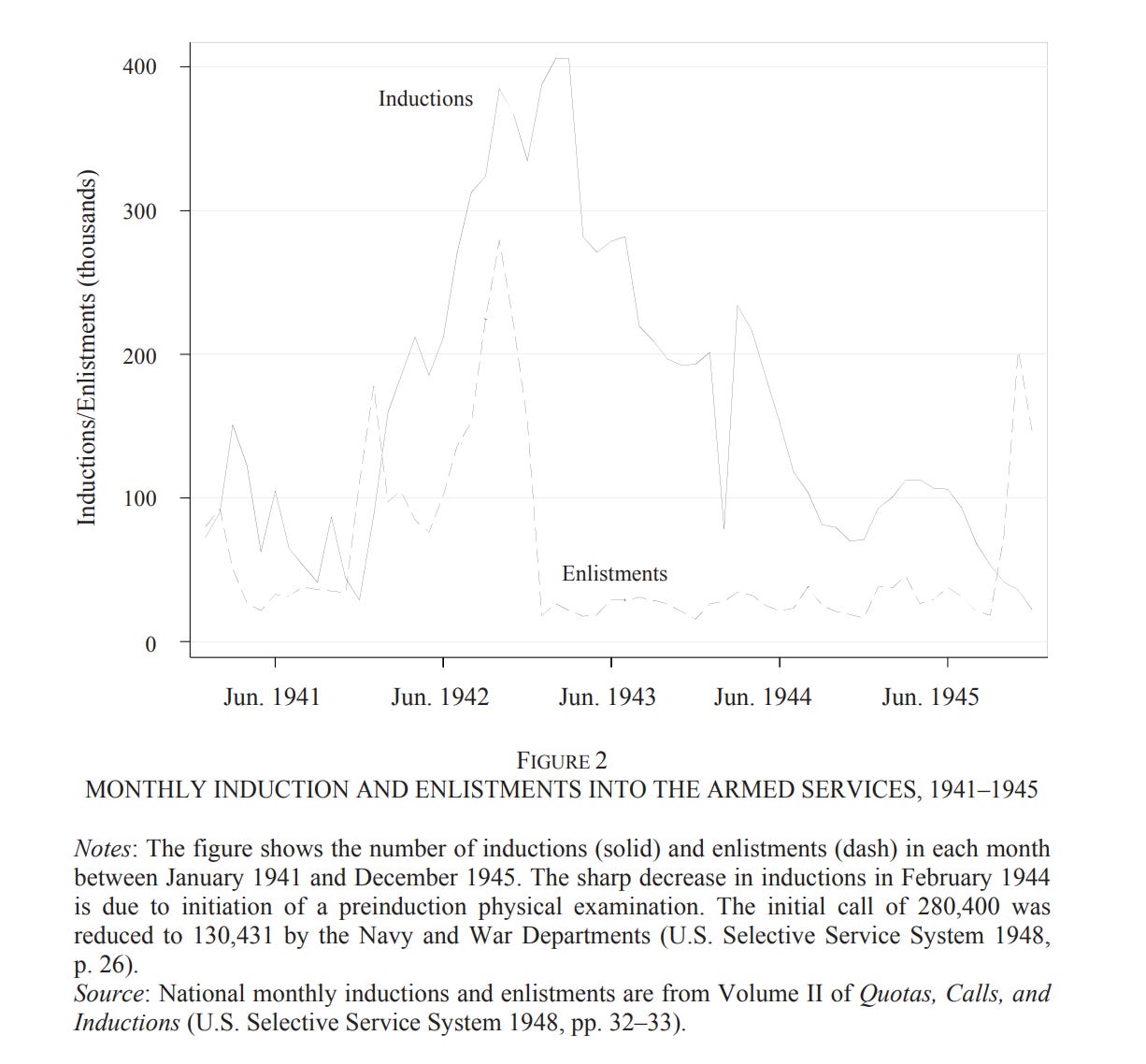
Sounds like a lot, right? Hardly. According to the 1940 Census (table No. 11), the U.S. had 6.2 million males ages 15-19, 5.7 million males ages 20-24, and and 5.5 million ages 25-29. That’s 17.4 million men of combat age. Let’s use David’s high figure of 140k for all three months. This means that during the first three months of U.S. involvement – a period where our national mythology describes a whole generation rushing to volunteer – just 2.4% actually did. This number is so low that I’d like David to double-check his source!
[Update: If anything, David’s numbers are high. This figure from Jaworski 2014 shows data for U.S. enlistments (volunteers) and inductions (conscripts).
The post appeared first on Econlib.
The civilian has no natural obligation to fight a war that a political agent starts. If a political agent wants a war, that political agent can pick up a rifle and demonstrate the depth of that conviction. The civilian is not a pawn, a spare part, or a convenient body to be fed into a policy choice. If political agents had to bear the risks they impose, the world would discover a remarkable new era of peace, restraint, and sudden diplomatic creativity.
Counting people who "entered the military" is meaningless, since the military could not accept everyone who volunteered and had to turn some volunteers away. They were constrained by infrastructure and funding.